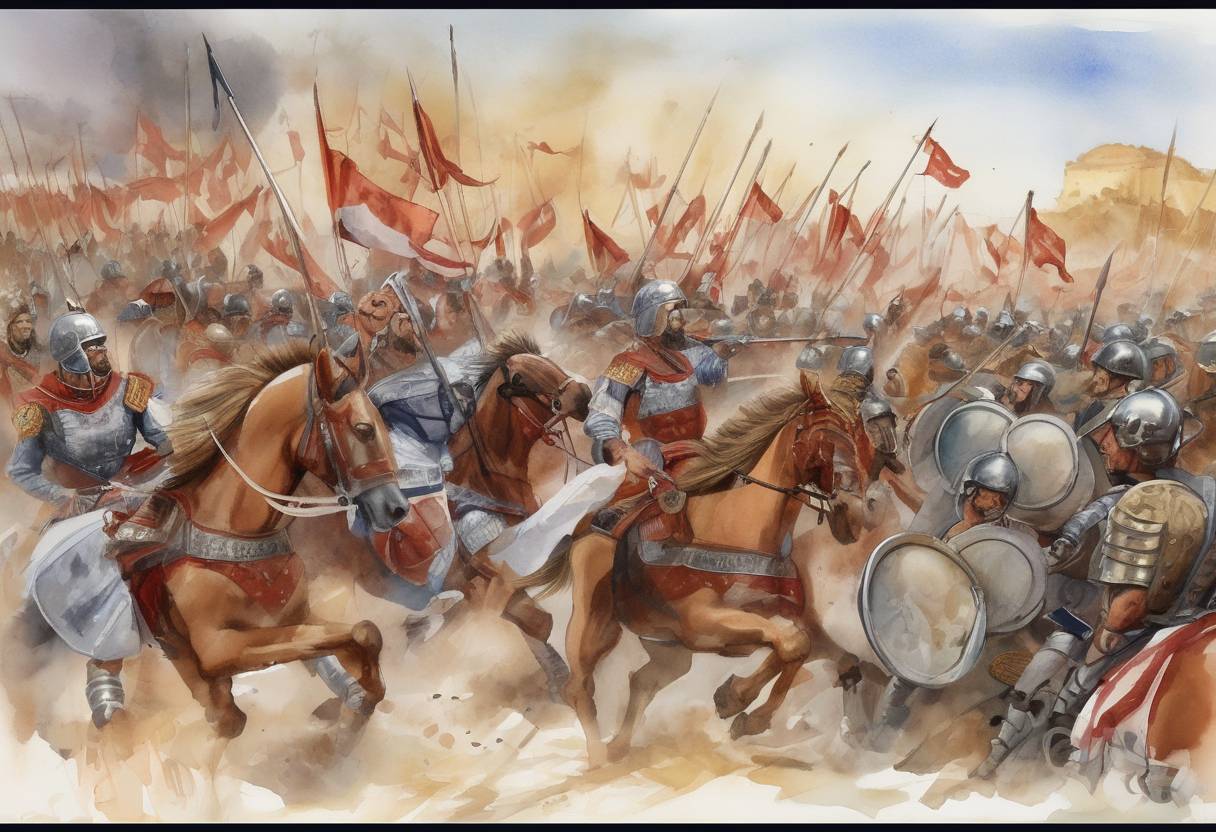
The Battle of Zama: October 19, 202 BCE
The Battle of Zama, fought on October 19, 202 BCE, was a decisive engagement that concluded the Second Punic War, a protracted conflict between the Roman Republic and the Carthaginian Empire. This battle marked a turning point in ancient history, establishing Roman dominance over the western Mediterranean.
Context and Prelude
The Second Punic War (218-201 BCE) was characterized by the legendary military campaigns of the Carthaginian general Hannibal Barca, who famously crossed the Alps to invade Italy. Despite his early victories, including the notable Battle of Cannae, Hannibal was unable to secure a decisive victory that would force Rome to surrender.
Meanwhile, the Roman Republic, resilient and resourceful, adapted its strategies under the leadership of Publius Cornelius Scipio, later known as Scipio Africanus. Scipio’s campaigns in Iberia (modern-day Spain) were crucial in cutting off Carthaginian resources and weakening their influence.
The Battle
The Battle of Zama took place near the town of Zama Regia, in present-day Tunisia. Scipio Africanus commanded the Roman forces, while Hannibal led the Carthaginian army. The Roman army was composed of seasoned legions and allied Numidian cavalry, led by the defector Masinissa, whose support was pivotal.
Key Events:
Tactics and Formations: Scipio employed innovative tactics, arranging his troops in a manner that neutralized Hannibal’s war elephants, which were a significant component of the Carthaginian army. The Roman forces created lanes to allow the elephants to pass through without causing disruption.
Cavalry Engagement: The Numidian cavalry, under Masinissa, played a crucial role in outflanking the Carthaginian cavalry, eventually returning to attack Hannibal’s forces from the rear.
Infantry Clash: The Roman legions engaged Hannibal’s infantry in a fierce battle. Despite Hannibal’s strategic acumen, the Roman forces, bolstered by their superior numbers and tactical positioning, gained the upper hand.
Aftermath and Consequences
The defeat at Zama forced Carthage to sue for peace, leading to the Treaty of Zama. The terms were harsh: Carthage had to cede its overseas territories, disband its navy, and pay a substantial indemnity to Rome. This effectively ended Carthage’s status as a major power and marked the beginning of Roman hegemony in the western Mediterranean.
Broader Historical Significance:
Roman Expansion: The victory at Zama and the subsequent peace treaty allowed Rome to expand its influence across the Mediterranean, setting the stage for its transformation from a regional power into a dominant empire.
Legacy of Scipio Africanus: Scipio’s success at Zama earned him the honorific “Africanus” and solidified his reputation as one of Rome’s greatest military commanders.
Hannibal’s Legacy: Despite his defeat, Hannibal remained a respected military strategist, and his tactics continued to be studied by military leaders throughout history.
The Battle of Zama remains a significant event in ancient military history, illustrating the impact of strategic innovation and the shifting balance of power in the ancient world.