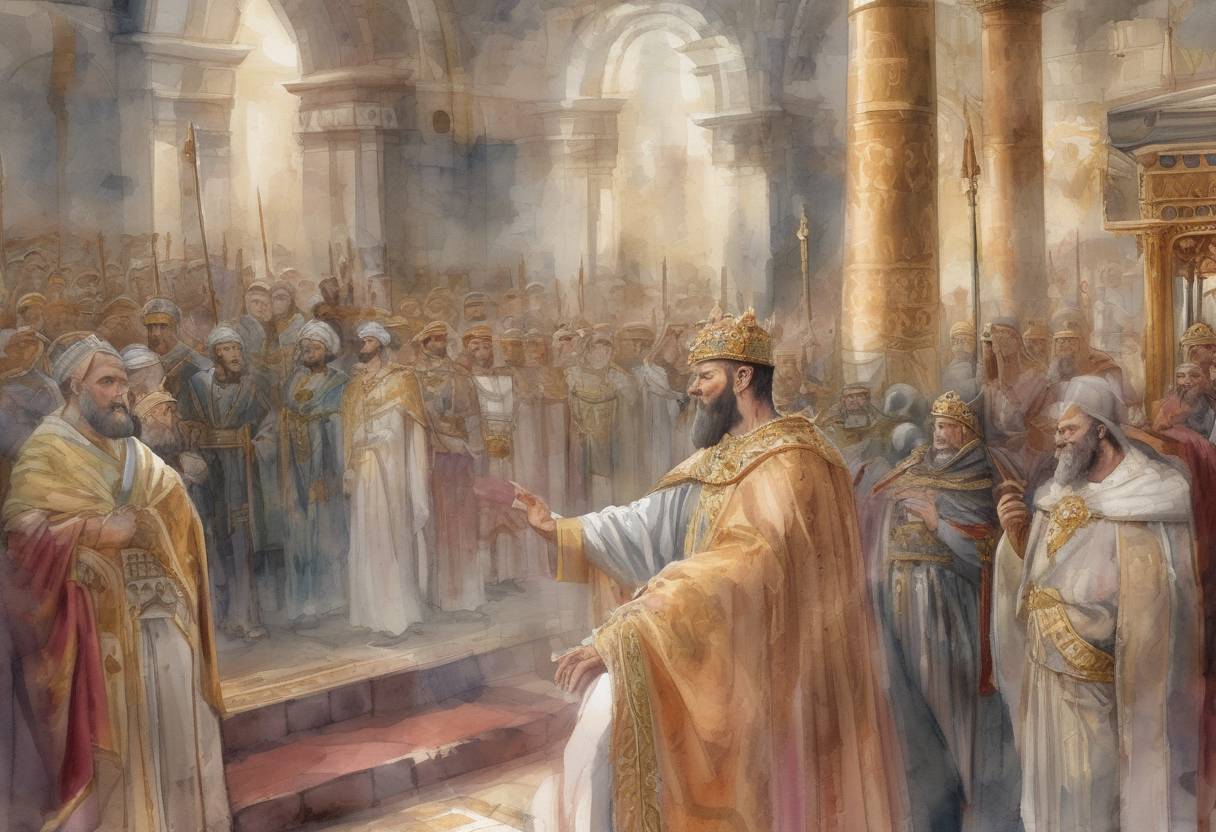
Succession of Justin II as Byzantine Emperor
On November 14, 565, Justin II ascended to the throne of the Byzantine Empire, succeeding his uncle, the renowned Emperor Justinian I. This transition marked a significant moment in Byzantine history, as Justinian I’s reign had been characterized by ambitious projects and extensive reforms.
Background
Justinian I’s Reign (527-565): Justinian I is remembered for his comprehensive legal reforms, including the Corpus Juris Civilis, which became a foundational work for Western legal tradition. His reign also saw the ambitious construction of the Hagia Sophia and efforts to reconquer former Roman territories in the West, including parts of Italy and North Africa.
Challenges: Despite these achievements, Justinian’s reign left the empire with significant challenges, including financial strain due to military campaigns and ongoing conflicts with the Sassanian Empire and other barbarian groups.
Justin II’s Ascension
Early Life: Justin II was born into the imperial family and was well-positioned to succeed his uncle. He had served in various administrative roles, gaining experience in governance.
Succession: Upon Justinian’s death, Justin II was proclaimed emperor. His succession was relatively smooth, aided by his established position within the court and the support of key political figures.
Reign of Justin II
Domestic Policies: Justin II initially sought to stabilize the empire’s finances and administration. He attempted to reduce the burden of taxation and address corruption within the government.
Foreign Policy: His reign was marked by renewed conflicts with the Lombards in Italy and the Persians in the East. Unlike his uncle, Justin II struggled to maintain the territorial gains achieved during Justinian’s reign.
Religious Affairs: Justin II faced significant religious tensions, particularly with the Monophysite Christians. His policies aimed at religious unity often led to further discord.
Challenges and Decline
Mental Health: In the later years of his reign, Justin II’s mental health deteriorated, affecting his ability to govern effectively. This led to the appointment of Tiberius II Constantine as Caesar and co-emperor, who effectively managed the empire’s affairs.
Legacy: Justin II’s reign is often viewed as a period of transition and decline following the ambitious projects of Justinian I. His inability to sustain the empire’s territorial and financial stability set the stage for future challenges.
Conclusion
The succession of Justin II marked the end of an era defined by Justinian I’s grand vision for the Byzantine Empire. While Justin II faced numerous challenges, his reign was a critical period that highlighted the complexities of maintaining a vast and diverse empire. His efforts, though often overshadowed by his uncle’s legacy, were pivotal in navigating the Byzantine Empire through a time of significant change and uncertainty.