Battle of Preveza - September 28, 1538
1538 · Preveza, Greece
The naval Battle of Preveza took place between the fleet of the Holy League and the Ottoman Empire, resulting in a decisive Ottoman victory.
October 7, 1571
The Battle of Lepanto took place, a significant naval engagement in which the Holy League, a coalition of European Catholic maritime states, decisively defeated the fleet of the Ottoman Empire in the Gulf of Patras.
Gulf of Patras, Greece | Holy League
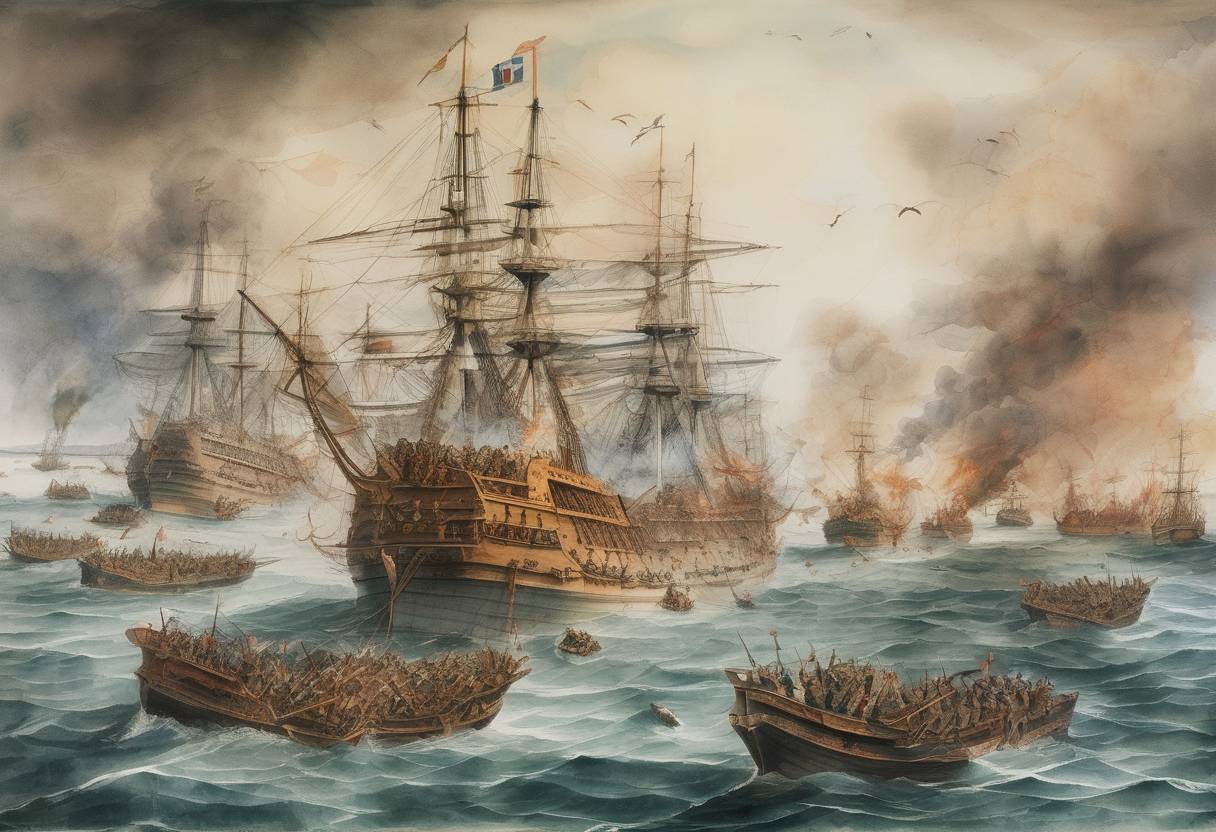
The Battle of Lepanto, fought on October 7, 1571, was a pivotal naval engagement that marked a significant turning point in the struggle for control of the Mediterranean Sea. This battle saw the forces of the Holy League, a coalition of European Catholic maritime states, decisively defeat the fleet of the Ottoman Empire in the Gulf of Patras, near the western coast of Greece.
The 16th century was a period of intense rivalry between the Christian states of Europe and the Muslim Ottoman Empire, which was expanding its influence across the Mediterranean. The Ottomans, under the leadership of Sultan Selim II, sought to consolidate their dominance in the region, threatening European territories and trade routes.
In response to the Ottoman threat, Pope Pius V spearheaded the formation of the Holy League in 1571. This coalition included major Catholic maritime powers such as Spain, the Papal States, the Republic of Venice, and several smaller Italian states. The League was commanded by Don John of Austria, the half-brother of King Philip II of Spain.
The fleets met in the Gulf of Patras, with the Holy League’s forces numbering around 212 ships, primarily galleys, and the Ottoman fleet comprising approximately 251 ships. The battle was characterized by close-quarters combat, with both sides employing galleys equipped with cannons and soldiers for boarding actions.
The Holy League’s fleet was strategically organized into three main divisions, with Don John of Austria commanding the center. The Ottomans, led by Ali Pasha, mirrored this formation. The battle commenced in the morning and lasted for several hours, with intense fighting and significant casualties on both sides.
The Holy League emerged victorious, capturing or sinking a large portion of the Ottoman fleet and killing Ali Pasha. This victory was significant for several reasons:
Strategic Impact: The defeat curtailed Ottoman naval dominance in the Mediterranean, preventing further expansion into Europe and securing European maritime routes.
Moral Boost: The victory was celebrated across Europe as a triumph of Christian forces over the Ottomans, boosting morale and unity among the Catholic states.
Technological and Tactical Lessons: The battle highlighted the effectiveness of coordinated naval tactics and the use of artillery on ships, influencing future naval engagements.
Cultural Legacy: The Battle of Lepanto became a symbol of Christian resistance against Ottoman expansion, inspiring art, literature, and religious narratives.
Despite the victory, the Holy League failed to capitalize fully on their success, and the Ottomans quickly rebuilt their fleet. However, the battle marked the beginning of a gradual decline in Ottoman naval power and a shift in the balance of power in the Mediterranean. It also underscored the importance of alliances and cooperation among European states in facing common threats.
The Battle of Lepanto remains a significant historical event, illustrating the complex interplay of religion, politics, and military strategy in the early modern period.
Source: en.wikipedia.org