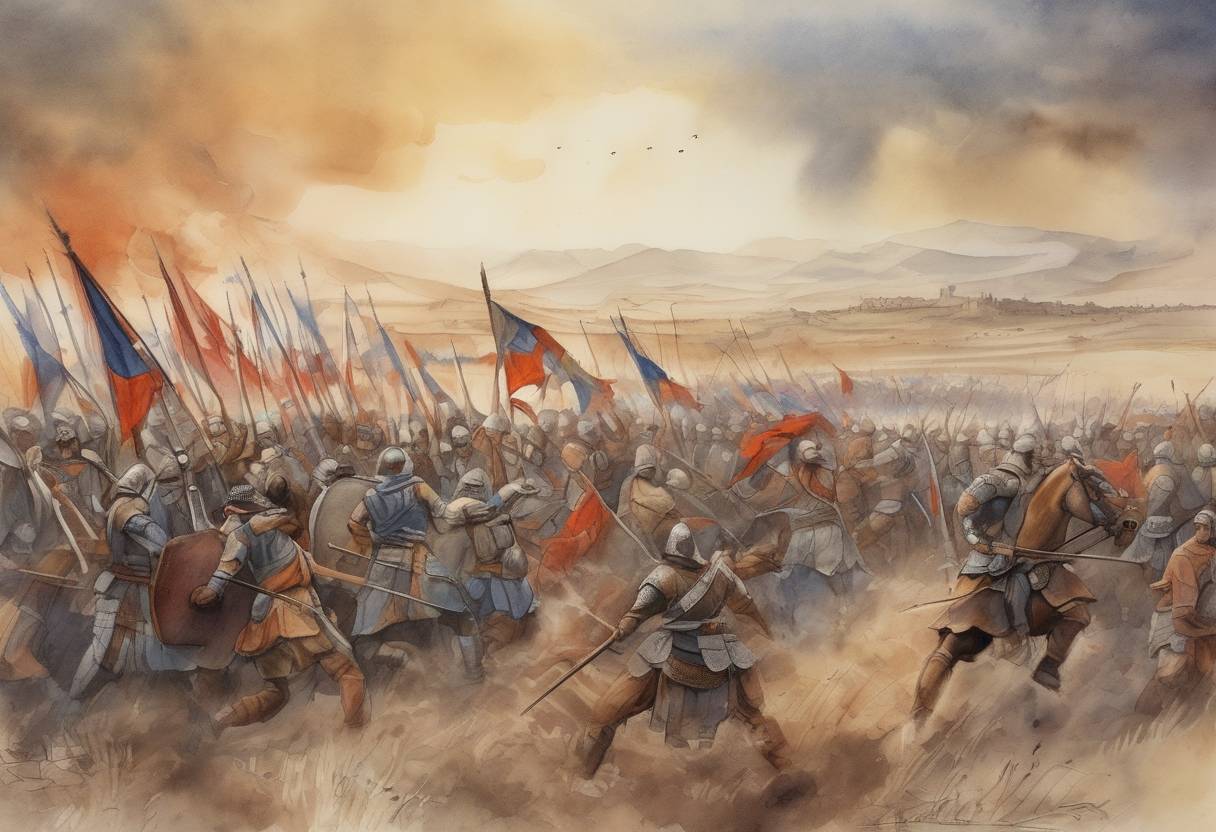
The Battle of Avarayr
Date and Context
The Battle of Avarayr took place on May 26, 451, in the region of Vaspurakan, which is part of modern-day Armenia. This battle was a pivotal moment in Armenian history, marking a significant stand against religious oppression by the Sasanian Empire.
Background
In the early 5th century, Armenia was under the influence of the Sasanian Empire, which sought to impose Zoroastrianism as the state religion. This was met with resistance from the predominantly Christian Armenian population, who had adopted Christianity as the state religion in 301 AD, making Armenia the first nation to do so.
The Sasanian king, Yazdegerd II, issued a decree in 449 demanding that Armenians convert to Zoroastrianism. This decree was met with defiance, leading to increased tensions and eventually the mobilization of Armenian forces.
- Vardan Mamikonian: The Armenian military leader and national hero who led the Armenian forces. He was a member of the influential Mamikonian family, known for their military prowess and leadership.
- Yazdegerd II: The Sasanian king who sought to consolidate his empire by enforcing religious uniformity.
The Battle
The Armenian forces, numbering around 66,000, were significantly outnumbered by the Sasanian army, which included war elephants and cavalry. Despite the odds, the Armenians, motivated by their desire to preserve their Christian faith, fought valiantly.
The battle was fierce and bloody, with heavy casualties on both sides. Vardan Mamikonian and many of his fellow commanders were killed in the fighting. Although the battle resulted in a tactical victory for the Sasanians, it did not achieve its strategic goal of converting the Armenian population to Zoroastrianism.
Aftermath and Significance
Despite their defeat on the battlefield, the Armenians’ resistance at Avarayr became a symbol of their determination to maintain their religious identity. The battle is commemorated annually by Armenians as a testament to their enduring faith and cultural resilience.
In the years following the battle, the Sasanians faced continued resistance and eventually granted religious freedom to the Armenians with the Nvarsak Treaty in 484. This treaty allowed Armenians to practice Christianity freely, marking a significant victory for the Armenian Church and its followers.
Broader Historical Impact
The Battle of Avarayr is considered a defining moment in Armenian history, symbolizing the struggle for religious freedom and national identity. It reinforced the Armenian commitment to Christianity and set a precedent for future resistance against external domination.
The legacy of Vardan Mamikonian and the battle itself has endured through Armenian literature, folklore, and religious tradition, highlighting the enduring spirit of the Armenian people in the face of adversity.