The Assassination of Leon Trotsky: August 20, 1940
1940 · Mexico City, Mexico
Leon Trotsky is fatally wounded by an ice-axe-wielding assassin in Mexico City.
August 21, 1940
Leon Trotsky, a Russian revolutionary and political theorist, died from injuries inflicted by an assassin's ice axe attack on August 20 in Mexico City. The attack was ordered by Joseph Stalin.
Mexico City, Mexico | Soviet Union
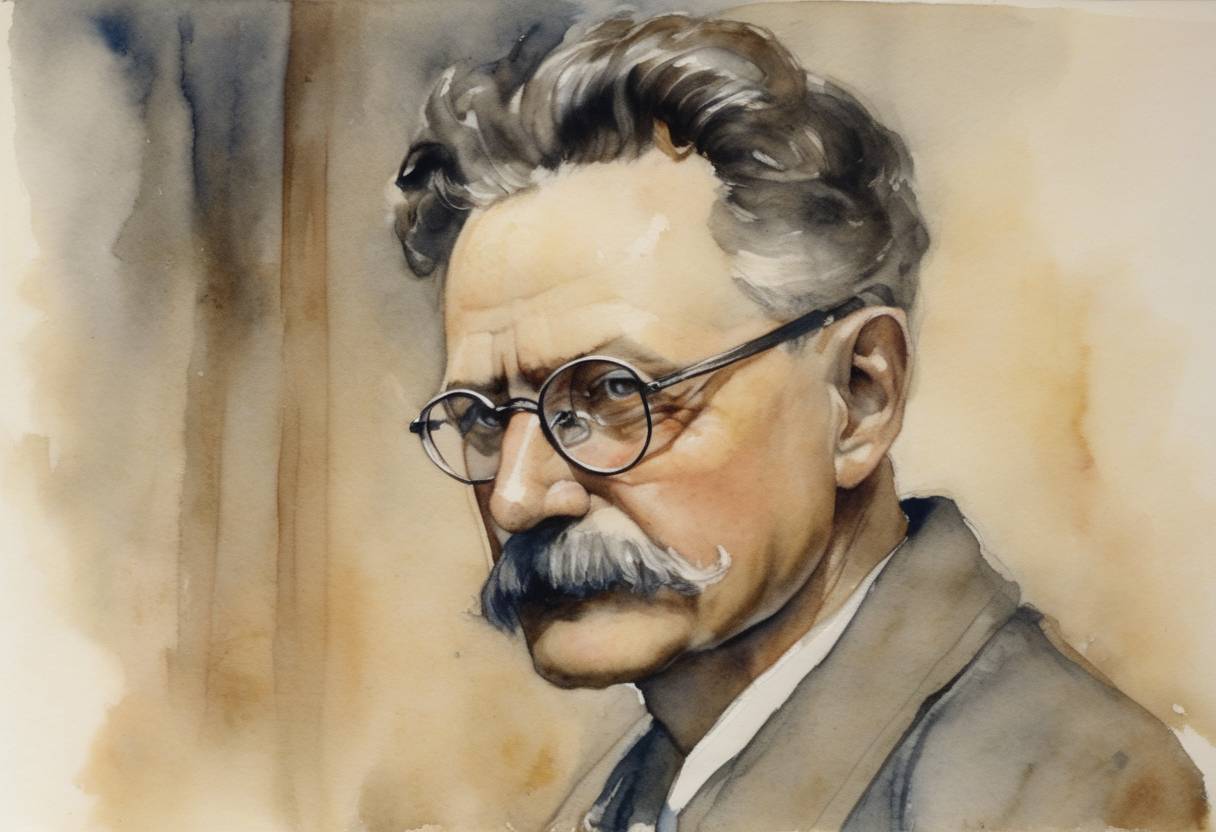
On August 21, 1940, Leon Trotsky, a prominent Russian revolutionary and a founding figure of the Soviet State, succumbed to injuries in a hospital in Mexico City. These injuries were inflicted by an assassin’s ice axe attack that had occurred the previous day. The attack was orchestrated under the orders of Joseph Stalin, Trotsky’s rival within the Communist Party of the Soviet Union. Trotsky’s death marked the end of a significant era in the history of Soviet politics and revolutionary movements worldwide.
Leon Trotsky, born Lev Davidovich Bronstein, was an influential Marxist theorist, a founder of the Red Army, and a key player in the Bolshevik victory during the Russian Civil War. However, after Lenin’s death and the subsequent power struggle within the Communist Party, Trotsky lost out to Joseph Stalin. By 1929, Trotsky found himself in exile, banished from the Soviet Union, following his frequent criticisms of Stalin’s policies and consolidation of power.
Trotsky lived in several countries before finally settling in Mexico in 1937, at the invitation of the artist Diego Rivera and his wife, Frida Kahlo. Throughout his exile, he remained an ardent advocate for Marxism and a vocal opponent of Stalin’s regime, continuing to write on his revolutionary ideas and critique of Stalinist policies.
The assassination was orchestrated by the Soviet NKVD (predecessor to the KGB), with the operation directed by Pavel Sudoplatov. The man who executed the attack, Ramón Mercader, infiltrated Trotsky’s inner circle by establishing a romantic relationship with a trusted member of Trotsky’s household. On August 20, 1940, Mercader struck Trotsky on the head with an ice axe in his study.
Despite the severe injury, Trotsky and his guards managed to subdue Mercader, who was subsequently taken into custody by the Mexican authorities. Trotsky was rushed to a hospital, but after struggling through hours of agonizing pain and unsuccessful medical interventions, he passed away on August 21, 1940.
Ramón Mercader was sentenced to 20 years in prison by the Mexican court for the murder of Trotsky. After his release in 1960, he returned to the Soviet Union, where he was honored as a hero. Trotsky’s assassination was a decisive move by Stalin to eliminate one of his most significant ideological adversaries, solidifying his uncontested rule over the Soviet Union.
Trotsky’s legacy continued to influence socialist movements globally, particularly through the formation and activities of the Fourth International, which sought to promote his ideas against what they viewed as the distortions of Stalinism.
The murder of Leon Trotsky is seen as a crucial moment in the violent suppression of dissenting voices within the Communist movement and highlights the lengths to which Stalin’s regime would go to maintain its grip on power. Trotsky’s death underscored the ruthless political climate of the time and left a lasting mark on both Soviet history and the broader struggle for legitimate socialist governance, which Trotsky championed until his untimely death.
Source: www.history.com