Discovery of the Magnetic North Pole by James Clark Ross
1831 · Magnetic North Pole, Canada
James Clark Ross discovered the Magnetic North Pole.
June 11, 1847
Sir John Franklin's expeditionary team departs from the company of their supply ships in an effort to chart the Northwest Passage as part of a British Royal Navy voyage.
, Canada | British Royal Navy
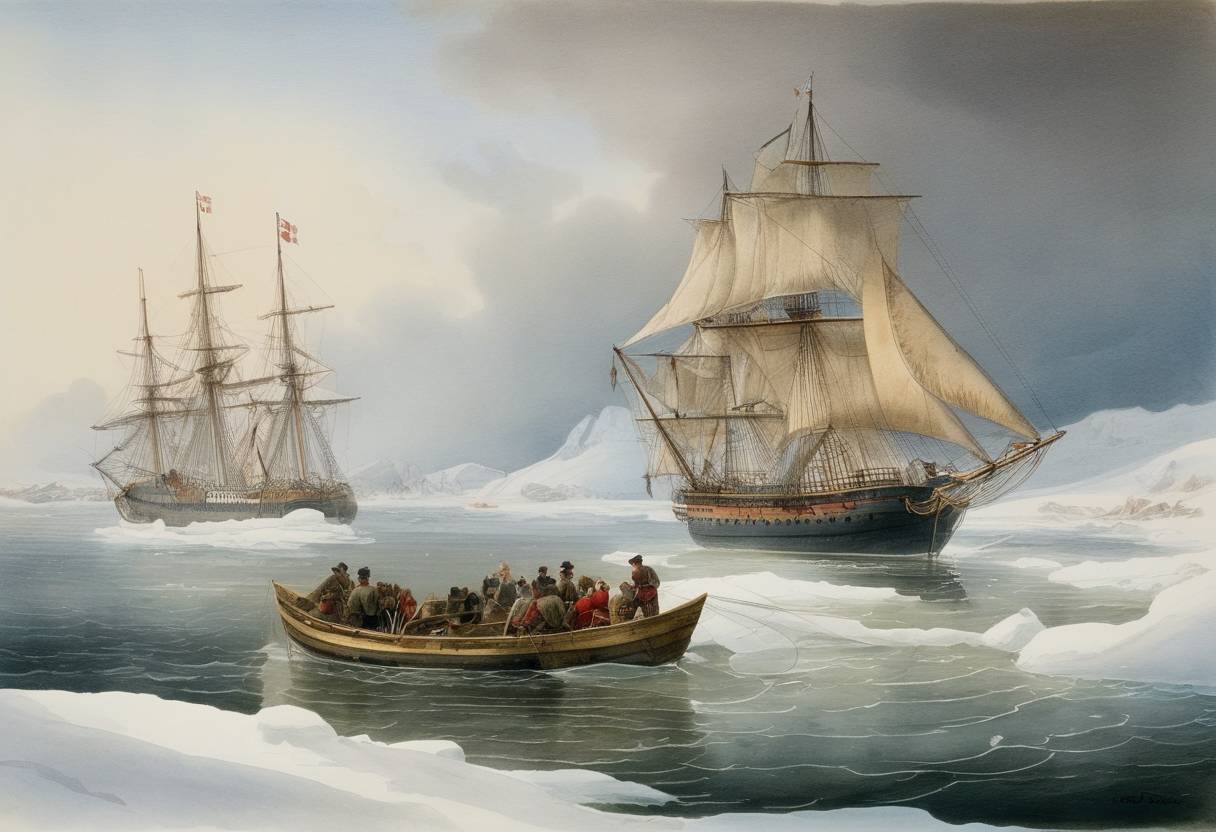
On June 11, 1847, a critical milestone occurred during Sir John Franklin’s ill-fated expedition aimed at discovering the Northwest Passage, one of the last uncharted segments of the Arctic. This British Royal Navy effort, headquartered primarily on HMS Erebus and HMS Terror, continued its attempts to establish a navigable sea route that would connect the Atlantic and Pacific Oceans. On this date, Sir John Franklin and his crew left the company of their supply ships, aiming to independently chart the treacherous Arctic waters.
The voyage, officially launched on May 19, 1845, from Greenhithe, England, was led by the seasoned naval officer Sir John Franklin, with Captain Francis Crozier commanding HMS Terror. The mission set sail with a crew of 129 men, including some of the Navy’s most skilled navigators and engineers. The ships were outfitted with the most advanced technology of the day, making them among the best-equipped Arctic exploration vessels at that time. The expedition was confident in its goal to overcome the Arctic’s icy barriers through its sophisticated training and provisions for a three-year voyage.
The initial progress of Franklin’s journey saw the ships safely travel through the Western coast of Greenland and then into the Canadian Arctic Archipelago. However, as they wintered near Beechey Island in 1845, the harsh realities of the environment began to take their toll. The subsequent move into the Victoria Strait during 1846 resulted in the ships becoming icebound. Over the harsh winters, they witnessed an increasingly dire situation as supplies dwindled and health conditions degenerated due to scurvy, lead poisoning from tin provisions, and extreme cold.
By the summer of 1847, Franklin’s ships remained trapped along the northern coast of King William Island. It was on June 11, 1847, that the expeditionary team made another concerted effort to explore the unyielding ice landscapes to find a passage westward. This departure from the supply ships signified their persistent determination to fulfill their mission objective despite the overwhelming adversities faced.
The challenges faced in navigating the Northwest Passage were compounded when Sir John Franklin passed away in June 1847, as evidenced by later discovered records. His expedition’s plight attracted global attention, sparking numerous search parties, including efforts led by Franklin’s wife, Lady Jane Franklin. These missions succeeded in mapping significant portions of the Canadian Arctic but confirmed the grim fate that befell Franklin’s men—the last of whom succumbed in 1848 as they attempted to journey overland to safety.
The Franklin Expedition holds substantial historical significance as it highlighted the perilous nature of Arctic exploration, leading to enhanced navigational techniques and eventual successful traversals in later decades. It also fueled a greater understanding of the Arctic regions, resulting in further scientific inquiry and mapping that benefitted future explorations.
This stark chapter in exploration history provides poignant lessons on human endeavor, the pursuit of knowledge, and the unpredictable power of nature that remains relevant even today.
Source: en.wikipedia.org