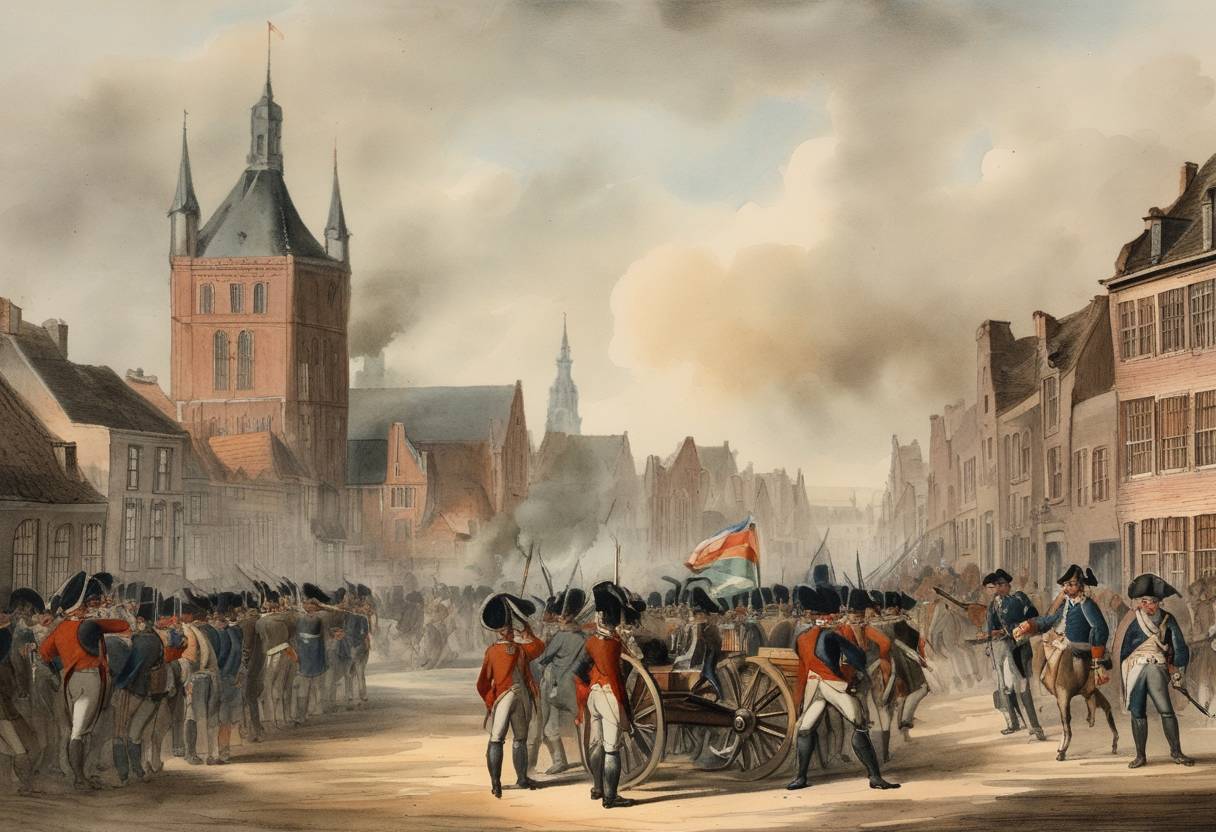
Capture of Utrecht - January 16, 1795
On January 16, 1795, the city of Utrecht in the Dutch Republic fell to French Revolutionary forces, marking a significant turning point during the War of the First Coalition. This military operation was part of the broader French Revolutionary Wars, during which France sought to spread revolutionary ideals and expand its influence against various European monarchies.
Context and Lead-Up
Since the late 1780s, the Dutch Republic had been embroiled in internal political conflict between the pro-French Patriots, who favored democratic reforms, and the pro-British Orangists, who supported the hereditary stadtholder regime. The French Revolution of 1789 further inspired the Patriots, who saw an ally in Revolutionary France against the conservative powers supporting the Prince of Orange.
By 1794, the War of the First Coalition was intensifying. French forces, under the command of generals such as Jean-Charles Pichegru, had made substantial inroads into the European heartland. The persistent success of the French Army against coalition forces paved the way for their advances into the Dutch Republic.
The Fall of Utrecht
In the winter of 1794-1795, unprecedented weather conditions, including the freezing of the rivers and canals, facilitated the mobility of the French troops, who otherwise would have been constrained by the extensive Dutch waterways. The rapid advance became known as the frost campaign, where ice-locked defenses were penetrated with relative ease.
On January 16, 1795, Utrecht, one of the key cities in the Netherlands, capitulated to the advancing French forces with little resistance. This surrender was emblematic of the waning Dutch resistance against the French invasion, which had already seen several successful French sieges and captures across the region.
Aftermath and Significance
The capture of Utrecht effectively marked the end of organized military opposition in the Dutch Republic. Shortly after, on January 19, 1795, the city of Amsterdam would also fall, consolidating French control over the region. In the following days, the Batavian Republic was proclaimed, aligning the Netherlands with the French Republic under a sister-republic model.
This period also saw the flight of the Prince of Orange, William V, to Britain, effectively ending the Oranje-Nassau’s stadtholderate. The Batavian Republic, established in the wake of these events, instituted significant political and social reforms in line with revolutionary ideals, aligning with the broader revolutionary changes sweeping across Europe.
The capture of Utrecht and the subsequent establishment of the Batavian Republic underscored the broader geopolitical shifts initiated by the French Revolutionary Wars. France’s influence expanded as it secured a strategic ally in the Batavian Republic, contributing to its position as a dominant continental power.