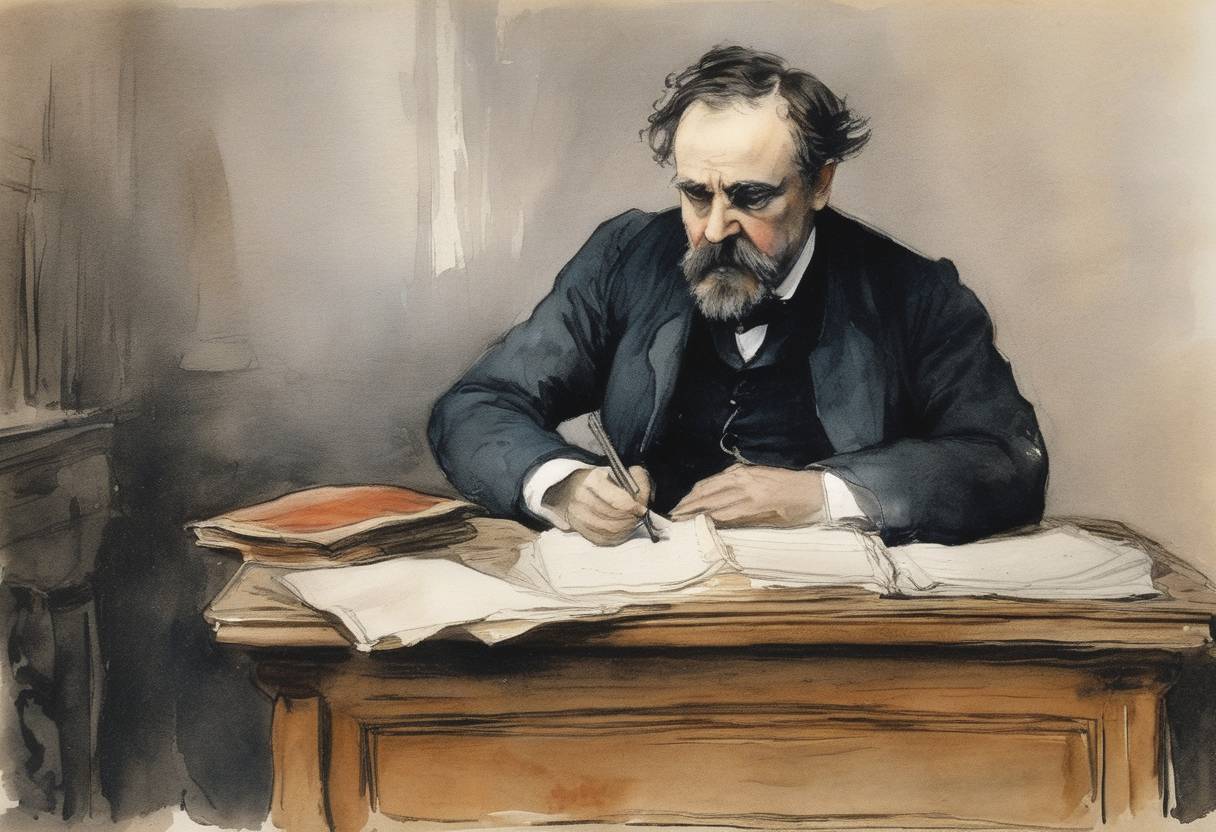
Émile Zola’s Open Letter “J’accuse”
On January 13, 1898, the French writer Émile Zola published his famous open letter “J’accuse” in the newspaper L’Aurore. This letter was addressed to the President of France, Félix Faure, and was a powerful critique of the French military and the judiciary system’s handling of the Dreyfus Affair.
Context of the Dreyfus Affair
The Dreyfus Affair centered around Alfred Dreyfus, a Jewish French army officer falsely accused and convicted of treason in 1894. Dreyfus was sentenced to life imprisonment on Devil’s Island, a remote penal colony. The case against him was built largely on anti-Semitic sentiment and fabricated evidence.
Contents of “J’accuse”
Émile Zola’s letter asserted that the wrongful conviction of Dreyfus was a result of gross injustices driven by rampant anti-Semitism within the military establishment and the judicial system. The headline “J’accuse,” meaning “I accuse,” symbolized Zola’s direct challenge to the corruption and bias he perceived in the highest levels of French society. Within the letter, Zola detailed specific accusations against military officers and government officials, criticizing them for conducting an erroneous investigation and concealing the truth.
“L’Aurore,” the liberal Parisian newspaper that published “J’accuse,” was edited by Georges Clemenceau, who would later become a significant political figure as the Prime Minister of France. The publication of “J’accuse” had an immediate and explosive impact, attracting widespread public attention and polarizing opinions across France and beyond.
Consequences
Zola’s letter resulted in his own trial and conviction for libel, forcing him to flee to England temporarily. The publication, however, fueled public debate and was instrumental in prompting a re-examination of the Dreyfus case. In 1906, Alfred Dreyfus was eventually exonerated and reinstated into the French Army.
Historical Significance
The Dreyfus Affair and Zola’s bold intervention became a pivotal moment in French history, highlighting issues of anti-Semitism, miscarriages of justice, and the role of the media and public intellectuals in societal affairs. “J’accuse” remains a landmark document representing the power of the written word to confront injustice and provoke significant social and political change.