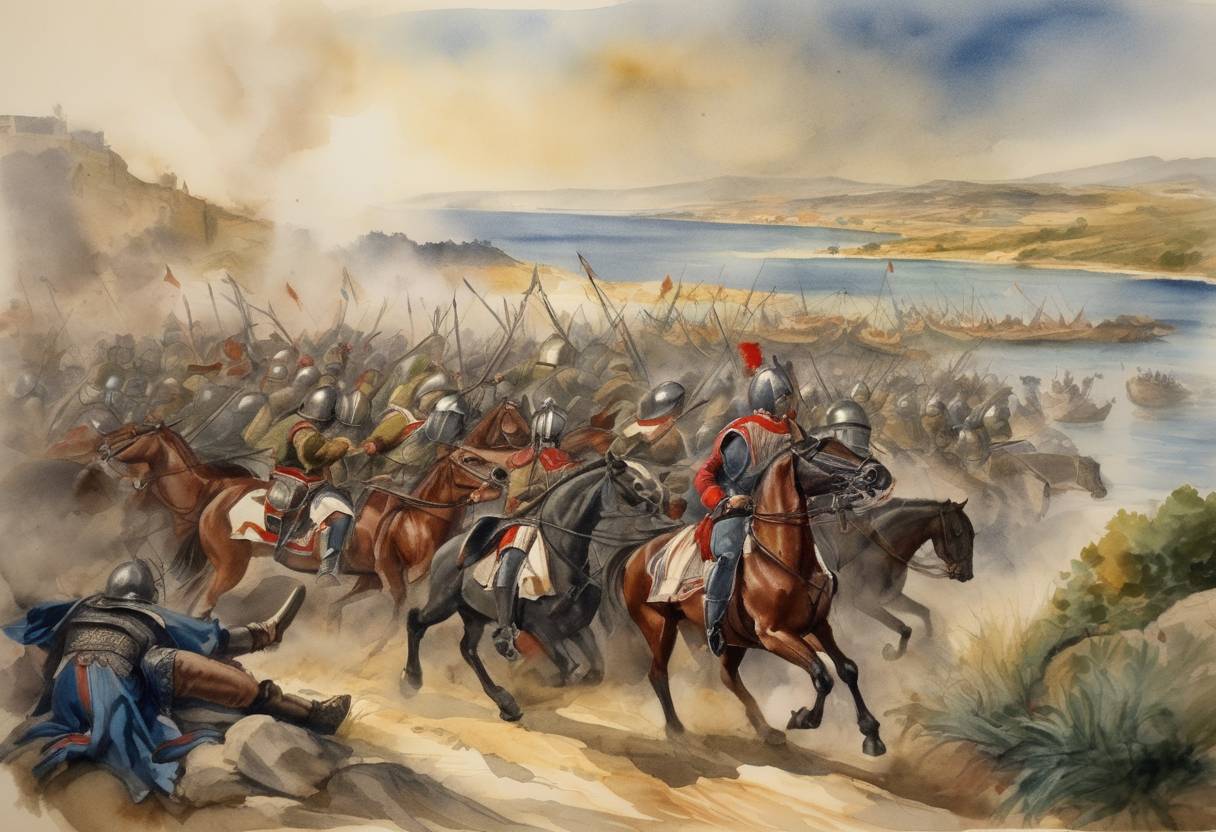
Battle of Rio Salado - October 30, 1340
The Battle of Rio Salado, also known as the Battle of Tarifa, occurred on October 30, 1340. It marked a significant turning point in the struggle for control over the Iberian Peninsula. This engagement involved the combined forces of Christian allies, the Kingdom of Castile under King Alfonso XI, and the Kingdom of Portugal led by King Afonso IV, countering the Marinid dynasty’s incursion from North Africa.
Context and Prelude
In the early 14th century, the Marinid dynasty under Sultan Abu al-Hasan Ali sought to establish its influence over Iberia, capitalizing on the weakening Christian foothold and internal conflicts among Christian kingdoms. The Marinids, based in present-day Morocco, allied with the Nasrid Kingdom of Granada—the last Muslim stronghold in Iberia—to challenge Christian territories.
Tensions escalated following multiple Marinid campaigns across the Strait of Gibraltar. The threat of Muslim expansion unified Christian rivals. Alfonso XI of Castile sought assistance from neighboring Portugal as well as from Western Europe, where England had intermittent alliances with these kingdoms.
The Battle
The confrontation took place near the Salado River, close to Tarifa, near today’s southern coast of Spain. The Marinid and Granadan forces, estimated to be tens of thousands strong, were opposed by a slightly smaller force. The Christians were strategically positioned, using advantageous terrain to counter the Marinid cavalry and soldiers.
The battle lasted a day, during which the effective deployment of the allied forces proved decisive. The Christian armies launched a surprise attack across the river, exploiting the Marinids’ divided positions. Coordination between the Portuguese and Castilian troops overwhelmed the Marinid forces, eventually breaking their lines and securing a pivotal victory.
Aftermath and Significance
The defeat at Rio Salado ended the last significant Muslim campaign to reclaim territories on the Iberian Peninsula. This victory solidified the Christian hold over southern Iberia, weakening the Nasrid Kingdom of Granada’s position, which would persist but eventually succumb to the Christian Reconquista in 1492.
Strategically, the battle diminished the Marinid dynasty’s power in the region, curbing subsequent attempts to influence Iberia. It also underscored the effectiveness of Christian alliances and military cooperation across the peninsula, fostering an era of relative stability among Christian kingdoms.
The victory at Rio Salado enhanced the prestige of both Alfonso XI and Afonso IV, reinforcing their leadership roles in the ongoing Christian reconquest efforts. It symbolized a turning of the tide in favor of the Reconquista, ultimately leading to the complete recapture of the peninsula by Christian forces over the following century.