Battle of Rio Salado - October 30, 1340
1340 · Tarifa, Spain
At the Battle of Rio Salado, English and Portuguese forces defeat the Marinid Muslim army in Iberia, effectively ending the last Muslim attempt to conquer the Iberian Peninsula.
August 6, 0939
The Battle of Simancas is fought between the forces of the Christian kingdoms of León and Castile, led by King Ramiro II, and the Muslim Umayyad Caliphate under the command of Abd al-Rahman III. The battle results in a decisive victory for the Christian forces.
Simancas, Spain | Christian Kingdoms of León and Castile
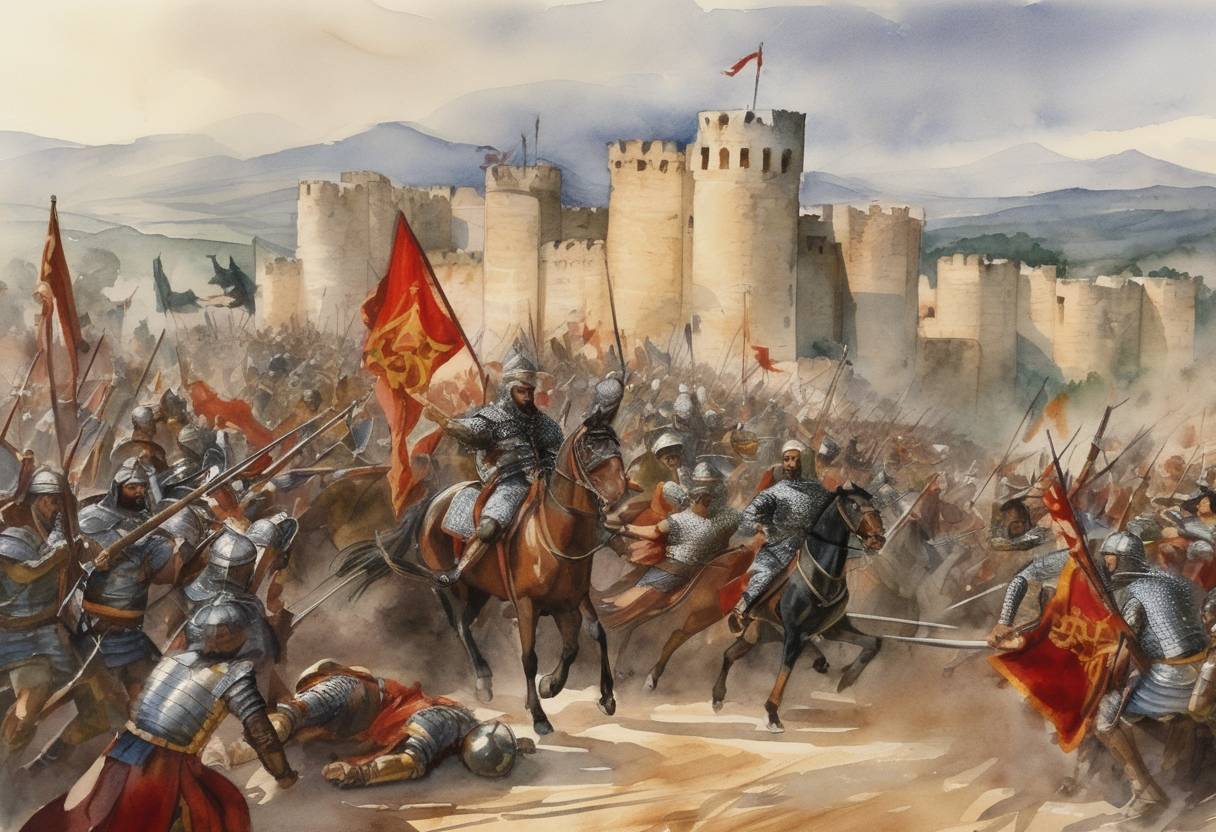
On August 6, 939, the Battle of Simancas was fought between the Christian kingdoms of León and Castile and the Muslim Umayyad Caliphate. The conflict was a pivotal moment in the Christian Reconquista efforts to reclaim the Iberian Peninsula from Muslim rule.
The early 10th century was a period of fluctuating power between the Christian and Muslim forces in the Iberian Peninsula. The Umayyad Caliphate, with its capital in Córdoba, was a dominant force in Al-Andalus, controlling much of the southern and central parts of the peninsula. In contrast, the northern Christian kingdoms sought to expand southward.
King Ramiro II of León: He ascended to the throne in 931 and was known for his military prowess and strategic acumen. Under his leadership, the Christian forces aimed to push back the territorial advances made by the Muslims.
Abd al-Rahman III: The skilled and strategic Umayyad caliph who had declared himself Caliph in 929, bolstering his authority and aiming to consolidate power across the Muslim territories in the Iberian Peninsula.
The battle took place near the town of Simancas, located near present-day Valladolid in northwestern Spain. King Ramiro II led a coalition of Christian forces, leveraging both strategic planning and strong alliances with neighboring Christian rulers.
The clash was intense, with both sides suffering significant casualties. However, the Christian forces, likely bolstered by local knowledge and tactical advantages, succeeded in outmaneuvering the Umayyad army.
The result was a decisive victory for the Christian forces, marking a turning point in the Reconquista. It signaled a halt to the northern expansion of the Umayyad Caliphate and showcased the resilience and growing strength of the Christian kingdoms.
Impact on Christian Forces: The victory cemented King Ramiro II’s reputation as a formidable military leader and spurred further campaigns to reclaim territory from Muslim control.
Effect on the Umayyad Caliphate: Although Abd al-Rahman III retained his power, the defeat at Simancas demonstrated the challenges faced by the Caliphate in maintaining control over the expansive and diverse territories.
Long-term Significance: The battle was a significant milestone within the broader context of the Reconquista, exemplifying the gradual shift in momentum towards the Christian kingdoms.
The Battle of Simancas stands as a crucial moment in the complex tapestry of medieval Spanish history, illustrating the ever-shifting dynamics of power and influence between Christian and Muslim forces on the Iberian Peninsula.