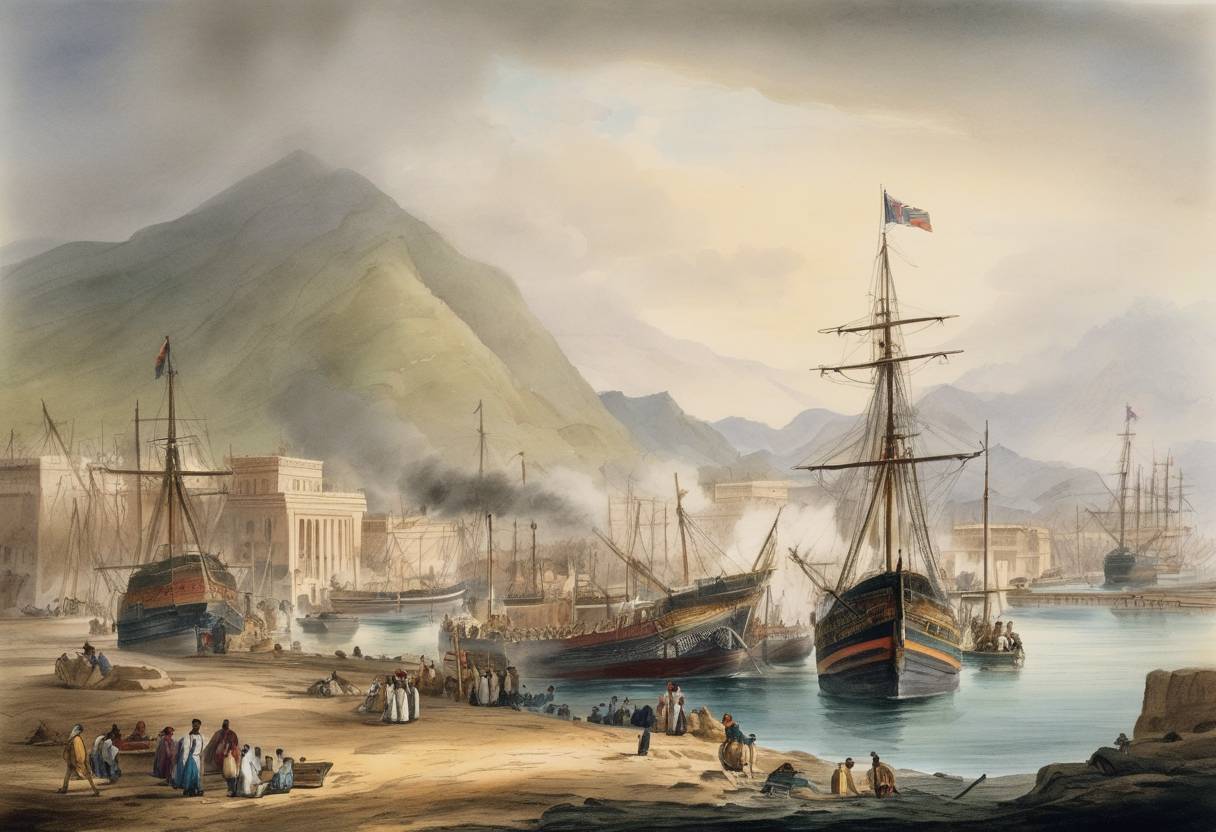
The Capture of Aden by the British East India Company - January 19, 1839
On January 19, 1839, the British East India Company seized the port of Aden, located on the southern coast of what is now Yemen. This move marked a significant strategic expansion for the Company, aimed at securing critical maritime routes and protecting British interests in the region.
Context and Background
Aden had long been recognized for its strategic position on the Arabian Peninsula, overlooking the vital maritime routes between the Red Sea and the Indian Ocean. During the early 19th century, the necessity for secure coaling stations increased with the advent of steam navigation. British interests were particularly focused on establishing a series of maintenance and supply ports necessary for the operational support of their naval and commercial fleets.
The capture of Aden was also influenced by the need to safeguard the route to India, which was the crown jewel of the British Empire. Control of Aden would provide a crucial halfway point for ships traveling from the Suez Canal to India, significantly enhancing the flexibility and security of British naval operations.
The Capture of Aden
The East India Company’s decision to seize Aden was partly driven by the harassment of British shipping by local rulers and partly by the strategic imperative. In 1838, Captain Stafford Bettesworth Haines, supported by a small force, approached the local sultan with a demand for a treaty that would allow the British to officially establish a presence there. After negotiations failed, Captain Haines launched a bombardment, leading to the capture of Aden on January 19, 1839.
Consequences and Strategic Importance
The establishment of British control over Aden set the stage for its development as an important hub along the international shipping lanes. Over the following decades, Aden became a significant refueling station, as steamships required regular coal resupply. This was particularly crucial after the opening of the Suez Canal in 1869, which shifted global trade dynamics by reducing the time and distance required to travel between Europe and Asia.
Furthermore, the control of Aden facilitated British dominance in the Arabian Peninsula and contributed to their broader imperial strategy, acting as a check against rival powers in the region. It remained an essential outpost within the British Empire, reflecting its long-term strategic importance beyond mere trade purposes.
Aftermath and Long-term Impact
Aden would remain under British control until 1967, long after the British East India Company had ceased to exist. The significance of Aden, which evolved into a modern urban settlement during British rule, highlighted the importance of strategic locations in the framework of 19th-century global maritime power structures. Its capture is illustrative of the broader geopolitical tactics employed by imperial powers during this era.