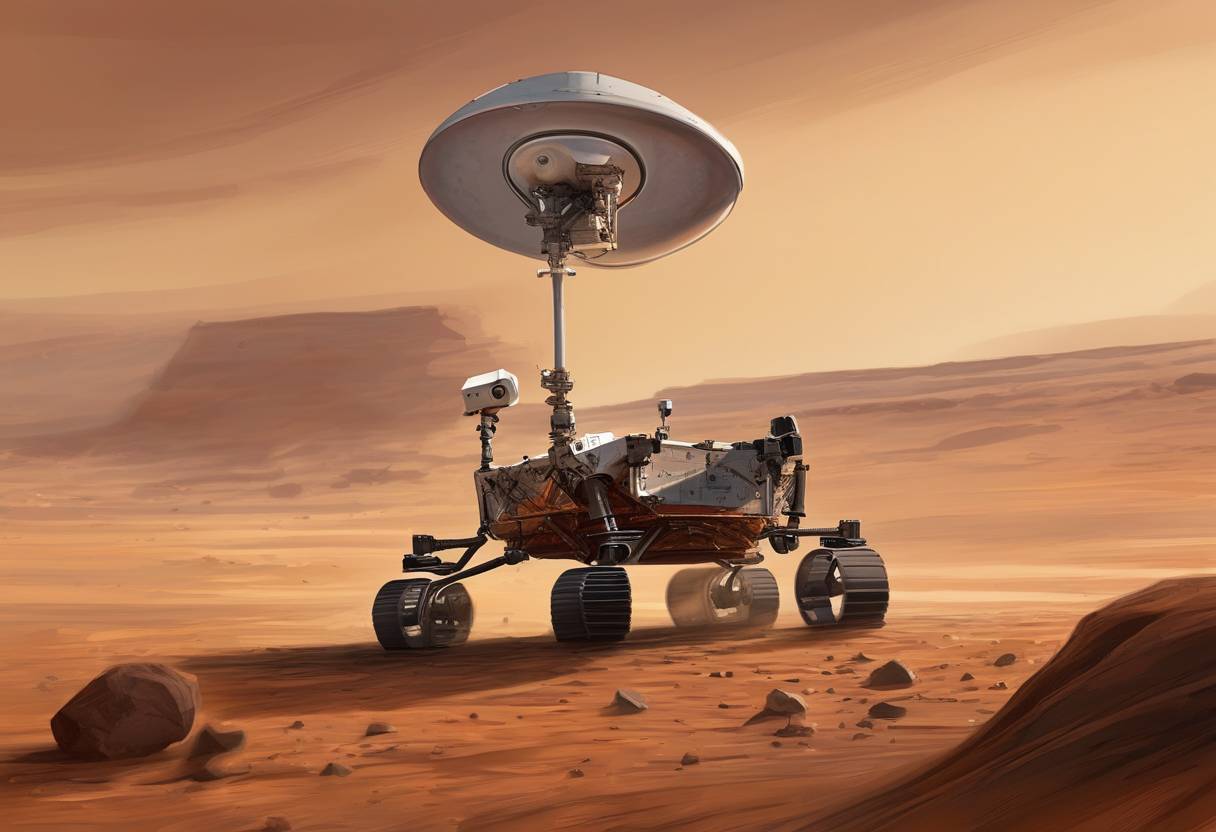
Perseverance Rover’s First High-Resolution Images on Mars
On February 19, 2021, NASA’s Perseverance rover began transmitting its first high-resolution images from the surface of Mars. This significant milestone came just one day after the rover’s successful landing at Jezero Crater on the Martian surface. The images provided scientists a detailed view of the Martian terrain and were a crucial step in the rover’s mission to search for signs of ancient life and collect rock and soil samples.
Background
The Perseverance rover, part of NASA’s Mars 2020 mission, was launched from Cape Canaveral, Florida, on July 30, 2020. The mission aimed to explore a region believed to have once hosted a significant body of water, making it a promising site for past microbial life.
Landing on Mars
On February 18, 2021, the rover executed its landing sequence, often referred to as the “seven minutes of terror,” due to the complexity and autonomous nature of the landing. Perseverance safely touched down on Mars, commencing its multi-year mission.
Image Transmission
The first high-resolution images sent back to Earth marked a critical achievement. These images were captured by the rover’s various onboard cameras, notably the Navigation Cameras (Navcams) and Hazard Cameras (Hazcams), which are designed to aid in navigation and hazard avoidance.
Significance of the Images
- Terrain Analysis: The images allowed scientists to analyze the immediate landing site and further plan the rover’s movements and objectives.
- Historical Context: Jezero Crater’s ancient river delta formations are of particular interest due to the potential for preserved biosignatures.
- Mission Planning: High-resolution images help identify interesting geological formations and sites, which could provide insights into the planet’s past conditions.
Mission Objectives
The Perseverance rover’s mission includes searching for biosignatures, collecting rock and soil samples, and caching them for potential future return to Earth. It also studies the planet’s geology and climate to advance understanding of Mars as a system.
Broader Impact
The successful image transmission from Perseverance furthers humanity’s exploration efforts and understanding of Mars. It inspires future missions and technological advancements in space exploration, reinforcing Mars’ status as a focal point for scientific discovery.