The Serbian Empire at Its Apogee: April 17, 1362
1362 · , Serbian Empire
The Serbian Empire reaches its greatest territorial extent under Emperor Stefan Uroš V.
April 16, 1346
Stefan Dušan was crowned Emperor of the Serbs and Greeks, establishing the Serbian Empire as a significant power in Southeast Europe during the 14th century. This event marked the height of the medieval Serbian state and the Nemanjić dynasty.
Skopje, Serbia (now North Macedonia)
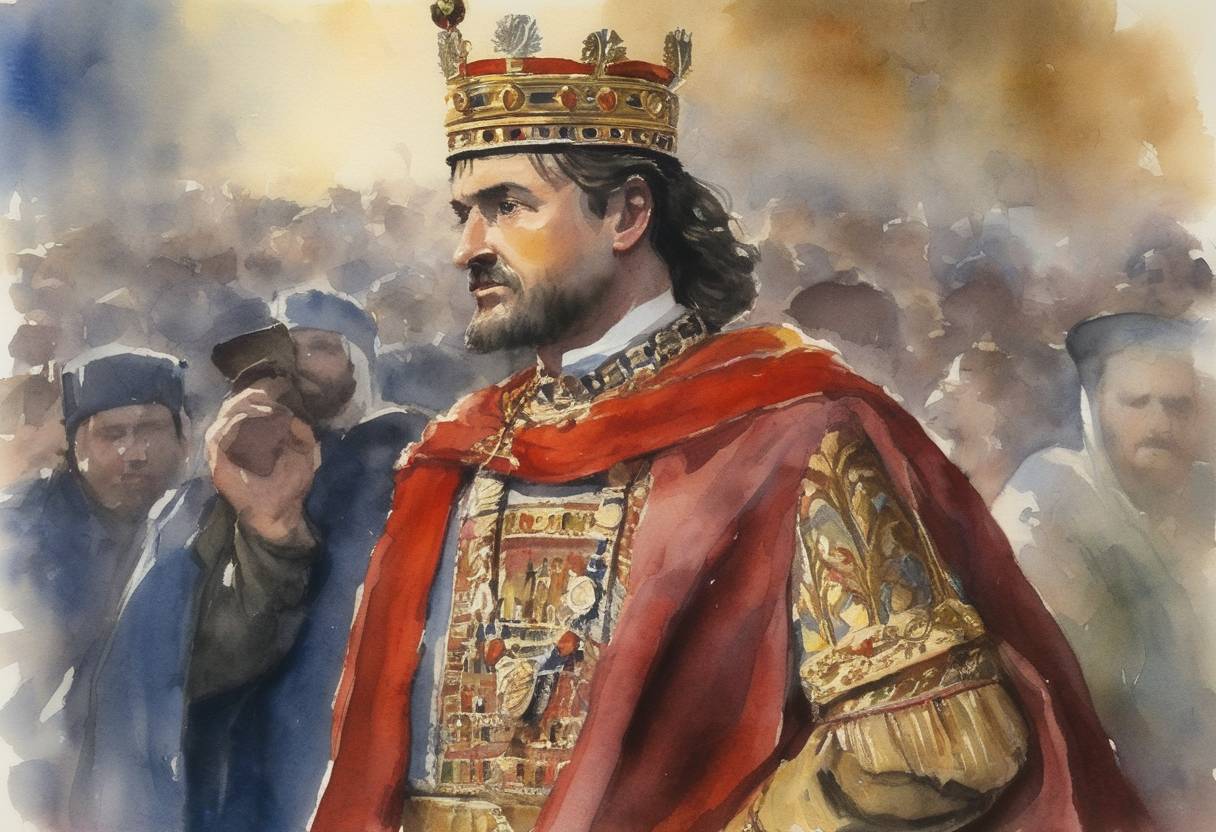
On April 16, 1346, Stefan Dušan, a pivotal medieval ruler, was crowned as the Emperor of the Serbs and Greeks. This event established the Serbian Empire as a significant power in Southeast Europe and marked a high point in the medieval Serbian state under the Nemanjić dynasty.
Stefan Dušan, a member of the Nemanjić dynasty, ascended to the Serbian throne in 1331. His reign was characterized by ambitious expansionist policies, enabling the Serbian state to encompass vast territories in the Balkans. By the early 1340s, Serbia had annexed significant portions of Byzantine-held lands, effectively forming a large, powerful empire poised to rival the Byzantine Empire itself.
The coronation of Stefan Dušan took place in the city of Skopje, which was part of the Serbian territories at the time. It was a grand affair that asserted Serbia’s status on the European stage. Importantly, the event was attended by the highest-ranking ecclesiastical and secular leaders, featuring Patriarch Joanikije II of Serbia, the Archbishop of Ohrid, and other church dignitaries, symbolizing ecclesiastical support for Dušan’s imperial ambitions.
Dušan’s coronation was not just a symbolic assertion of power but also a calculated political move. By taking the imperial title, Dušan sought to legitimize his control over Greek lands and position himself as a key player in the ongoing power struggles in the Byzantine realm.
Strengthened Control: The establishment of the Serbian Empire under Dušan’s rule extended Serbian influence deep into the Balkans. His empire controlled parts of modern-day Albania, Macedonia, Montenegro, Greece, and Bulgaria.
Codification of Laws: Post-coronation, Dušan focused on consolidating his empire by instituting the “Dušan’s Code,” a comprehensive legal code that governed everything from civil matters to military obligations. It reflected both Serbian and Byzantine influences.
Cultural Flourishing: The period of Dušan’s rule saw significant cultural and architectural developments, signaling a blend of Serbian and Byzantine traditions that defined the empire’s character.
Orthodox Christian Influence: The creation of the Serbian Patriarchate in 1346 alongside his coronation secured the Serbian Orthodox Church’s hierarchy independent of Byzantine influence.
Dušan ruled as Emperor until his death in 1355. The dynasty struggled to maintain the cohesive control that he wielded, leading to fragmentation and vulnerability to external threats, such as the Ottoman Empire. Despite its eventual decline, the Serbian Empire under Stefan Dušan’s reign remains a celebrated chapter in Serbia’s medieval history, symbolizing a peak in political and cultural achievement.
This critical moment in Serbian history established a legacy of ambition and power that would shape the cultural identity of the region and influence historical developments in Southeast Europe.
Source: en.wikipedia.org