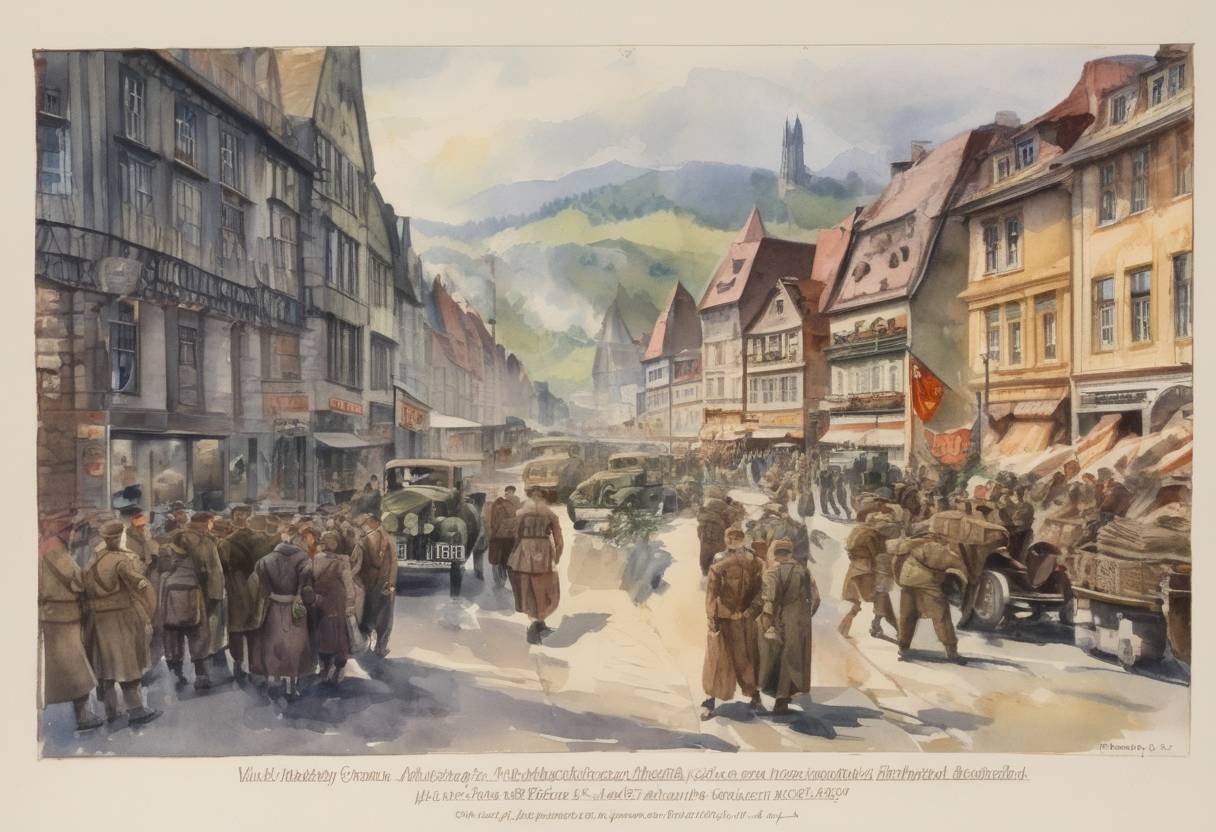
Reoccupation of the Rhineland: March 7, 1936
On March 7, 1936, Nazi Germany, under the leadership of Adolf Hitler, reoccupied the Rhineland, a significant event that marked a pivotal moment in the lead-up to World War II. This action was a direct violation of both the Treaty of Versailles and the Locarno Treaties, which had been established to maintain peace and stability in post-World War I Europe.
Background
Treaty of Versailles (1919)
- Purpose: The Treaty of Versailles was signed at the end of World War I, imposing strict disarmament and territorial restrictions on Germany to prevent future aggression.
- Rhineland Clause: The treaty demilitarized the Rhineland, a region in western Germany along the Rhine River, to serve as a buffer zone between Germany and France.
Locarno Treaties (1925)
- Objective: These treaties were designed to normalize relations between Germany and its neighbors, particularly France and Belgium, and to ensure the borders established by the Treaty of Versailles were respected.
- Guarantee: The treaties included a mutual guarantee of the borders between Germany, France, and Belgium, with Britain and Italy as guarantors.
The Reoccupation
Hitler’s Strategy
- Motivation: Hitler aimed to strengthen Germany’s strategic position and test the resolve of France and Britain. The reoccupation was also intended to bolster his domestic support by defying the post-World War I restrictions.
- Execution: On March 7, 1936, German troops marched into the Rhineland. The operation was carried out with limited military force, as Hitler was aware of the potential for international backlash.
International Reaction
- France: Despite being directly threatened by the reoccupation, France was politically divided and hesitant to respond militarily without British support.
- Britain: The British government, preoccupied with domestic issues and the desire to avoid another war, opted for a policy of appeasement, viewing the reoccupation as Germany moving troops within its own borders.
- League of Nations: The League condemned the action but lacked the power to enforce its resolutions.
Consequences
Emboldening Nazi Germany
- The successful reoccupation without significant opposition emboldened Hitler, reinforcing his aggressive foreign policy and expansionist ambitions.
- It marked a significant step towards the dismantling of the post-World War I international order and set the stage for further territorial expansion by Nazi Germany.
Prelude to World War II
- The lack of decisive action by France and Britain is often cited as a critical failure of appeasement, encouraging further violations by Hitler, including the annexation of Austria and the Sudetenland in the years that followed.
In summary, the reoccupation of the Rhineland was a bold move by Nazi Germany that challenged the post-World War I peace settlements and highlighted the weaknesses of the international community’s response, contributing to the conditions that led to World War II.