The Battle of the Philippine Sea: June 20, 1944
1944 · Philippine Sea, Pacific Ocean
The Battle of the Philippine Sea, a major naval battle of World War II, takes place between the United States and Japan, resulting in a decisive American victory.
June 4, 1942
The Battle of Midway begins, marking a turning point in the Pacific Theater of World War II as the United States Navy decisively defeats the Imperial Japanese Navy.
Midway Atoll, United States | United States Navy
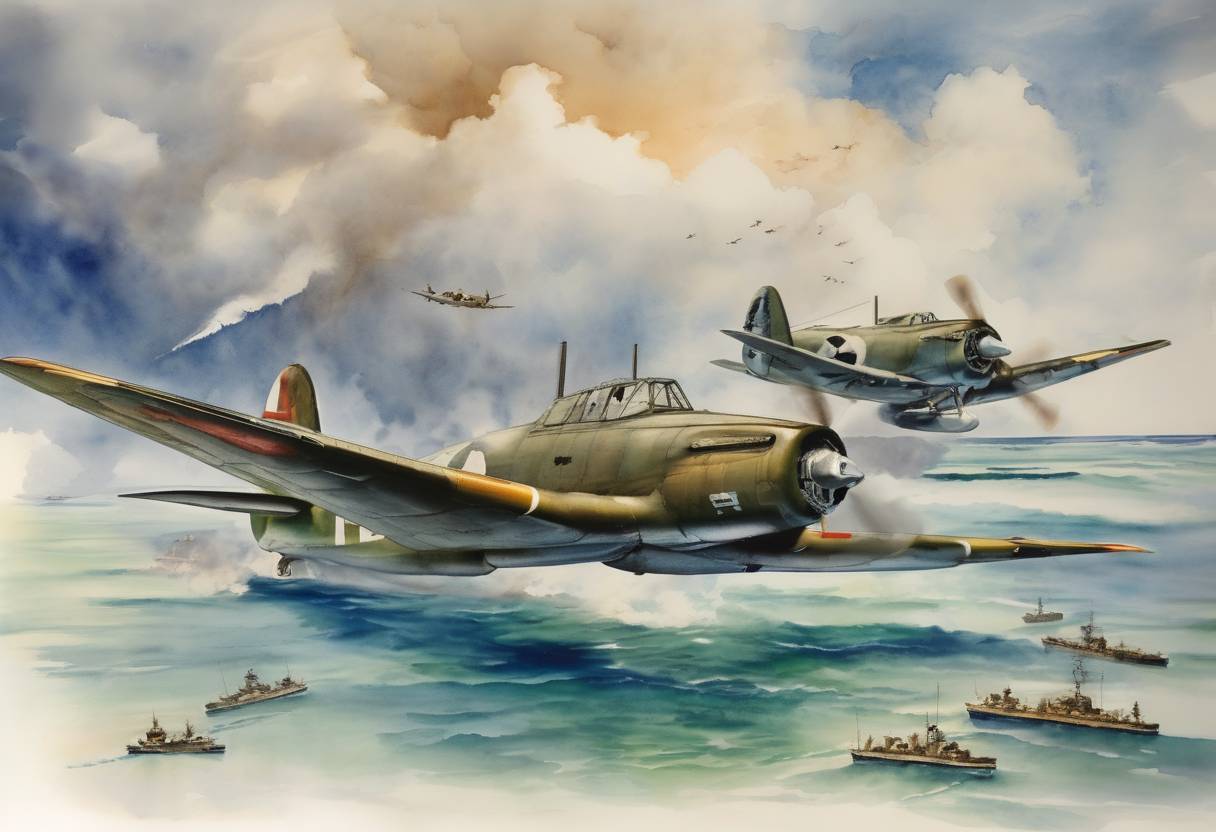
The Battle of Midway, which commenced on June 4, 1942, is widely regarded as a pivotal turning point in the Pacific Theater during World War II. This decisive naval battle saw the United States Navy achieve a significant victory over the Imperial Japanese Navy, altering the course of the war in the Pacific.
Strategic Importance: Midway Atoll, located in the central Pacific Ocean, was of strategic importance to both the United States and Japan. For the Japanese, capturing Midway would extend their defensive perimeter and potentially lure the U.S. Pacific Fleet into a decisive battle.
Japanese Objectives: The Japanese aimed to eliminate the United States as a strategic power in the Pacific, thereby securing their dominance. The plan, orchestrated by Admiral Isoroku Yamamoto, involved a complex operation to invade and occupy Midway.
American Intelligence: Prior to the battle, U.S. Navy cryptanalysts had broken Japanese communication codes, allowing them to anticipate the attack on Midway. This intelligence advantage enabled Admiral Chester W. Nimitz, Commander in Chief of the U.S. Pacific Fleet, to prepare and position his forces effectively.
Initial Japanese Attack: On the morning of June 4, Japanese aircraft launched an assault on Midway Atoll, causing significant damage but failing to neutralize the island’s defenses.
U.S. Counterattack: Utilizing the element of surprise, American carrier-based aircraft from USS Enterprise, USS Hornet, and USS Yorktown launched a series of attacks on the Japanese fleet.
Sinking of Japanese Carriers: In a dramatic and decisive series of attacks, U.S. dive bombers managed to sink four Japanese aircraft carriers: Akagi, Kaga, Soryu, and Hiryu. These carriers had been instrumental in the attack on Pearl Harbor just six months earlier.
Japanese Losses: The loss of four carriers, along with a significant number of experienced pilots and aircraft, dealt a severe blow to the Japanese Navy, from which it never fully recovered.
Turning Point: The Battle of Midway shifted the balance of naval power in the Pacific in favor of the United States. It marked the beginning of a series of offensive operations by the Allies, ultimately leading to Japan’s defeat.
Strategic Impact: The victory at Midway halted Japanese expansion in the Pacific and set the stage for future Allied offensives, including the Guadalcanal Campaign and the island-hopping strategy that would bring Allied forces closer to Japan.
The Battle of Midway remains a testament to the importance of intelligence, strategic planning, and the bravery of those who fought. It is celebrated as one of the most significant naval battles in history, demonstrating the critical role of aircraft carriers in modern naval warfare.
Source: en.wikipedia.org