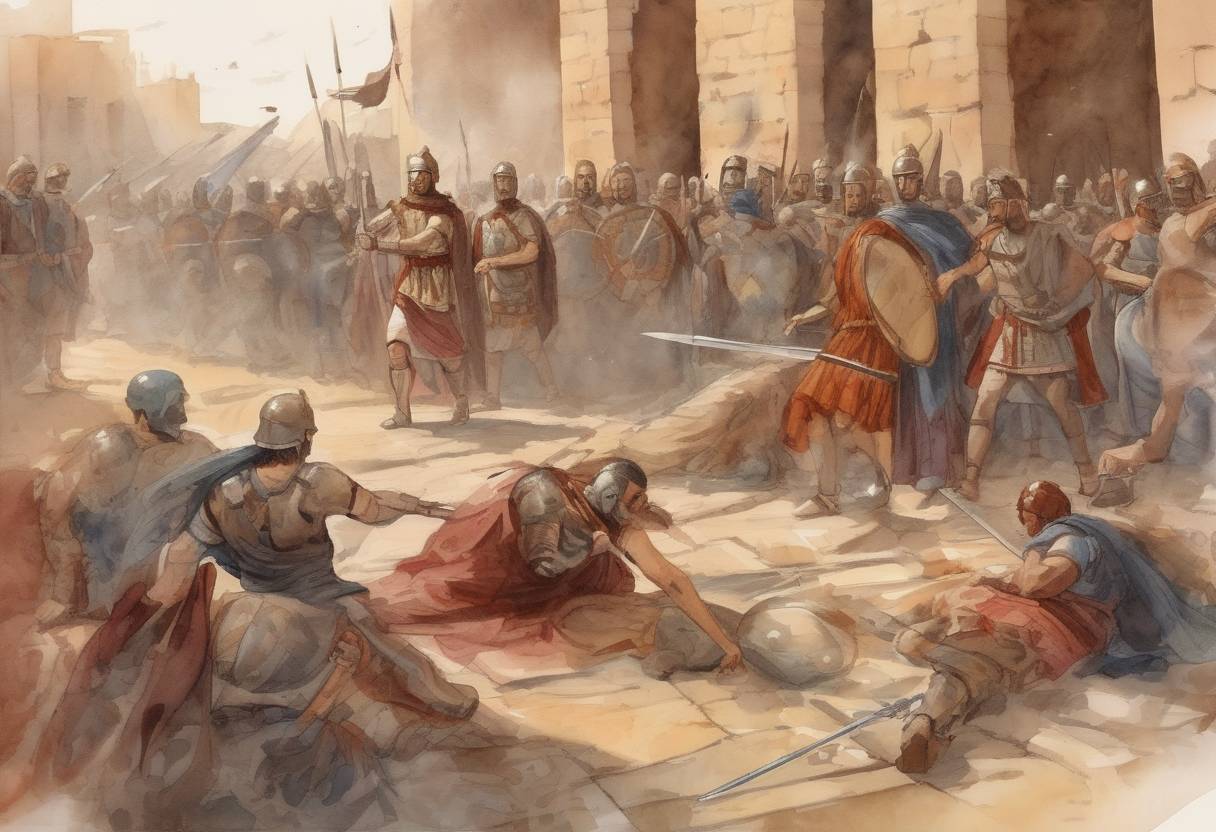
The Death of Emperor Julian the Apostate: May 29, 363
On May 29, 363, the Roman Emperor Julian, often referred to as Julian the Apostate, was mortally wounded during the Battle of Samarra against the Sassanid Empire. This event marked a significant turning point in Roman history, as it effectively ended the last major attempt to restore paganism within the Roman Empire.
Background
Julian, born in 331 or 332, was a member of the Constantinian dynasty. He rose to power after the death of his cousin, Emperor Constantius II, in 361. Unlike his predecessors, Julian was a staunch advocate of paganism and sought to revive traditional Roman religious practices, which had been increasingly supplanted by Christianity since the reign of Constantine the Great.
Julian’s efforts to restore paganism included reopening pagan temples, revoking the privileges of Christian clergy, and promoting Neoplatonism. His policies earned him the epithet “the Apostate” from Christian historians, as he was seen as a renegade from the Christian faith.
The Persian Campaign
In 363, Julian embarked on a military campaign against the Sassanid Empire, which was then ruled by Shapur II. The campaign was part of a broader strategy to secure the eastern borders of the Roman Empire and to assert Roman dominance over the Sassanids.
Julian’s forces initially achieved some success, capturing several key cities and advancing deep into Persian territory. However, the campaign soon faced logistical challenges, including supply shortages and the harsh desert environment.
The Battle of Samarra
The decisive moment came during the Battle of Samarra, near the city of Ctesiphon, the Sassanid capital. On May 29, 363, during a skirmish with Persian forces, Julian was struck by a spear, which inflicted a mortal wound. The exact circumstances of his injury remain unclear, with some accounts suggesting he was struck by a Persian soldier, while others speculate it might have been an accident or even an act of treachery from within his ranks.
Julian succumbed to his injuries shortly after, dying at the age of 31. His death left the Roman army in a precarious position, and they were forced to negotiate a hasty retreat with the Persians.
Aftermath and Historical Significance
Julian’s death marked the end of the last significant attempt to restore paganism in the Roman Empire. His successor, Jovian, quickly abandoned Julian’s pagan revival policies and restored Christianity as the favored religion of the empire. Jovian also negotiated a peace treaty with the Sassanids, ceding several territories to secure the safe withdrawal of Roman forces.
The failure of Julian’s campaign and his subsequent death underscored the challenges of maintaining a vast empire with diverse religious and cultural identities. His reign, though brief, remains a fascinating chapter in Roman history, illustrating the complex interplay between religion, politics, and military ambition.
Julian’s legacy is a subject of considerable debate among historians, with some viewing him as a tragic figure who sought to preserve Roman traditions, while others see him as a misguided ruler whose policies were out of step with the changing religious landscape of the empire.