Capture of Kiev: September 19, 1941
1941 · Kiev, Ukraine
The German Army captured Kiev during Operation Barbarossa, resulting in a significant victory for Nazi Germany on the Eastern Front of World War II.
June 22, 1941
Operation Barbarossa, the code name for Nazi Germany's invasion of the Soviet Union during World War II, was launched, marking a significant escalation in the war.
Eastern Front, Soviet Union | Nazi Germany
Date: June 22, 1941
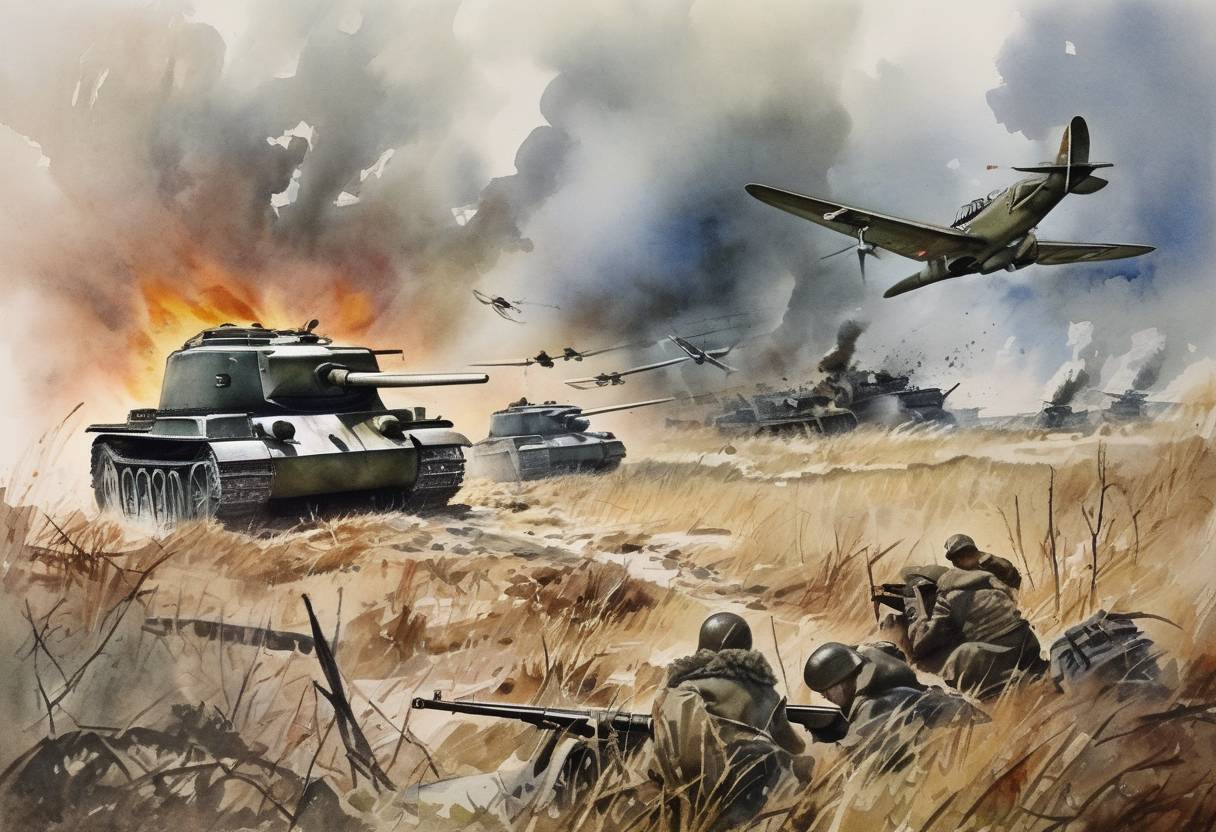
Operation Barbarossa was the code name for Nazi Germany’s invasion of the Soviet Union during World War II. This military campaign marked a pivotal escalation in the war, as it opened up the Eastern Front, which became the largest theater of war in history. The operation was named after Frederick Barbarossa, the medieval Holy Roman Emperor, symbolizing the ambition and scale of the undertaking.
Nazi-Soviet Pact: Prior to the invasion, Germany and the Soviet Union had signed the Molotov-Ribbentrop Pact in August 1939, a non-aggression treaty that also included secret protocols for the division of Eastern Europe. This pact allowed Germany to invade Poland without fear of Soviet intervention, leading to the outbreak of World War II.
Strategic Intentions: Adolf Hitler viewed the Soviet Union as a key ideological and territorial target. He aimed to destroy Soviet communism, acquire vast territories for German expansion (Lebensraum), and exploit the Soviet Union’s natural resources to fuel the Nazi war machine.
Forces Involved: Operation Barbarossa was the largest military operation in history in terms of manpower and casualties. Approximately 3 million Axis troops, including German, Finnish, Romanian, Hungarian, and Italian forces, were involved. They were supported by thousands of tanks, aircraft, and artillery pieces.
Initial Attack: The invasion began in the early hours of June 22, 1941, with a massive surprise attack along a front stretching from the Baltic Sea in the north to the Black Sea in the south. The Germans employed Blitzkrieg tactics, characterized by rapid and coordinated strikes using air and ground forces.
Soviet Unpreparedness: Despite intelligence warnings, the Soviet Union was caught off guard. Stalin had not anticipated an immediate German betrayal, and the Red Army was in the midst of reorganization and modernization, leaving it vulnerable to the initial onslaught.
Rapid Advances: In the first weeks, German forces made significant advances, capturing vast territories and encircling large numbers of Soviet troops. Cities such as Minsk and Smolensk fell quickly, and the Germans approached the gates of Leningrad and Moscow.
Soviet Resistance: Despite initial setbacks, the Soviet Union began to mount a fierce resistance. The vast distances, logistical challenges, and harsh weather conditions began to slow the German advance.
Battle of Moscow: By December 1941, the German advance on Moscow stalled due to stiff Soviet defense and the onset of the brutal Russian winter. The Soviet counteroffensive, launched in December, marked the first major setback for the Wehrmacht.
Prolonged Conflict: Operation Barbarossa failed to achieve its primary objective of a quick victory over the Soviet Union. Instead, it led to a prolonged and brutal conflict on the Eastern Front, which became a war of attrition.
Turning Point: The failure of Operation Barbarossa marked a turning point in World War II. It drained German resources and opened up a two-front war, which ultimately contributed to the downfall of Nazi Germany.
Human Cost: The invasion resulted in immense human suffering and loss of life. Millions of soldiers and civilians perished, and the Eastern Front became synonymous with some of the war’s most horrific atrocities.
Operation Barbarossa is considered one of the most significant military campaigns in history. It reshaped the course of World War II, leading to the eventual defeat of Nazi Germany and the emergence of the Soviet Union as a superpower in the post-war world. The operation’s failure underscored the dangers of underestimating an opponent and the complexities of waging war on multiple fronts.
Source: en.wikipedia.org