Excommunication of King Henry VIII by Pope Paul III on December 17, 1538
1538 · Rome, Papal States
Pope Paul III excommunicated King Henry VIII of England.
October 11, 1521
Pope Leo X conferred the title 'Defender of the Faith' on King Henry VIII of England for his defense of the seven sacraments against Martin Luther.
Rome, Italy | Catholic Church
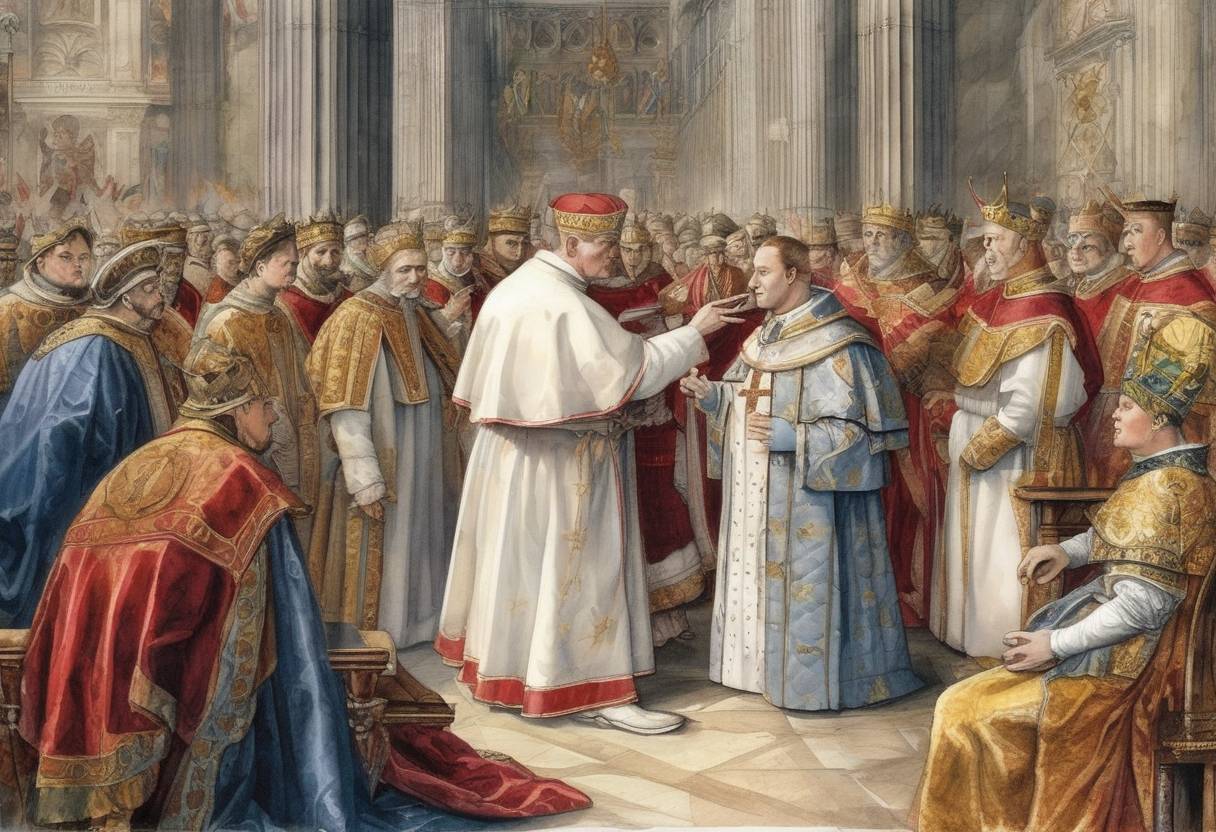
On October 11, 1521, Pope Leo X bestowed the title “Defender of the Faith” (Latin: Fidei Defensor) upon King Henry VIII of England. This significant event was a recognition of Henry’s staunch support for the Catholic Church amidst the burgeoning Protestant Reformation.
The early 16th century was a period of religious upheaval in Europe, marked by the rise of Protestantism. Martin Luther, a German monk, had initiated the Reformation in 1517 by nailing his Ninety-Five Theses to the door of the Wittenberg Castle Church, challenging the Catholic Church’s practices and doctrines, particularly the sale of indulgences.
In response to the growing influence of Lutheran ideas, King Henry VIII, a devout Catholic at the time, authored a treatise titled Assertio Septem Sacramentorum (Defense of the Seven Sacraments). This work was a direct rebuttal to Luther’s criticisms and defended the sacramental theology of the Catholic Church.
Impressed by Henry’s theological defense and his loyalty to the papacy, Pope Leo X conferred the title “Defender of the Faith” on the English monarch. The title was meant to honor Henry’s efforts to uphold Catholic doctrine and to counteract the spread of Protestantism.
The papal bull granting this title praised Henry’s intellectual and spiritual contributions, highlighting his role as a protector of the Church’s teachings. The title “Defender of the Faith” was intended to signify Henry’s commitment to maintaining the unity and orthodoxy of the Catholic Church.
Ironically, within a decade, Henry VIII’s relationship with the papacy would dramatically change. His desire to annul his marriage to Catherine of Aragon, which the Pope refused to sanction, led to England’s break with the Catholic Church and the establishment of the Church of England. Despite this schism, English monarchs have retained the title “Defender of the Faith” to this day, though its meaning has evolved over time.
The conferment of this title is a poignant reminder of the complex interplay between religion and politics during the Reformation. It underscores the shifting allegiances and the profound impact of religious reform movements on European history.
In summary, the event of October 11, 1521, highlights a moment when King Henry VIII was celebrated as a champion of Catholicism, a role that would soon be overshadowed by his pivotal part in the English Reformation.
Source: en.wikipedia.org