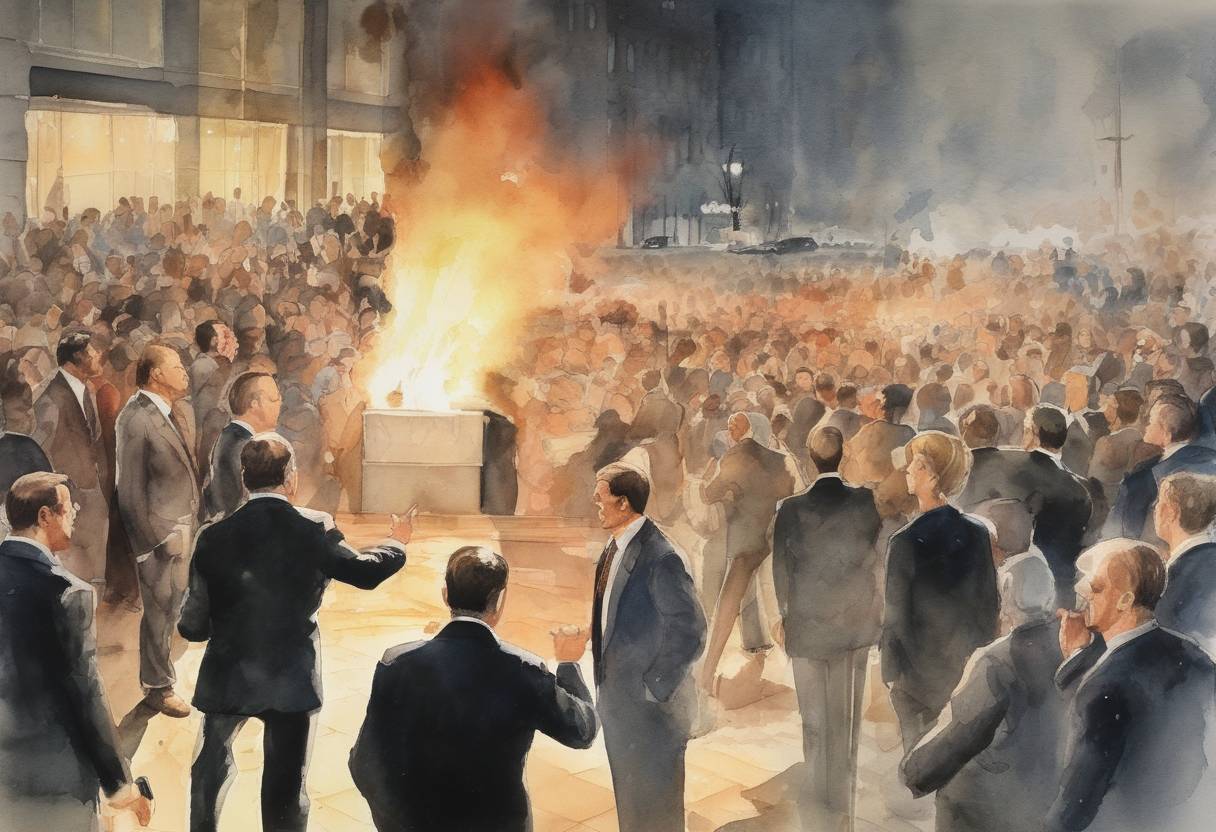
The Saturday Night Massacre: October 20, 1973
The Saturday Night Massacre was a pivotal event in the Watergate scandal, which ultimately led to the resignation of U.S. President Richard Nixon. This dramatic episode unfolded on October 20, 1973, and involved a series of high-profile resignations and firings within the U.S. Department of Justice.
Background
The Watergate scandal began with a break-in at the Democratic National Committee headquarters at the Watergate office complex in Washington, D.C., on June 17, 1972. The subsequent investigation revealed a web of political espionage and sabotage orchestrated by members of Nixon’s administration. As the scandal unfolded, it became clear that there was an attempt to cover up the administration’s involvement.
In May 1973, Archibald Cox was appointed as the special prosecutor to investigate the Watergate scandal. Cox’s investigation soon zeroed in on the existence of tape recordings of conversations in the Oval Office, which were believed to contain evidence of Nixon’s involvement in the cover-up.
The Events of October 20, 1973
Archibald Cox’s Subpoena: Cox issued a subpoena for the tapes, which Nixon refused to release, citing executive privilege. The standoff escalated when a federal court ordered Nixon to comply with the subpoena.
Nixon’s Orders: In an attempt to remove Cox and halt the investigation, Nixon ordered Attorney General Elliot Richardson to fire Cox. Richardson, who had promised Congress that Cox would only be dismissed for cause, refused to comply and resigned in protest.
Deputy Attorney General’s Resignation: Following Richardson’s resignation, Nixon directed Deputy Attorney General William Ruckelshaus to fire Cox. Ruckelshaus also refused and resigned.
Robert Bork’s Role: Solicitor General Robert Bork, who was third in line at the Justice Department, was then ordered to dismiss Cox. Bork complied with Nixon’s directive and fired Cox, later stating that he believed it was his duty to follow the President’s orders.
Aftermath and Significance
The Saturday Night Massacre had immediate and far-reaching consequences:
Public Outcry: The events triggered a massive public outcry and intensified calls for Nixon’s impeachment. Many Americans viewed the firings as an abuse of presidential power.
Judicial and Legislative Response: The incident led to a surge in support for the impeachment process in Congress. Additionally, the judiciary continued to press for the release of the tapes.
Appointment of a New Special Prosecutor: In response to the backlash, Nixon agreed to appoint a new special prosecutor, Leon Jaworski, who continued the investigation.
Nixon’s Resignation: The relentless pursuit of the truth by the special prosecutors and the mounting evidence of wrongdoing eventually led to Nixon’s resignation on August 8, 1974, making him the first U.S. president to resign from office.
The Saturday Night Massacre is often cited as a critical moment in the Watergate scandal, highlighting the importance of checks and balances in the U.S. government and the rule of law. It underscored the resilience of democratic institutions in the face of executive overreach.