1836 · San Antonio, Republic of Texas
The Battle of the Alamo Mission in San Antonio began on October 25, 1836, marking the start of this pivotal conflict in Texas' fight for independence from Mexico.
October 3, 1835
The Siege of San Antonio begins as part of the Texas Revolution, where Texan settlers start a campaign against Mexican forces.
San Antonio, Mexico | Texan settlers
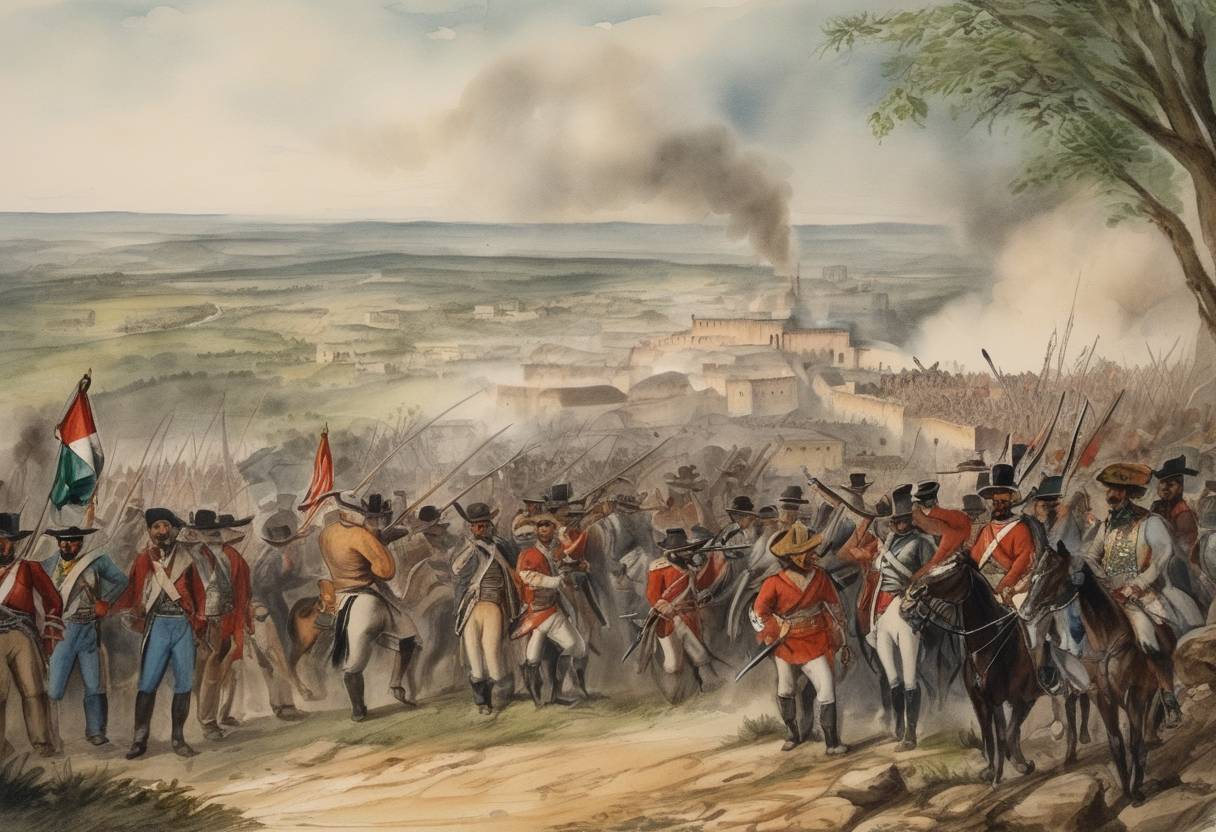
On October 3, 1835, the Siege of San Antonio, also known as the Siege of Bexar, commenced as a pivotal early confrontation in the Texas Revolution. This campaign marked the efforts of Texan settlers, or Texians as they were also known, to achieve independence from Mexican rule, culminating in a significant moment of armed resistance against Mexican forces.
Prior to the siege, tensions between Anglo settlers in Texas and the Mexican government had been escalating for several years. The laws imposed by the Mexican Centralist government, particularly the Law of April 6, 1830, which curtailed immigration from the United States and imposed customs duties, were perceived as oppressive by the settlers. The Texian defiance was further inflamed by the distant and authoritarian nature of the Mexican government under President Antonio López de Santa Anna.
The catalyst for the siege was an earlier confrontation, the Battle of Gonzales, on October 2, 1835, where Texians repelled Mexican soldiers attempting to seize a cannon. This skirmish effectively marked the beginning of the Texas Revolution. The following day, on October 3, a larger contingent of Texian volunteers congregated and launched a campaign targeting San Antonio de Béxar, an important military and administrative center in Texas, under Mexican General Martín Perfecto de Cos.
The Texians, commanded by Stephen F. Austin, laid siege to San Antonio de Béxar as part of their broader strategy to press for Texas independence. The siege was characterized by a series of minor skirmishes and a blockade that aimed to cut off supplies and reinforcements to the Mexican garrison stationed within the town. The encirclement lasted several weeks, involving a slow buildup as more volunteers from various Texian settlements joined the ranks.
The prolonged siege culminated in the Battle of Bexar, leading to the eventual surrender of General Cos’s forces in December 1835. This victory significantly boosted the morale of the Texian forces and provided them control over all of Texas north of the Rio Grande, setting the stage for subsequent events in the Texas Revolution. The withdrawal of Mexican troops also emboldened the Texian push for independence, which was formally declared on March 2, 1836.
This protracted engagement proved pivotal in shaping the future of Texas, exemplifying the settlers’ resolve and foreshadowing the larger struggle that lay ahead, including the famed Battle of the Alamo in 1836.
Source: en.wikipedia.org