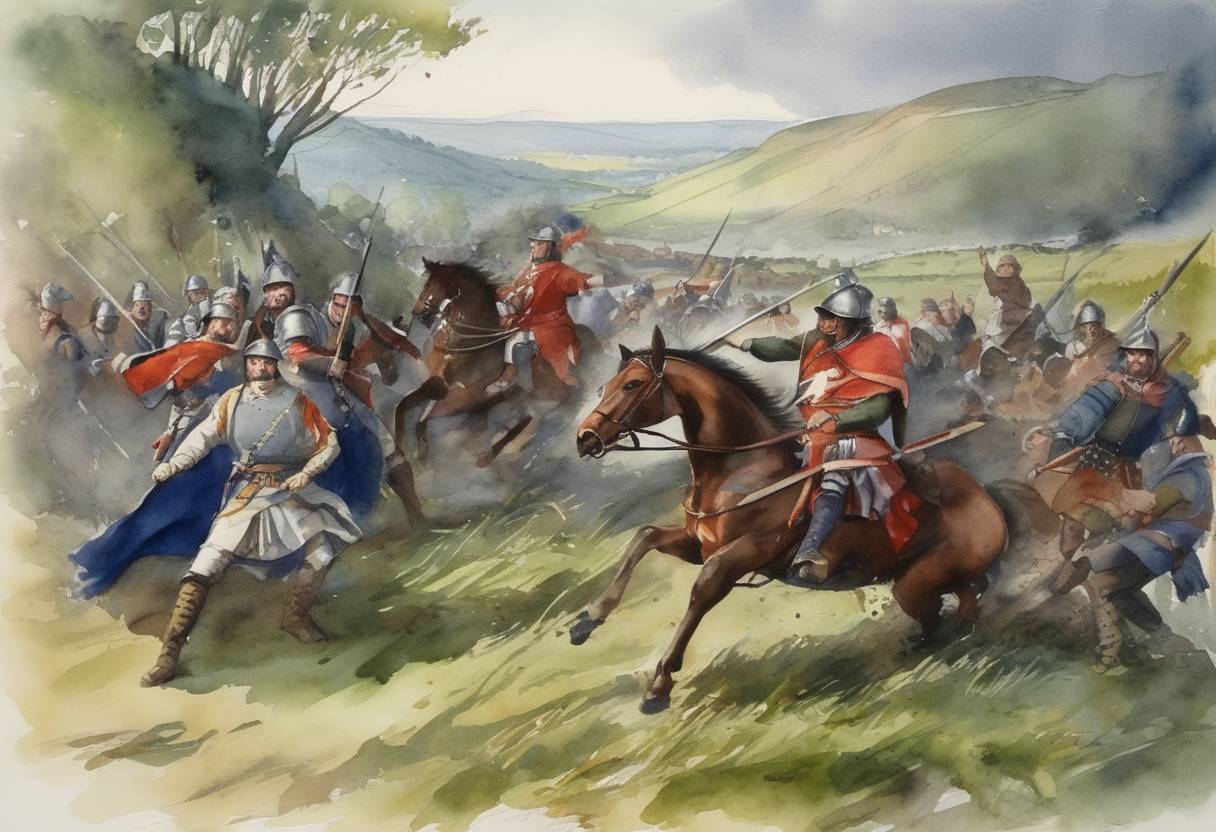
Death of Andrew Moray on 21 October 1297
Andrew Moray, a key leader in the Scottish resistance against English occupation, succumbed to wounds on 21 October 1297, sustained during the pivotal Battle of Stirling Bridge, part of the broader First War of Scottish Independence.
Background
Andrew Moray was born into a prominent Scottish noble family, becoming a significant military leader during the rebellion against English rule, which began after King Edward I of England’s aggressive expansion into Scotland. In 1296, Edward invaded Scotland to assert authority, thus igniting the First War of Scottish Independence.
The Battle of Stirling Bridge
On 11 September 1297, Moray co-led the Scottish forces alongside William Wallace at the Battle of Stirling Bridge. This engagement was a defining moment in Scottish history. The Scots, using the strategic advantage provided by the narrow Stirling Bridge, decisively defeated the larger and better-armed English forces. Moray’s tactical acumen was instrumental in the victory that invigorated the Scottish resistance.
Mortally Wounded
During the battle, Moray was gravely injured. Despite the victory, his wounds were severe, and over the following weeks, they led to his death on 21 October 1297. His passing was a significant loss for the Scottish cause, as his leadership and vision had inspired many to continue fighting for Scotland’s autonomy.
Aftermath and Significance
Moray’s role in the Battle of Stirling Bridge solidified his legacy as a national hero. This success galvanized Scottish forces, significantly boosting morale and proving that the English could be defeated. Moray’s partnership with William Wallace set a foundational chapter for the ongoing struggle for Scottish sovereignty, which would continue to resonate through subsequent generations and battles in the quest for independence.
Moray is remembered for his bravery and strategic mind, and his contributions laid crucial groundwork for the ongoing saga of resistance that characterized the Scottish Wars of Independence.