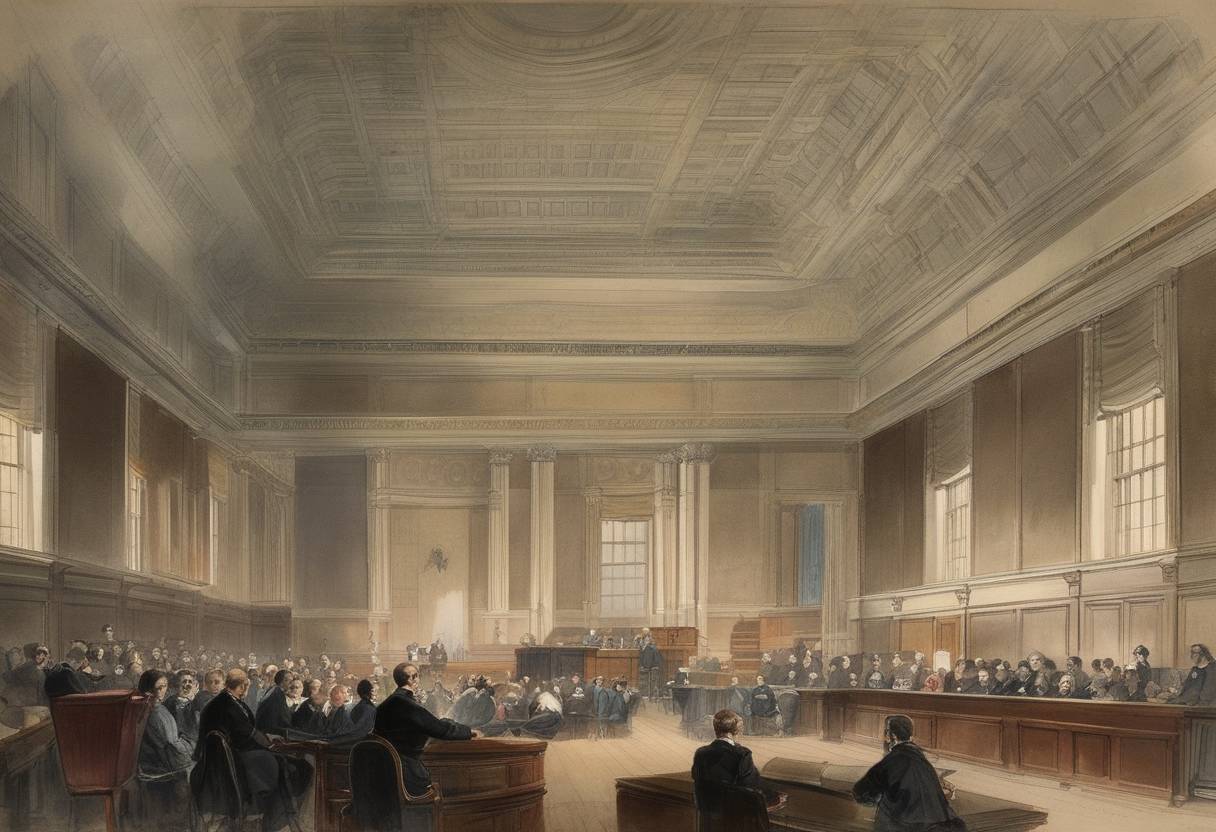
Roberts v. Boston: May 18, 1852
On May 18, 1852, the Massachusetts Supreme Judicial Court delivered its decision in the case of Roberts v. Boston, a pivotal ruling concerning the legality of racially segregated schools. The court upheld the practice of separation in public educational facilities within Boston, Massachusetts, effectively ruling that racially segregated schools were legal under state law.
Context
The case was brought forward by Benjamin F. Roberts on behalf of his daughter, Sarah C. Roberts, a five-year-old African American girl. Sarah had been denied entry to an all-white school close to their home based on her race, forcing her to attend an all-black school further away. Roberts argued that the segregated school system was inherently unequal and prejudicial against African American children.
Court’s Decision
Chief Justice Lemuel Shaw delivered the opinion of the court, stating that the segregated schools did not violate any rights under the Massachusetts state constitution. Shaw’s decision reflected the prevailing sentiment of the time, which assumed that racial segregation was a natural division that did not implicitly denote inferiority or harm.
Significance and Aftermath
The decision in Roberts v. Boston set a precedent that echoed in subsequent legal battles over racial segregation in the United States. It laid the groundwork for justifying segregation under the doctrine of “separate but equal,” a legal standard that would be enshrined nationally in the 1896 U.S. Supreme Court case Plessy v. Ferguson. In Plessy, the Court ruled that racial segregation in public facilities did not violate the Fourteenth Amendment, provided the facilities were equal.
Despite the ruling’s initial affirmation of segregationist policies, the case also sparked early civil rights activism. The ruling incited efforts to desegregate schools in Massachusetts, culminating in the passage of the first legislation in the United States to abolish segregated schools just five years later in 1855.
The Roberts v. Boston case remains a foundational legal reference for understanding the historical context of racial segregation in America and its eventual national repudiation in the mid-20th century with Brown v. Board of Education in 1954.