Battle of Pyongyang - September 17, 1894
1894 · Pyongyang, Korea
The Sino-Japanese War saw its first major land engagement at the Battle of Pyongyang, resulting in a decisive victory for Japanese forces over Qing China.
October 26, 1597
Admiral Yi Sun-sin defeats the Japanese in the Battle of Myeongnyang.
Myeongnyang Strait, Korea | Korean Navy
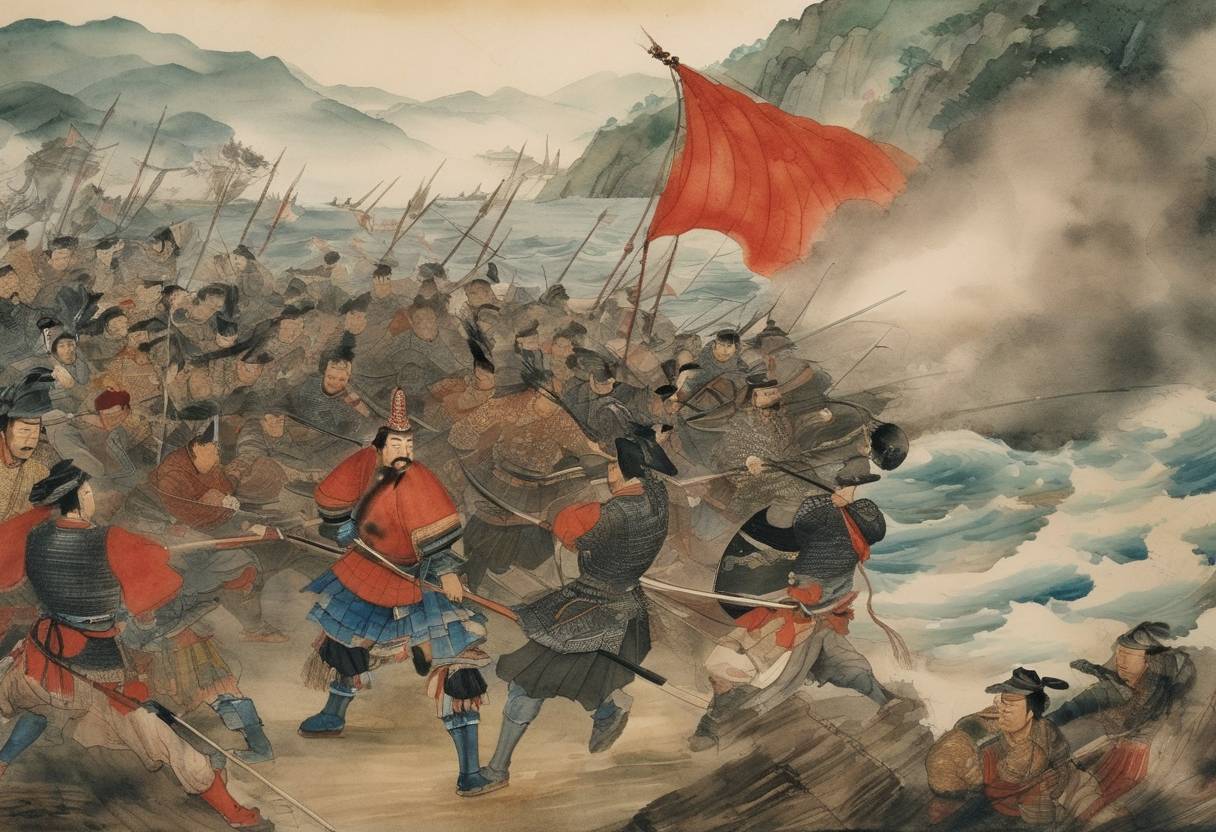
The Battle of Myeongnyang took place on October 26, 1597, during the Imjin War (1592-1598), which was part of the larger conflict known as the Japan-Korea War. The battle stands as one of the most remarkable naval engagements in history, primarily due to the tactical genius of Admiral Yi Sun-sin.
Following a series of Japanese invasions starting in 1592, Japan aimed to conquer the Korean Peninsula and use it as a staging area for further incursions into China. By 1597, Japan launched a second invasion, known as the Jeongyu War, and aimed their naval prowess towards dominating the seas, crucial for maintaining supply lines and troop movements.
Admiral Yi Sun-sin had been reinstated after being wrongfully imprisoned due to political machinations and was tasked with defending the Korean coast. Despite his reinstatement, Yi faced overwhelming odds. He commanded a severely outnumbered fleet, consisting of only 13 ships against the Japanese armada of over 130 warships.
The battlefield was the Myeongnyang Strait, a narrow waterway with notoriously strong and unpredictable currents. Admiral Yi, understanding the treacherous nature of the strait, chose it as the site of his defense due to its narrowness, which could neutralize the numerical superiority of the Japanese fleet.
On October 26, 1597, the Japanese fleet, confident of their dominance, advanced into the strait. Admiral Yi employed his intimate knowledge of the local sea conditions to outmaneuver the larger force. The Korean ships utilized the powerful tidal currents to their advantage, creating chaos among the Japanese vessels. Yi’s flagship, leading from the front, delivered crippling volleys against the enemy.
Against overwhelming odds, Admiral Yi’s fleet not only repelled the invaders but also inflicted significant casualties and damage, sinking or incapacitating over 30 Japanese ships. This victory at Myeongnyang was pivotal, as it safeguarded the remaining parts of Korea from seaborne assault and ensured the protection of critical supply routes.
The battle’s success fostered Korean morale, renewed the determination of Korean and Chinese forces, and cemented Admiral Yi Sun-sin’s legacy as one of the greatest naval commanders in history. The victory at Myeongnyang is remembered as a testament to strategic ingenuity and the ability of a smaller, resourceful force to repel a superior opponent through superior tactics and leadership.
Source: en.wikipedia.org