The Opening of the Liverpool and Manchester Railway: September 15, 1830
1830 · Liverpool, United Kingdom
The Liverpool and Manchester Railway, the world's first inter-city railway, opened.
June 26, 1819
The Savannah, a steamboat, became the first steam-powered ship to successfully cross the Atlantic Ocean, arriving in Liverpool, England. It sailed from Savannah, Georgia, marking a significant advancement in maritime technology.
Liverpool, England | Savannah Steamship Company
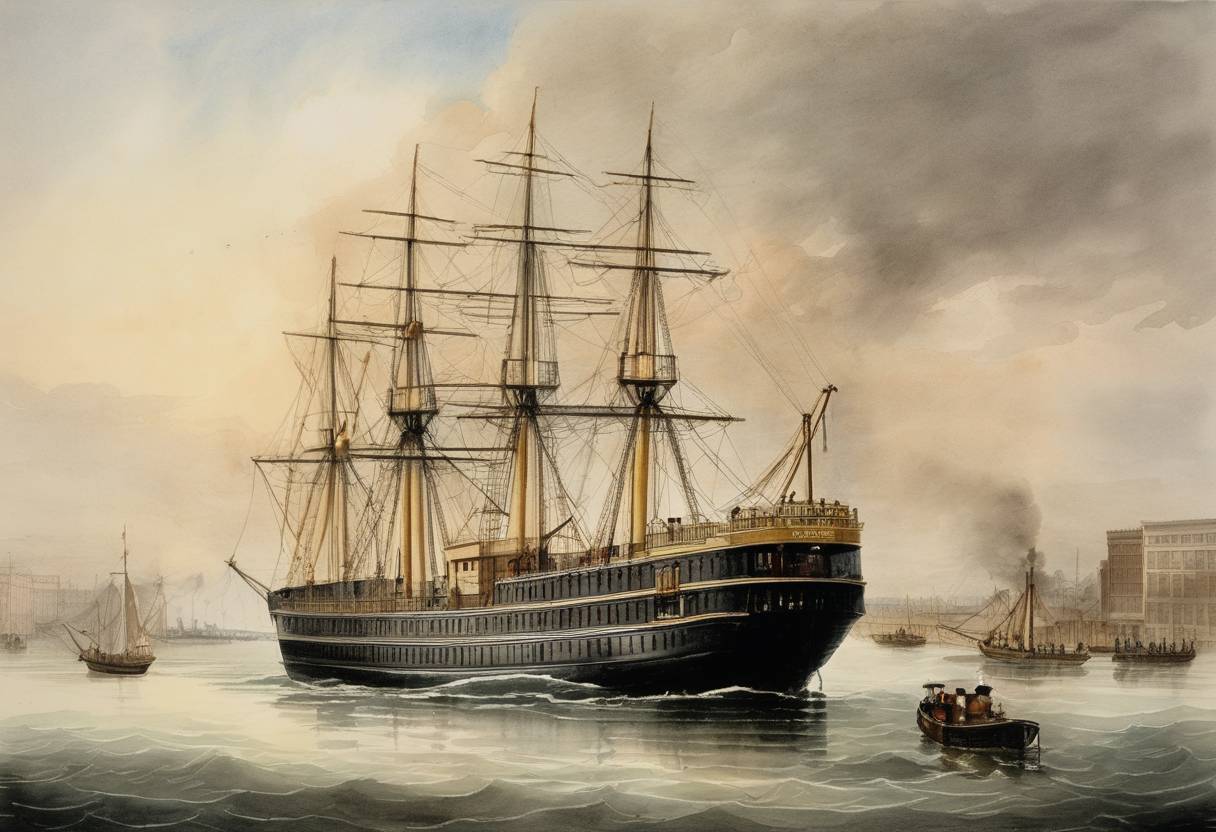
On June 20, 1819, the steamship SS Savannah completed a groundbreaking journey, becoming the first steam-powered vessel to cross the Atlantic Ocean. Arriving in Liverpool, England, from Savannah, Georgia, this remarkable feat marked a significant milestone in maritime history and the evolution of steam navigation.
The early 19th century was a period of substantial innovation in steam technology, particularly within the maritime industry. The SS Savannah was constructed in 1818 as a hybrid vessel, uniquely outfitted with both sails and steam power. Built in New York City by the shipbuilding firm Fickett & Crockett, she was a 320-ton vessel that was purchased and converted into a steamship by the Savannah Steamship Company in 1818. The propulsion system included a 90-horsepower steam engine, alongside a full set of sails for auxiliary use.
The SS Savannah set sail from her namesake city, Savannah, Georgia, on May 22, 1819, under the command of Captain Moses Rogers. The journey from Savannah to Liverpool covered approximately 3,000 miles, during which both steam and sail power were utilized. Despite heavy seas and technical challenges, including the need to stock a large amount of coal on an already cramped ship, the vessel reached Liverpool successfully in 29 days.
The successful crossing of the Atlantic by the SS Savannah demonstrated the potential for steam-powered ships to revolutionize sea travel. Although the vessel primarily relied on sails during much of the voyage due to coal limitations, it was the pioneering use of steam power that captured public interest. This crossing paved the way for future advancements in steamship technology, ultimately leading to the decline of sail-powered commerce in favor of more reliable and faster steam-driven vessels.
Despite her historic journey, the SS Savannah did not achieve commercial success and was soon converted back to a sailing ship before being wrecked off Long Island in 1821. Nonetheless, her voyage remains a pivotal moment in maritime history, underscoring the innovation and daring that defines the era. The SS Savannah’s legacy is preserved as a symbol of technological progress and the dawning age of steam power in marine navigation.
Source: www.historytoday.com