Panama's Independence from Colombia: November 3, 1903
1903 · Panama City, Panama
With the encouragement of the United States, Panama separates from Colombia and becomes an independent nation.
November 2, 1824
The first Congress of Panama, also known as the Amphictyonic Congress, is proposed by Simón Bolívar. This multilateral conference is intended to foster unity among the newly independent nations of Latin America.
Panama City, Panama | Gran Colombia
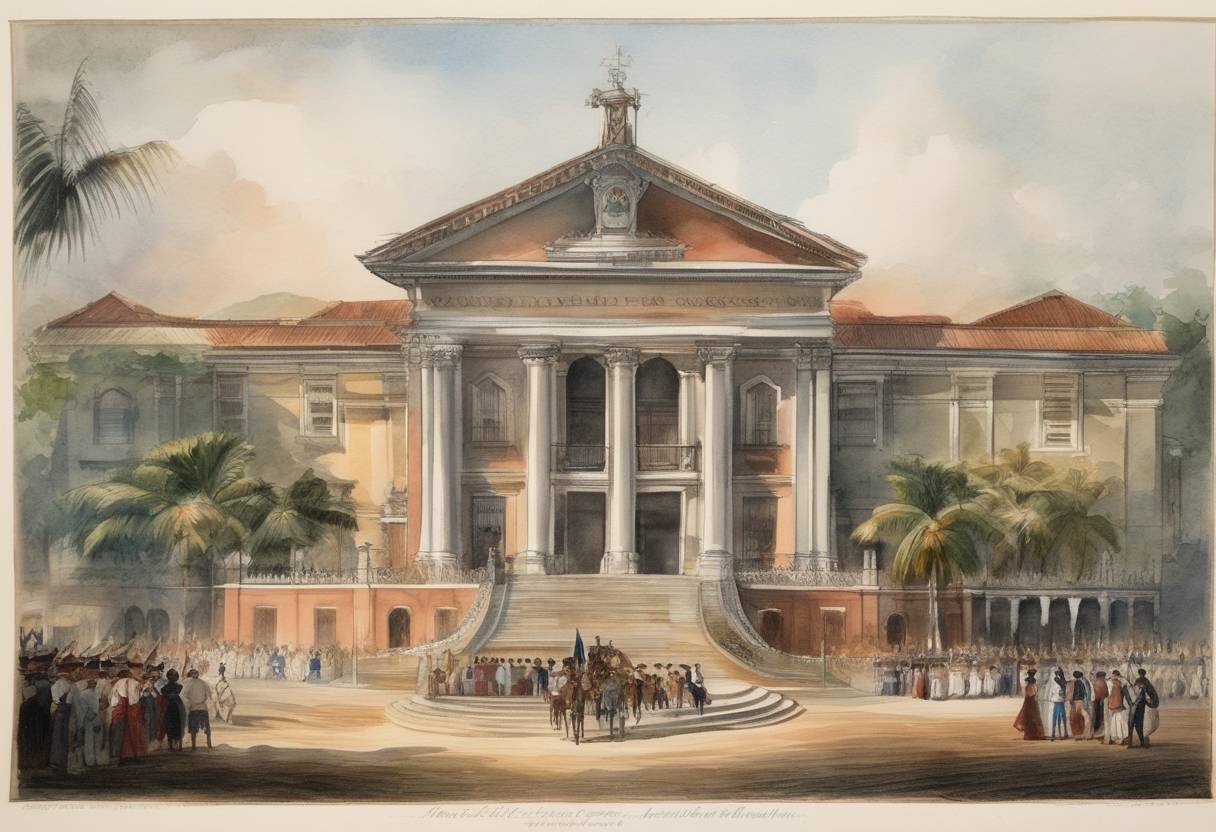
On November 2, 1824, Simón Bolívar, one of South America’s most renowned liberators, formally proposed a visionary diplomatic initiative known as the Congress of Panama, or the Amphictyonic Congress. This proposal aimed to gather the newly independent Latin American nations to foster unity and collective security among them. Bolívar’s initiative marked a significant step towards cooperation and solidarity in post-colonial Latin America.
During the early 19th century, many countries in Latin America were emerging from colonial rule, having successfully fought wars of independence against the Spanish Empire. However, these nascent states faced myriad challenges, including political instability, economic difficulties, internal conflicts, and the threat of re-colonization by European powers.
Simón Bolívar, often referred to as “El Libertador,” recognized the need for a unified approach to address these challenges. He believed that a confederation or congress of Latin American states would provide a platform to resolve disputes, coordinate defense strategies, and promote shared interests in the international arena.
Bolívar’s proposal for the Congress of Panama aimed to accomplish several key goals:
In a letter to the governments of the newly independent nations, Bolívar outlined his vision for the congress and emphasized the need for a unified approach to securing the sovereignty and progress of Latin America.
The Congress of Panama, which eventually convened in the following years, represented a pioneering attempt at regional integration in Latin America. Although the outcomes of the actual congress fell short of Bolívar’s grand vision due to various political and logistical challenges, the proposal itself was a groundbreaking step towards the idea of regional unity.
The concept of pan-Americanism, championed by Bolívar, paved the way for future regional organizations, such as the Organization of American States (OAS). Bolívar’s advocacy for unity and cooperation continues to resonate in contemporary Latin American political discourse.
Source: www.britannica.com