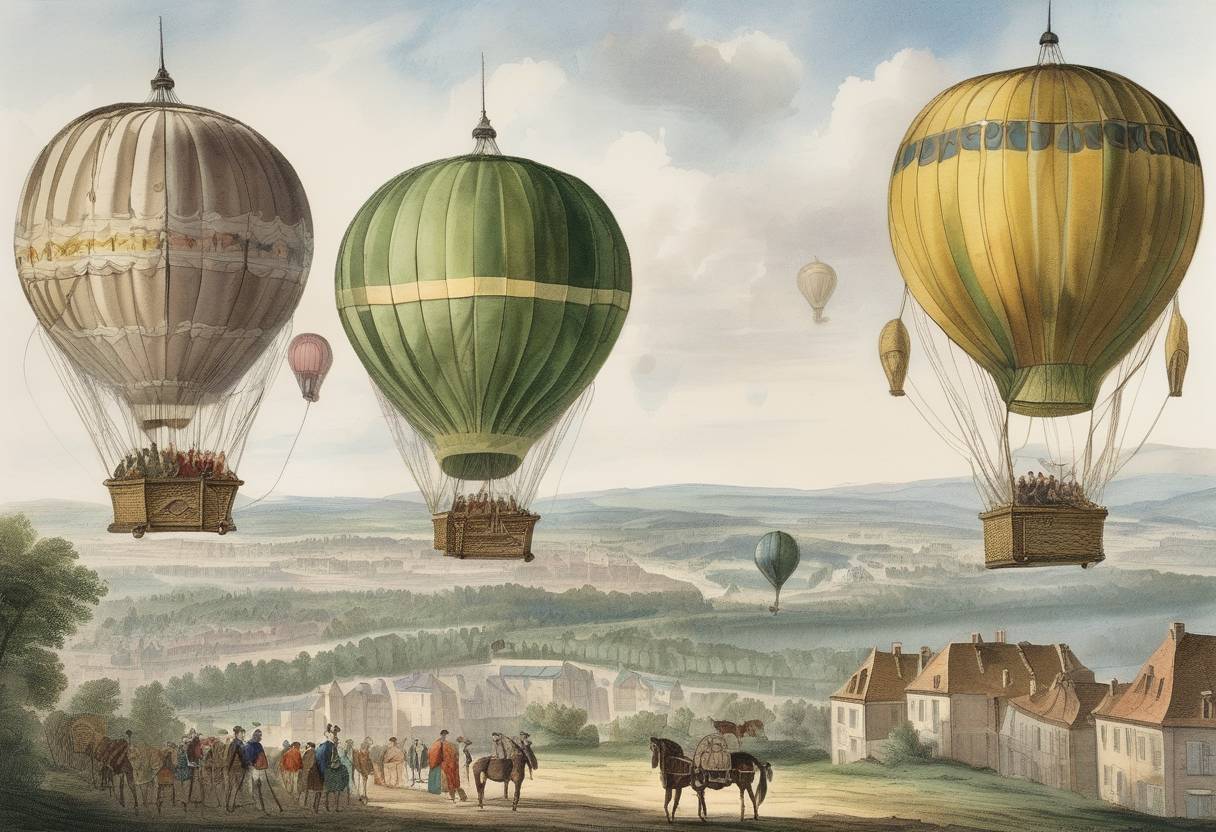
The Montgolfier Brothers’ Hot Air Balloon Demonstration
On June 4, 1783, the Montgolfier brothers, Joseph-Michel and Jacques-Étienne, conducted a public demonstration of their hot air balloon in Annonay, France. This event marked a pivotal moment in the history of aviation, showcasing the potential of human flight.
Background
The Montgolfier brothers were paper manufacturers from a family with a long tradition in the paper industry. Inspired by the principles of aerostatics, they began experimenting with lighter-than-air flight. Their interest was piqued by observing how smoke rose from a fire, leading them to theorize that heated air could lift a balloon.
The Demonstration
- Date and Location: June 4, 1783, in Annonay, a town near Lyon, France.
- The Balloon: The brothers constructed a large spherical balloon made of sackcloth lined with three layers of thin paper. The balloon measured approximately 33 feet (10 meters) in diameter.
- The Flight: During the demonstration, the balloon was filled with hot air from a fire, causing it to rise. It ascended to an estimated height of 5,200 to 6,600 feet (1,600 to 2,000 meters) and traveled for about 1.2 miles (2 kilometers) before safely descending after approximately 10 minutes.
Significance
The successful flight of the Montgolfier brothers’ balloon was a groundbreaking achievement in the field of aviation. It demonstrated the feasibility of using hot air to achieve lift, paving the way for future developments in ballooning and aeronautics.
Aftermath and Legacy
- Further Developments: Following the Annonay demonstration, the Montgolfier brothers continued to refine their designs. In September 1783, they conducted another significant flight in Paris, which included a sheep, a duck, and a rooster as passengers.
- Human Flight: The first manned flight in a Montgolfier balloon occurred on November 21, 1783, when Jean-François Pilâtre de Rozier and François Laurent d’Arlandes ascended over Paris.
- Impact on Aviation: The Montgolfier brothers’ experiments inspired further exploration into human flight, contributing to the eventual development of powered flight technologies.
The Montgolfier brothers’ demonstration in 1783 remains a celebrated milestone in aviation history, symbolizing human ingenuity and the enduring quest to conquer the skies.