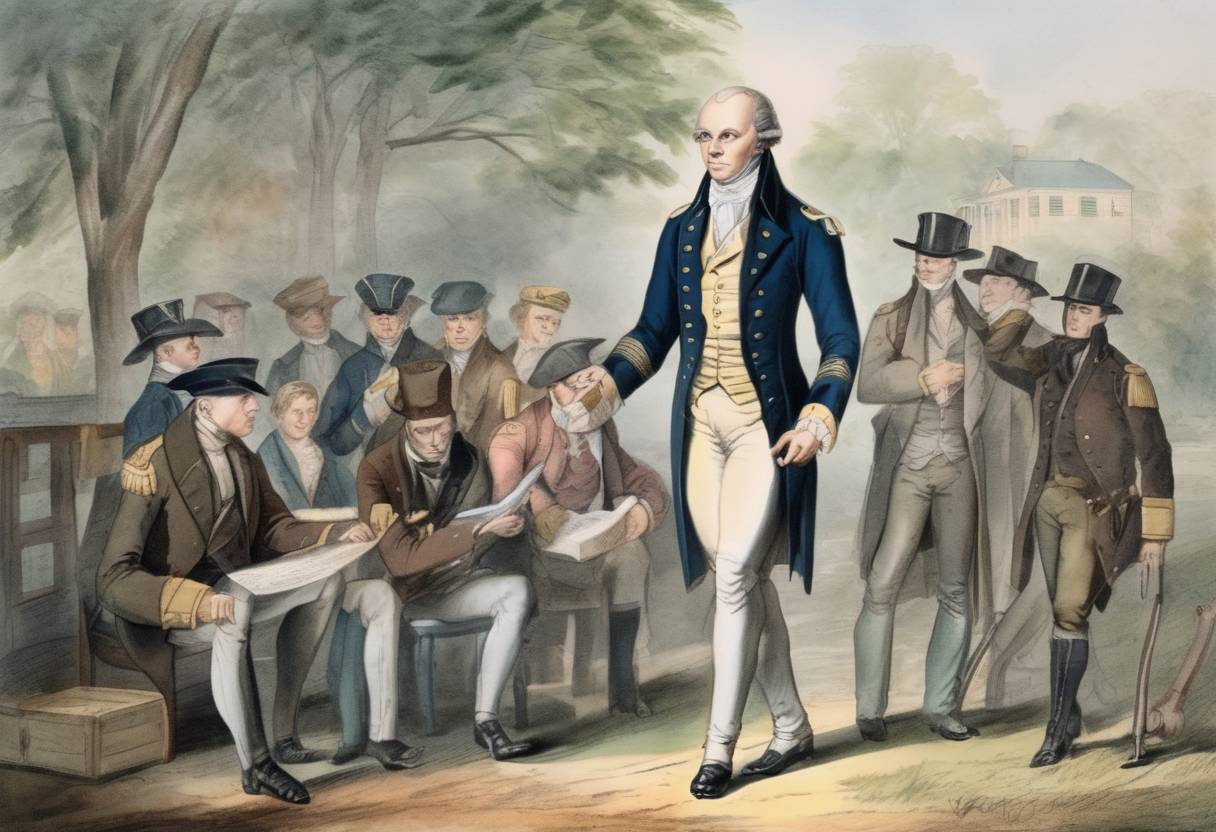
Arrest of Aaron Burr for Treason
On February 19, 1807, former U.S. Vice President Aaron Burr was arrested for treason in Wakefield, Alabama, and subsequently confined to Fort Stoddert. This event marked a significant moment in early American history, reflecting the young nation’s challenges in maintaining unity and addressing internal threats.
Background
Aaron Burr, who served as the third Vice President of the United States under President Thomas Jefferson from 1801 to 1805, became a controversial figure following his infamous duel with Alexander Hamilton in 1804, which resulted in Hamilton’s death. After his vice presidency, Burr’s political career was effectively over, and he turned his attention to more ambitious and, ultimately, dubious plans.
The Alleged Conspiracy
Burr’s arrest stemmed from his alleged involvement in a conspiracy to create an independent nation in the center of North America, which would include parts of the Louisiana Territory and Spanish territories in Mexico. Burr’s intentions remain a subject of historical debate, but it is clear that he sought to exploit the political and territorial uncertainties of the time.
Burr gathered a group of followers and secured financial backing, leading to suspicions of his intentions. His activities caught the attention of President Jefferson, who issued a proclamation in 1806 warning citizens against participating in Burr’s schemes.
Arrest and Confinement
Burr’s movements were closely monitored, and he was eventually apprehended near Wakefield, Alabama, by U.S. military forces. He was taken to Fort Stoddert, a military post on the Mobile River, where he was held under guard.
Trial and Aftermath
Burr was transported to Richmond, Virginia, to stand trial for treason. The trial, presided over by Chief Justice John Marshall, became one of the most high-profile cases in early American history. Despite the seriousness of the charges, Burr was acquitted due to a lack of concrete evidence that he had committed an overt act of treason, as required by the Constitution.
The trial had significant implications for the interpretation of treason in the United States, emphasizing the need for clear evidence of an overt act. Burr’s acquittal, however, did not restore his reputation, and he lived the remainder of his life in relative obscurity.
Historical Significance
The arrest and trial of Aaron Burr highlighted the fragility of the early United States and the challenges it faced in maintaining national unity. It also underscored the complexities of interpreting constitutional law in the young republic. Burr’s case remains a pivotal moment in the history of American jurisprudence and political intrigue.