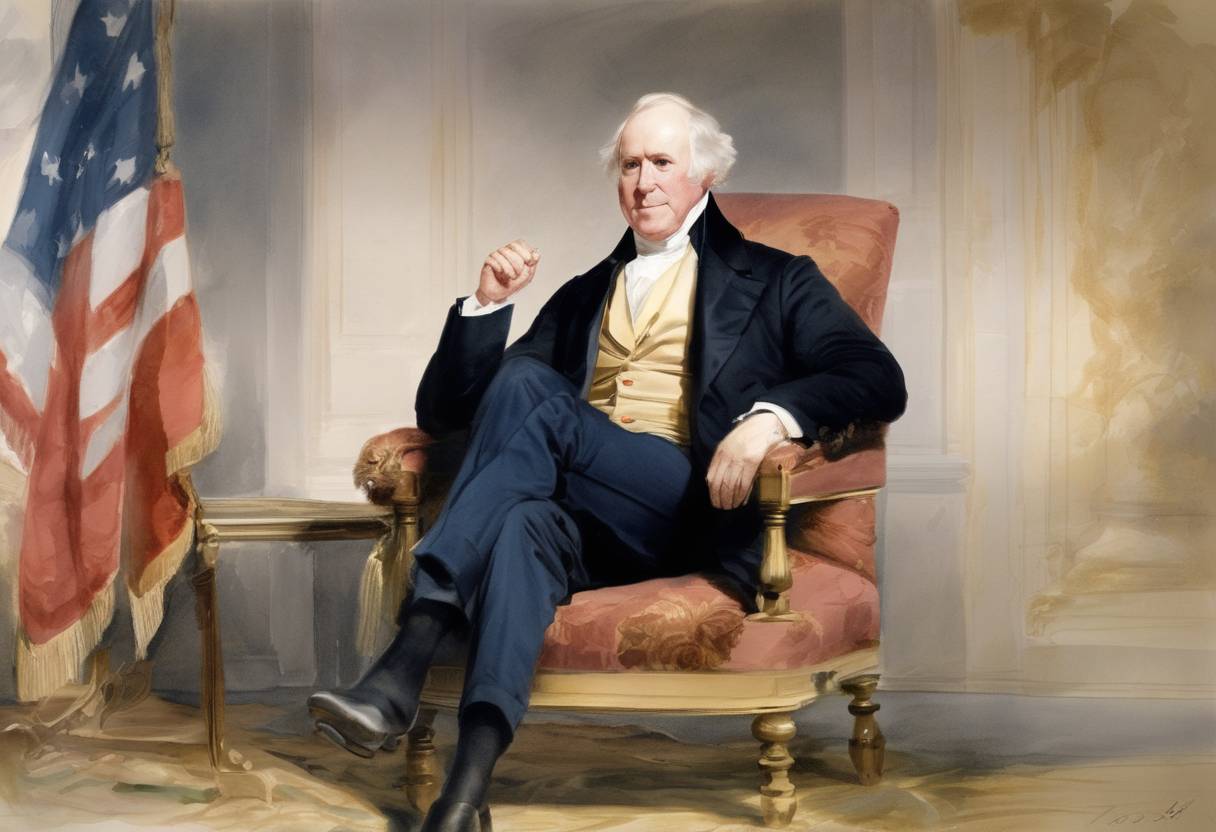
Richard Mentor Johnson’s Election as Vice President
On February 8, 1837, Richard Mentor Johnson was elected Vice President of the United States by the U.S. Senate, an event that holds significance due to its unique execution under the Twelfth Amendment to the U.S. Constitution. This amendment, ratified in 1804, outlines the electoral procedures for president and vice president, specifically detailing that if no vice presidential candidate wins a majority of electoral votes, the Senate chooses the winner from the top two candidates.
Context Leading to the Election
The presidential election of 1836 saw Martin Van Buren running as the Democratic candidate, with the seasoned politician Richard Mentor Johnson as his running mate. However, within the Electoral College, while Van Buren secured an outright majority for the presidency, Johnson did not achieve the requisite majority of electoral votes for vice president.
Johnson’s candidacy was contested, primarily because he was a controversial figure, partly due to his personal life. His longstanding relationship with Julia Chinn, an enslaved woman, and his mixed-race children were factors that contributed to some Southern electors withholding their votes.
The Senate’s Decision
With the Electoral College stalemated on the vice presidency, the selection moved to the Senate, as prescribed by the Twelfth Amendment. This was a rare invocation of the amendment, underscoring the framers’ foresight in anticipating electoral deadlocks. On February 8, 1837, the Senate convened and elected Richard Mentor Johnson as vice president. He was chosen by a simple majority, in keeping with the amendment’s outlined procedure.
Significance and Aftermath
Johnson’s vice-presidency is historically notable for being the only instance where the Senate has exercised its Twelfth Amendment power to elect a vice president. His term, which lasted from 1837 to 1841 under President Martin Van Buren, was marked by limited influence and growing tensions within the Democratic Party.
His vice-presidency was not successful in addressing factional disputes within the party, and in the presidential election of 1840, the Van Buren-Johnson ticket was defeated by the Whig candidates, William Henry Harrison and John Tyler. Johnson’s unique path to the vice presidency, however, remains a constitutional curiosity and a testament to the intricacies of the United States’ electoral process.