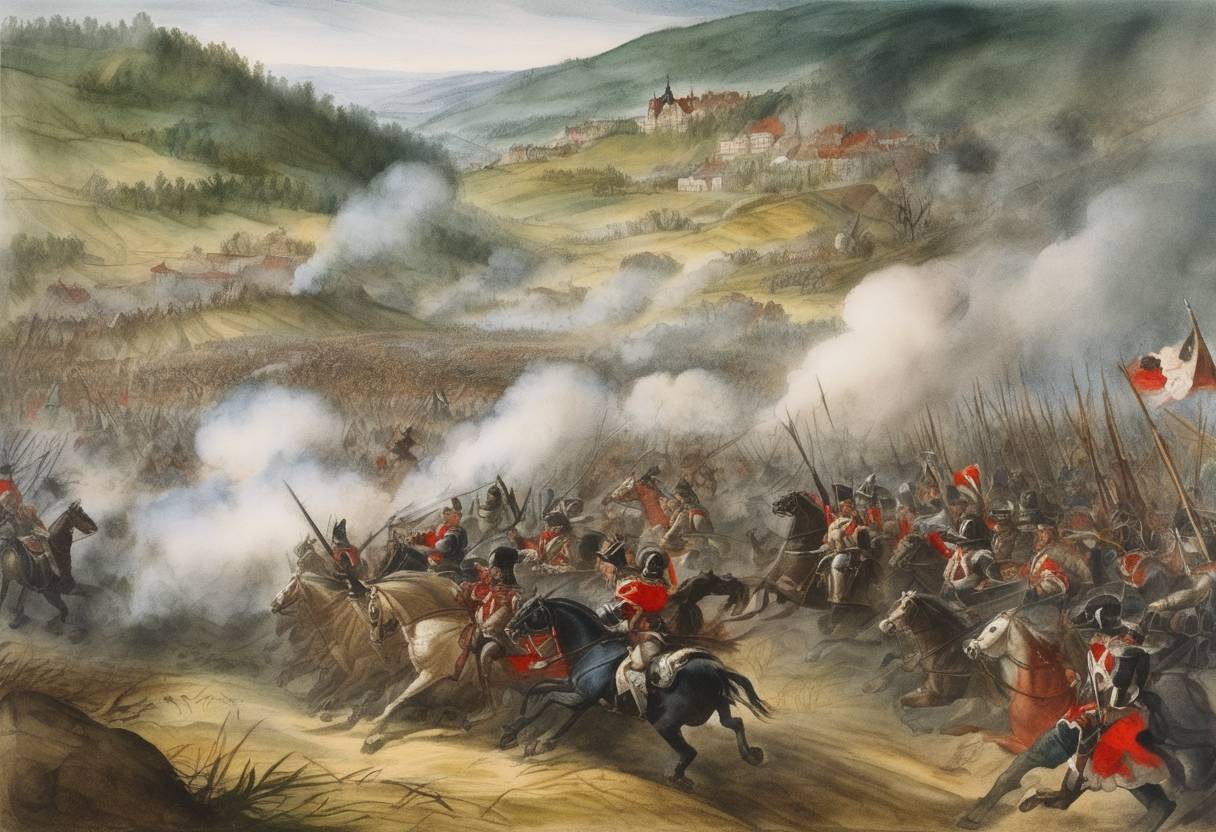
The Battle of White Mountain: November 8, 1620
On November 8, 1620, the Battle of White Mountain was fought near Prague, marking a pivotal moment in the early stages of the Thirty Years’ War. This significant battle resulted in a decisive victory for the Catholic forces of the Holy Roman Emperor Ferdinand II, which was instrumental in ending Protestant rule in Bohemia.
Context and Prelude
The Thirty Years’ War, which began in 1618, was a complicated conflict involving many European states, driven by religious, political, and territorial disputes. The immediate cause of the war was the Bohemian Revolt, which began when Protestant noblemen threw two Catholic officials out of a window in Prague’s Hradčany Castle—a defenestration that symbolized the deep-seated religious and political tensions within the Holy Roman Empire.
Frederick V, a Calvinist who was elector of the Palatinate, was elected by the Bohemian Estates to be the king of Bohemia after they deposed the Catholic Habsburg king, Ferdinand II. However, the Protestant forces were fractured, lacking both the financial and military support necessary for sustained resistance against the Habsburgs.
The Battle
The Battle of White Mountain took place just outside Prague on the distinctive flat-topped hill known as Bílá Hora (White Mountain). The Catholic army, led by the skilled Count Johan Tilly and the Spanish General Don Anthonio de Zúñiga, fielded approximately 25,000 well-equipped troops, while the Protestant forces, under Christian of Anhalt and Ernst von Mansfeld, stood at around 15,000 men.
The battle itself was short but brutal. The Catholic forces held superior tactical positions and executed an aggressive and decisive charge against the Protestant lines. The Protestant army was not only outnumbered but also disorganized. By late morning, the battle was over, lasting around two hours. The Protestant forces were thoroughly defeated, suffering heavy casualties, and their retreat was chaotic.
Aftermath and Consequences
The victory at White Mountain had profound implications. It essentially marked the collapse of the Bohemian resistance against the Habsburgs and led to the reassertion of Catholic dominance in Bohemia. Frederick V, disparagingly nicknamed the “Winter King” for his short reign, was forced into exile. The Imperial forces conducted a vigorous campaign to re-Catholicize the Bohemian lands, leading to significant changes in religious and political power structures.
This battle also solidified Ferdinand II’s position within the Holy Roman Empire, enabling him to consolidate power and clamp down on Protestant uprisings within his domains. The battle’s outcome further polarized the European powers, making the conflict more sectarian and setting the stage for prolonged and widespread warfare throughout Europe.
The Battle of White Mountain ultimately underscored the significance of military cohesion and resource availability in early modern warfare and illustrated the complex interplay of religious and political interests that would shape European history for decades.