The Battle of Neville's Cross: October 17, 1346
1346 · Durham, England
The Battle of Neville's Cross took place, where English forces defeated the Scots, capturing King David II of Scotland.
July 4, 1333
The Battle of Halidon Hill took place, marking a significant encounter during the Second War of Scottish Independence. The English forces, led by King Edward III, decisively defeated the Scots under Sir Archibald Douglas.
Berwick-upon-Tweed, Kingdom of England | English Army
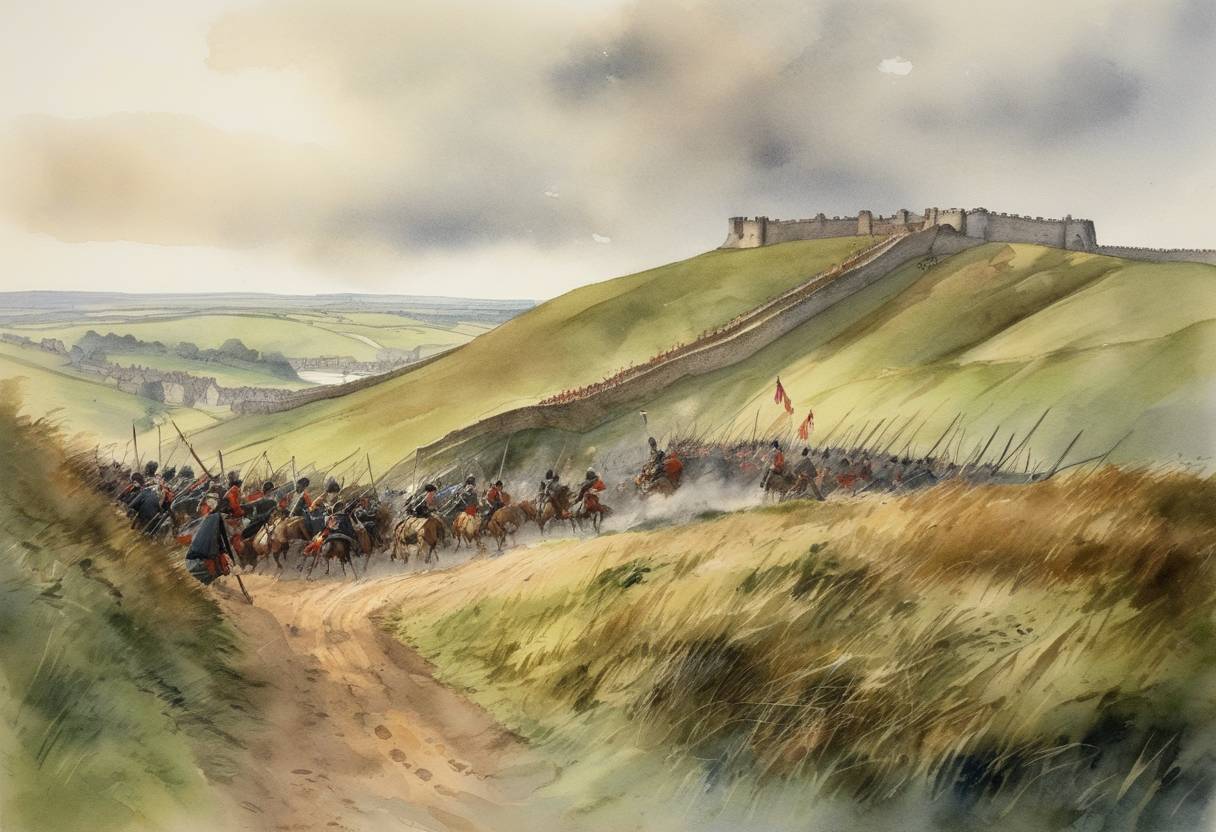
The Battle of Halidon Hill occurred on July 4, 1333, during the Second War of Scottish Independence, marking a defining encounter between English and Scottish forces. The conflict saw the English army, commanded by King Edward III, deliver a crushing defeat to the Scottish troops led by Sir Archibald Douglas.
The battle was part of the ongoing Second War of Scottish Independence, a conflict that arose following the First War of Scottish Independence. After the Treaty of Edinburgh-Northampton in 1328, which recognized Robert the Bruce’s son David II as the king of an independent Scotland, political turmoil and competing claims triggered renewed hostilities between England and Scotland. Edward Balliol, son of the former King John Balliol, challenged David II’s rule, leading to a series of confrontations.
In 1333, Edward III sought to assert English authority and support Balliol’s claim to the Scottish throne. The siege of Berwick by the English in March 1333 precipitated the major engagements culminating in the Battle of Halidon Hill.
The battle took place near the town of Berwick-upon-Tweed. The English forces strategically positioned themselves on the elevated ground of Halidon Hill, providing a tactical advantage. The Scots needed to break through English lines to relieve the besieged town of Berwick.
As the Scots, commanded by Sir Archibald Douglas, advanced across marshy terrain toward the English positions, they faced severe difficulties due to the unfavorable conditions. The English longbowmen, stationed on the heights, exploited their vantage point and unleashed devastating volleys of arrows on the advancing Scots.
The Scottish forces, struggling against both the terrain and the rain of arrows, were unable to mount an effective assault. Their formations broke under the relentless attack, leading to catastrophic losses. As the Scottish army began to falter, the English forces advanced and overwhelmed their opponents.
The victory at Halidon Hill effectively broke Scottish resistance at Berwick. Edward Balliol was instated as King of Scotland, albeit a puppet ruler under English influence. The triumph solidified Edward III’s hold over the contested regions and temporarily restored English dominance over Scotland.
Strategically, the battle demonstrated the effectiveness of English longbowmen, a lesson that would echo in future warfare, particularly during the Hundred Years’ War. The defeat also highlighted the challenges the Scots faced in maintaining autonomy, leading to extended periods of English dominance until internal reorganization and future campaigns restored Scottish independence.
The Battle of Halidon Hill remains a significant event in the British Isles’ tumultuous history, demonstrating the shifting allegiances and enduring conflicts that shaped the region during the Middle Ages.
Source: en.wikipedia.org