The Battle of Rain: April 15, 1632
1632 · Rain, Germany
The Battle of Rain occurred during the Thirty Years' War, where Swedish forces under Gustavus Adolphus defeated the Holy Roman Empire's army.
May 5, 1525
The Battle of Frankenhausen took place during the German Peasants' War, ending in a decisive victory for the princely forces led by Philip I, Landgrave of Hesse, and George, Duke of Saxony, over the insurgent peasants.
Frankenhausen, Germany
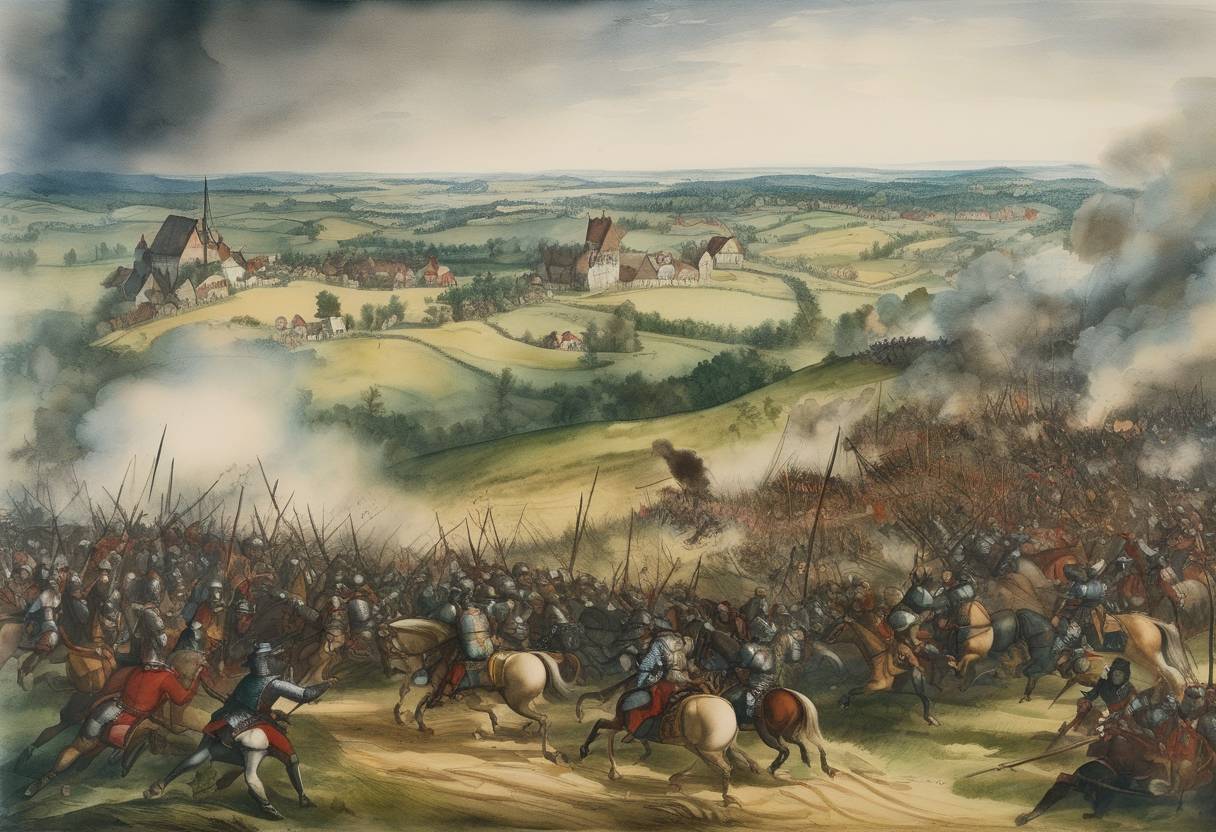
The Battle of Frankenhausen, a pivotal confrontation during the German Peasants’ War, marked a decisive victory for the combined forces of Philip I, Landgrave of Hesse, and George, Duke of Saxony, over the insurgent peasants. Occurring on May 15, 1525, this battle was one of the final and most significant engagements in the widespread peasant uprisings across the Holy Roman Empire.
The German Peasants’ War (1524-1525) was a series of revolts driven by economic hardships, high taxes, and the demand for agrarian reforms. Inspired by the Reformation and the dissemination of Martin Luther’s ideas, the peasants sought to address social injustices and religious grievances, rallying widespread support among the lower classes.
Thomas Müntzer, a radical preacher, became a prominent leader of the peasant forces. He envisioned a divine reordering of society, urging peasants to fight for their rights under the banner of religious reform. Frankenhausen, a town in Thuringia, was a stronghold for Müntzer’s followers.
On May 15, 1525, princely forces under Philip I of Hesse and George of Saxony confronted the peasant army near Frankenhausen. The peasant troops, poorly armed and lacking professional military training, were significantly disadvantaged compared to the well-equipped and organized princely armies.
The battle concluded swiftly with the superior military tactics and cavalry of the princely forces overwhelming the peasant positions. Müntzer and his troops were unable to withstand the onslaught, resulting in a catastrophic defeat.
The victory at Frankenhausen effectively crushed the peasant movement, with thousands of peasants killed or captured. Thomas Müntzer was captured, tortured, and executed shortly thereafter, symbolizing the collapse of the peasant resistance.
The suppression of the peasants’ revolt had profound implications. While the nobility solidified their power and enacted punitive measures, the social and economic conditions that had fueled the unrest largely persisted, delaying meaningful reform. Moreover, the revolt’s failure reinforced the political and religious status quo within the fragmented territories of the Holy Roman Empire.
The Battle of Frankenhausen is remembered as a significant event in early modern European history, illustrating the tensions between emerging reformist ideologies and entrenched feudal systems.