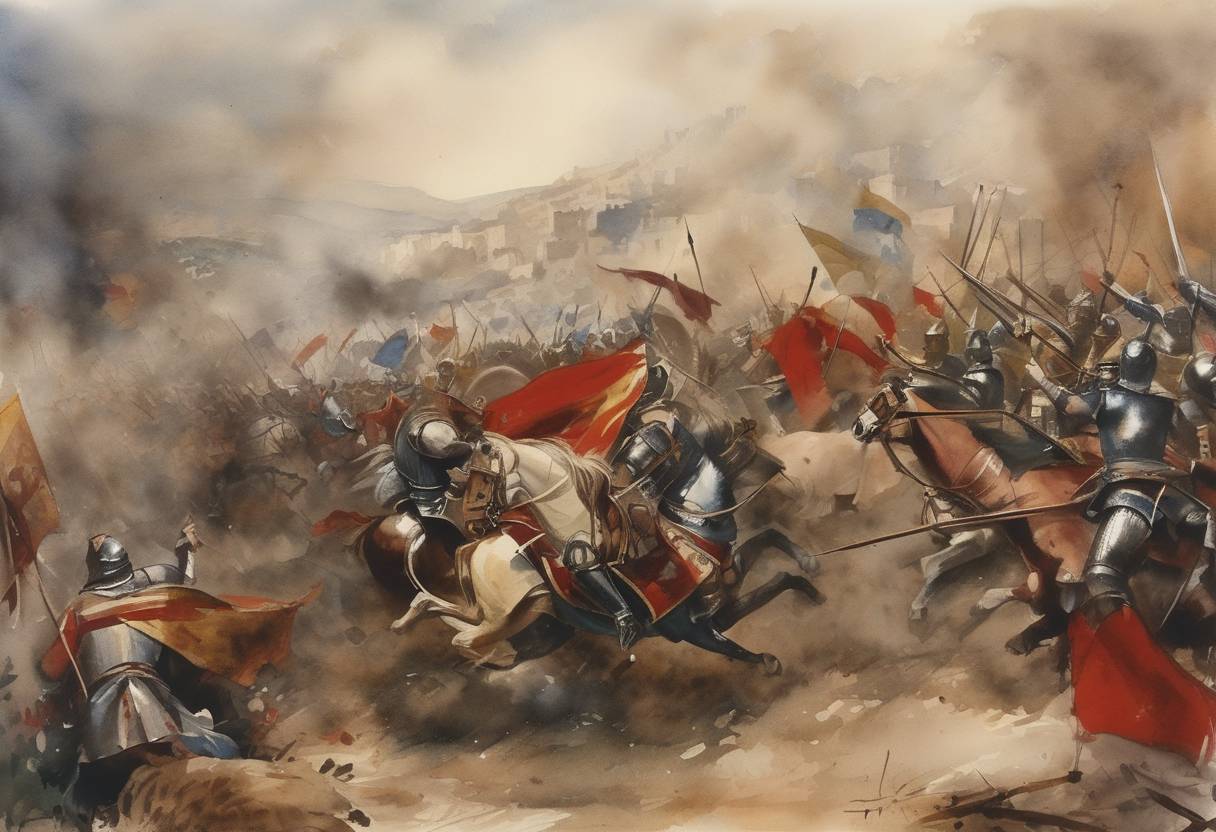
The Battle of Fraga - January 14, 1131
The Battle of Fraga, fought on January 14, 1131, was a significant event during the Aragonese conquest of Muslim territories in what is now modern-day Spain. This battle was part of a series of military campaigns led by King Alfonso I of Aragon, also known as Alfonso the Battler, against the Almoravid Empire, a powerful North African Berber Muslim empire that had extended its influence into the Iberian Peninsula.
Context
The early 12th century was marked by intense conflict between the Christian kingdoms of northern Iberia and the Muslim states to the south. This period was characterized by the Reconquista, the Christian efforts to reclaim territories from Muslim rule. Alfonso I, the King of Aragon and Navarre, was among the most proactive leaders in this movement. His reign from 1104 to 1134 was focused on expanding his domain and reclaiming land from Muslim control.
Prior to the Battle of Fraga, Alfonso I had achieved several successes, including the capture of Zaragoza in 1118. These victories bolstered his determination to push further into territories held by the Almoravids.
The Battle
The town of Fraga, located in the present-day province of Huesca in Aragon, became a focal point due to its strategic importance. Attempts to capture Fraga emerged as a part of Alfonso’s broader strategy to control the Ebro Valley and solidify Aragonese presence in the region.
On January 14, 1131, Alfonso I laid siege to Fraga with an army of Aragonese and Navarrese troops. However, the Almoravids, aware of the strategic importance of the town and the threat posed by Alfonso’s expansion, were prepared to defend it vigorously. The siege resulted in a fierce battle, with the Almoravid forces managing to repel Alfonso’s attack and maintain control over the town.
Aftermath
The failure to capture Fraga was a setback for Alfonso I. Despite this defeat, Alfonso continued to engage in military campaigns until his death in 1134. His efforts during the Reconquista significantly shaped the territorial and political landscapes of the Iberian Peninsula. The continued contest for control over key territories like Fraga set the stage for future confrontations between Christian and Muslim forces, which persisted throughout the centuries-long Reconquista.
The Battle of Fraga, thus, illustrates the ebb and flow of fortunes in the military campaigns of the period. It highlights the tenacity of both Christian and Muslim powers in the medieval struggle for dominance in Spain.