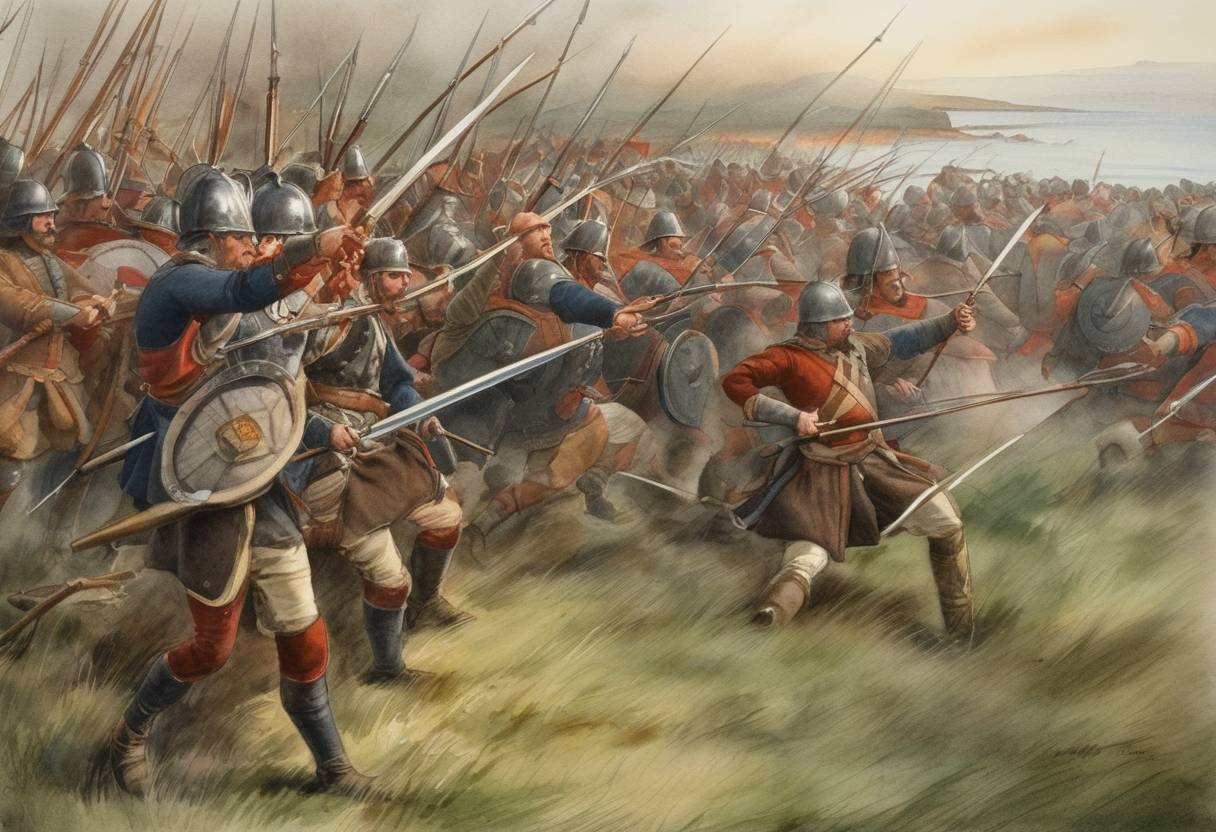
The Battle of Dunbar - April 27, 1296
The Battle of Dunbar was a significant early conflict during the First War of Scottish Independence. It took place on April 27, 1296, marking a consequential victory for the English forces led by King Edward I over the Scots.
Context Leading to the Battle
In the late 13th century, tensions between England and Scotland had reached a breaking point. Following the death of the Scottish king Alexander III in 1286, the Scottish throne was left vacant, triggering a succession crisis known as the “Great Cause.” Edward I of England was invited to arbitrate the succession, leading to the selection of John Balliol as the King of Scots in 1292. However, Edward’s demands for fealty and his intrusive domination led to unrest and discontent in Scotland.
In 1296, hostilities escalated when Edward I invaded Scotland as a response to Scottish raids into northern England. The invasion began Edward’s campaign to assert his claim over Scotland.
The Battle
The Battle of Dunbar occurred near the town of Dunbar in southeastern Scotland. The Scottish forces, under the command of John Comyn of Badenoch and other nobles supporting King John Balliol, sought to defend against the English advance.
Key Events
- Deployment: The Scots were positioned defensively, attempting to block the English from advancing further into Scotland. However, their forces were poorly coordinated.
- The Clash: On April 27, Edward’s forces engaged the Scots near Dunbar Castle. The English army, benefiting from greater discipline and superior tactics, managed to outmaneuver and decisively defeat the Scottish troops.
- Outcome: The Scots suffered significant losses, with many taken prisoner, and the battle ended in a rout.
Aftermath and Consequences
Following the victory at Dunbar, Edward’s army continued its advance into Scotland:
- Occupation of Scotland: Edward swiftly occupied key Scottish territories, and by the summer of 1296, much of southern Scotland was under English control.
- Surrender by Balliol: King John Balliol was coerced into abdicating his throne. This event effectively left Scotland without a king and allowed Edward to install English administrators.
- Long-term Impact: The Battle of Dunbar set the stage for ongoing conflicts over Scottish independence, as resistance movements within Scotland, including those led by figures such as William Wallace, emerged in response to English occupation.
The Battle of Dunbar was thus a pivotal moment in the First War of Scottish Independence, marking the beginning of English dominance in Scotland that would spark future resistance and alter the historical trajectory of the two nations.