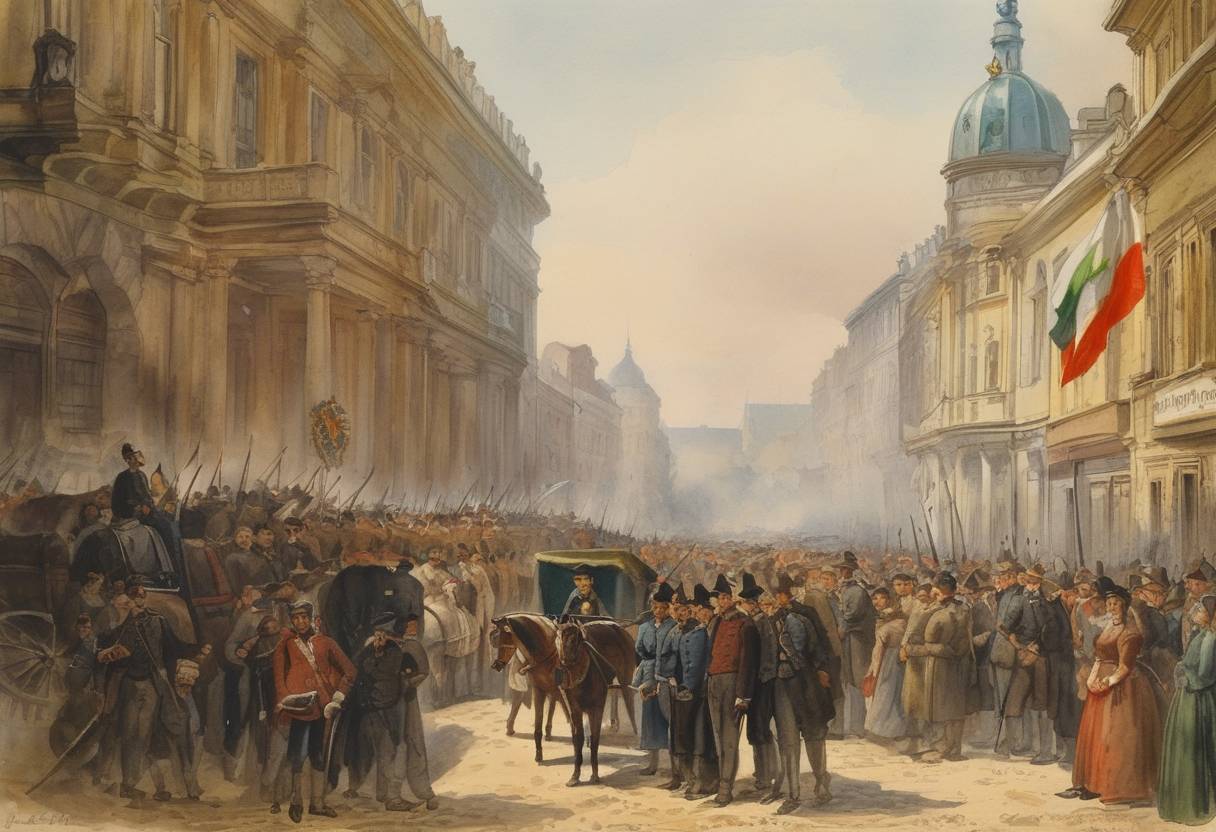
Proclamation of the Hungarian Republic - April 14, 1849
On April 14, 1849, amidst the Hungarian Revolution of 1848, the Hungarian Diet proclaimed the independence of Hungary from the Habsburg Austrian Empire, marking a definitive moment in Hungary’s struggle for self-determination. This act represented the culmination of a series of revolutionary developments that had begun in March 1848 as part of the broader European wave of uprisings.
Context and Prelude
The Hungarian Revolution of 1848 was part of the larger European Revolutions of 1848, driven by nationalist, liberal, and democratic ideals. In Hungary, these revolutions aimed at gaining greater autonomy from Habsburg dominion and enacting significant social and political reforms. This included demands for freedom of the press, the formation of a national army, and the abolition of serfdom.
Initially, the Hungarian movement achieved considerable success, leading to the April Laws of 1848, which granted Hungary self-governance under the Habsburg crown. However, tensions rose when Austrian authorities attempted to curtail these freedoms to reassert control.
Proclamation of Independence
On April 14, 1849, responding to Austrian resistance and aggression, the Hungarian National Assembly convened in Debrecen, a key city away from the conflict-ridden Buda-Pest area. It formally declared Hungary an independent republic, dissolving the constitutional ties to the Habsburg monarchy. Lajos Kossuth, a prominent revolutionary statesman, was appointed as Governor-President, symbolizing Hungary’s commitment to self-governance and republican ideals.
The proclamation of independence was a crucial assertion of Hungarian sovereignty. It represented the peak of the revolutionary fervor that swept through Hungary during this period. However, it also intensified the conflict with Austria, which, backed by the Russian Empire following the Austro-Russian alliance, moved decisively to crush the Hungarian uprising.
Diplomatic isolation and military disadvantage led to the eventual Hungarian defeat. By August 1849, the combined Austrian and Russian forces had overwhelmed the Hungarian revolutionaries, resulting in the surrender at Világos, marking a temporary end to Hungarian aspirations for independence.
Broader Historical Impact
Though short-lived, the April 14, 1849, declaration of the Hungarian Republic left a lasting legacy. It became a symbol of Hungarian national identity and resistance. The ideas and fervor of the 1848-49 revolution influenced future generations, eventually contributing to Hungary’s more enduring independence at the end of World War I, with the dissolution of the Austro-Hungarian Empire in 1918.
The events of April 14, 1849, thus stand as a prominent chapter in the narrative of Hungarian nationalism and the broader 19th-century European struggles for identity and self-determination.