Xuanzang's Translation: The Earliest Reliably Dated Chinese Buddhist Written Document
657 · Chang'an, China
The earliest reliably dated Chinese Buddhist written document is composed during the Tang dynasty, a translation by monk Xuanzang.
April 6, 0648
The first Buddhist Council was convened during the month of Vesak following the death of Gautama Buddha. This council, held in Rajgir (present day Bihar, India), aimed to preserve his teachings (Dhamma) and monastic discipline (Vinaya).
Rajgir, India | Buddhist Sangha
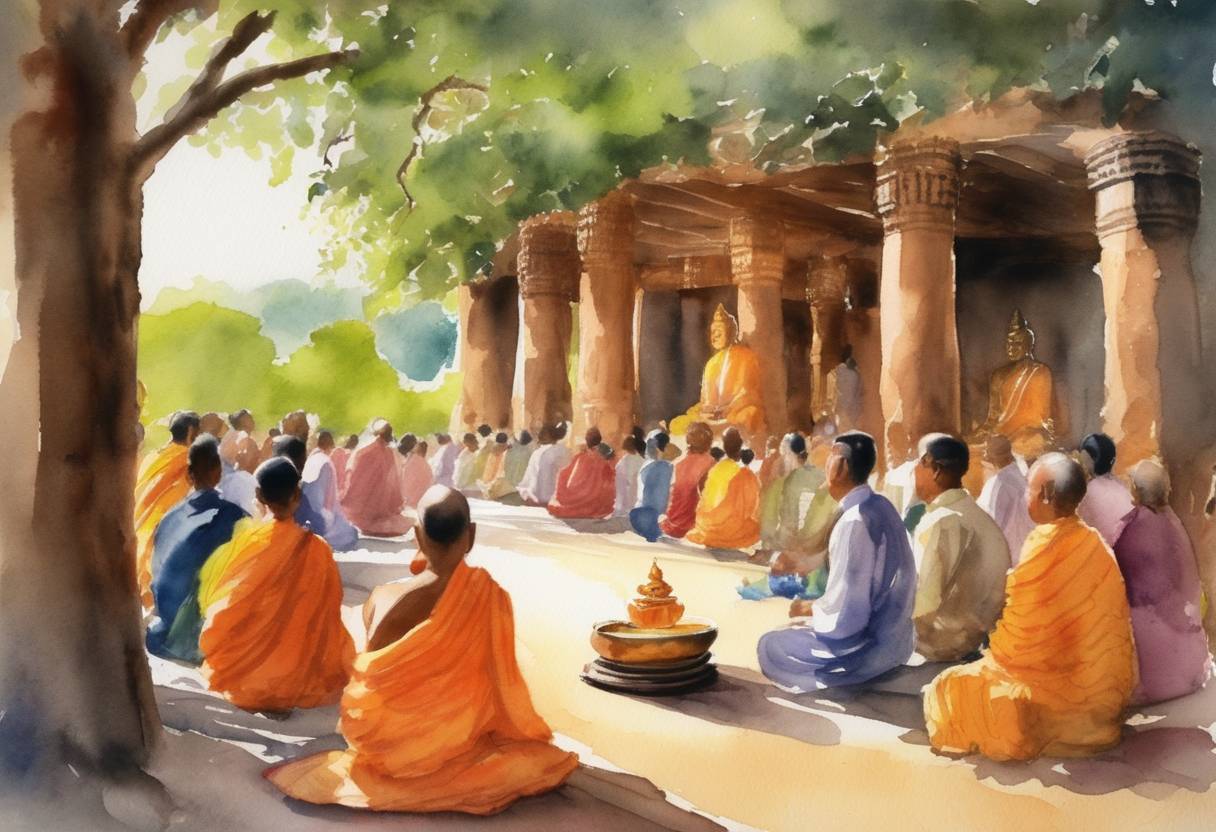
The first Buddhist Council took place in the year 486 BCE, following the passing of Gautama Buddha, a significant event that spurred the need to preserve his teachings. This assembly was held in Rajgir, present-day Bihar, India, during the month of Vesak, the time of Buddha’s birth, enlightenment, and passing away.
The primary objectives of this council were to compile and preserve the Buddha’s teachings (known as the Dhamma) and the monastic code of conduct (referred to as the Vinaya). With the absence of Gautama Buddha, it was imperative for his followers to ensure that the Dhamma and Vinaya were correctly remembered and transmitted to future generations, and to maintain the unity of the Buddhist community.
The council was convened by King Ajatashatru in the Sattapanni Cave located in the hills of Rajgir. It was presided over by Mahakasyapa, one of the Buddha’s foremost disciples. A total of 500 monks who had attained Arahatship, a state of enlightenment, were invited to participate.
Two key figures played crucial roles during the Council:
During the council, Ananda formally recited Buddha’s discourses, which were then categorized and memorized as the Sutta Pitaka. Upali’s recitation of the Vinaya recaptured the rules of monastic discipline. These oral recitations formed the foundation of what would later be written down as part of the Theravada Buddhist canon, the Pali Canon or Tipitaka.
This council set an important precedent for subsequent Buddhist councils and was instrumental in preserving the authenticity and continuity of the Buddha’s teachings. By codifying these teachings, the council facilitated the spread and establishment of Buddhism beyond India, ensuring its survival as a major world religion. The consensus and cohesion achieved during this council played a vital role in maintaining doctrinal unity among early Buddhists amidst growing sectarian developments.
The first Buddhist Council was a cornerstone event in the history of Buddhism, crucial for both the preservation and dissemination of the Buddha’s teachings. It occurred at a pivotal moment when the new religious community was at a crossroads following the Buddha’s parinibbana (final departure), ensuring that his teachings would endure for future generations.
Source: www.britannica.com