The Battle of Stirling Bridge: September 11, 1297
1297 · Stirling, Scotland
The Battle of Stirling Bridge took place, where Scottish forces led by William Wallace and Andrew Moray defeated the English army.
August 5, 1305
William Wallace, leader of the Scottish resistance against England, was captured by the English near Glasgow.
Glasgow, Scotland | English Crown
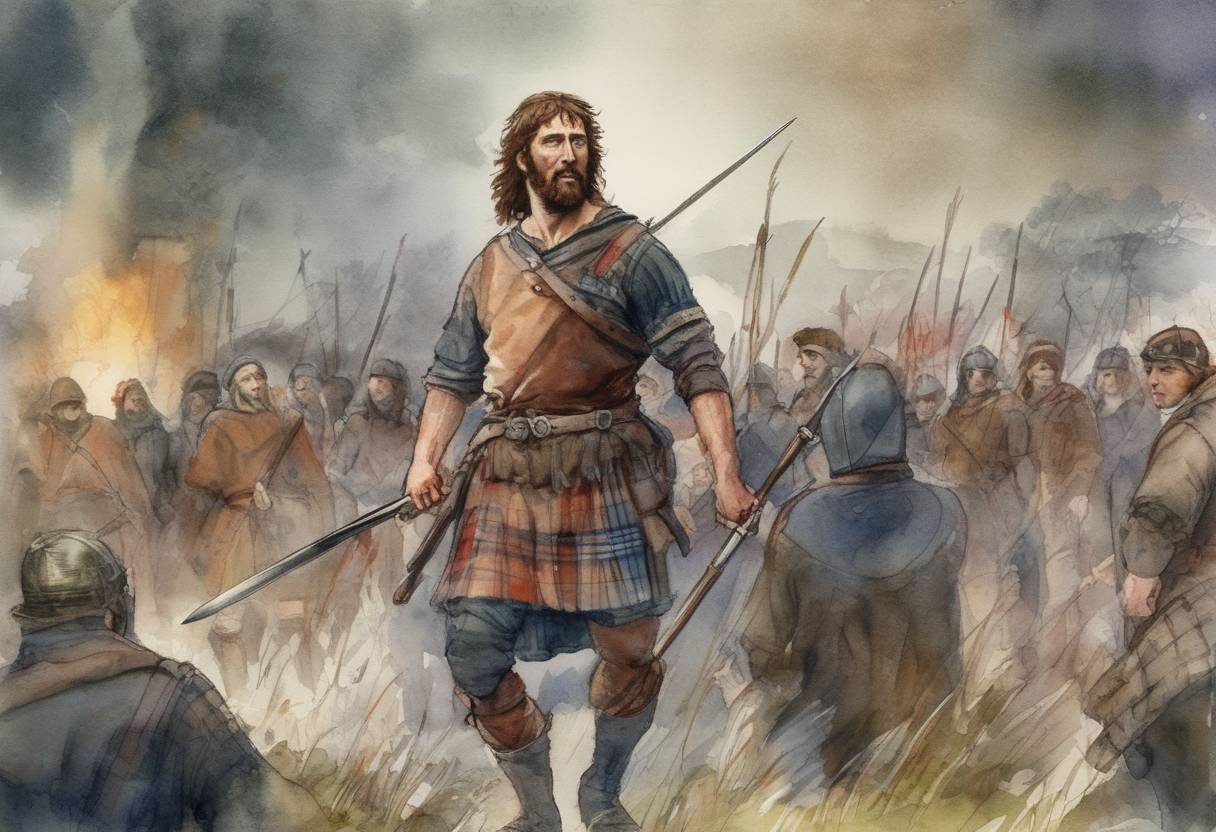
William Wallace, a prominent leader in the Scottish resistance against English rule, was captured on August 5, 1305. This event marked a significant turning point in the First War of Scottish Independence.
William Wallace emerged as a key figure in the Scottish struggle for independence following the death of King Alexander III of Scotland in 1286 and the subsequent political turmoil. The lack of a clear successor led to the intervention of King Edward I of England, who sought to assert control over Scotland. Wallace became renowned for his leadership and military prowess, particularly after his victory at the Battle of Stirling Bridge in 1297.
Wallace’s capture occurred near Glasgow, although the exact location is often cited as Robroyston, a small village in the vicinity. Betrayed by a Scottish knight named John de Menteith, Wallace was apprehended by English forces. His capture was a result of a concerted effort by the English to quell the ongoing Scottish resistance and eliminate its most charismatic leader.
Following his capture, Wallace was transported to London, where he was put on trial for treason and atrocities against civilians during the war. Despite his defense that he could not be a traitor as he owed no allegiance to Edward I, Wallace was found guilty. On August 23, 1305, he was executed in a brutal manner, being hanged, drawn, and quartered.
Wallace’s execution did not end the Scottish fight for independence. Instead, it galvanized further resistance, eventually leading to the rise of Robert the Bruce, who would continue the struggle and eventually secure Scottish independence with the Treaty of Edinburgh-Northampton in 1328.
Wallace’s legacy endures as a symbol of Scotland’s fight for freedom and resistance against oppression. His life and actions have been immortalized in literature and film, most notably in the 1995 movie “Braveheart,” albeit with significant historical inaccuracies.
The capture of William Wallace was a pivotal moment in the history of Scotland’s fight for independence. It underscored the challenges faced by the Scots in their struggle against English domination and highlighted the enduring spirit of resistance that would eventually lead to their victory.
Source: en.wikipedia.org