Charles Darwin's Presentation to the Geological Society of London on January 7, 1838
1838 · London, United Kingdom
Charles Darwin presented a paper on his evolutionary theory and findings in geology to the Geological Society of London.
October 2, 1836
Charles Darwin returned to Falmouth, England, after his five-year voyage on the HMS Beagle. This journey was crucial in developing his theory of evolution by natural selection.
Falmouth, England | HMS Beagle expedition
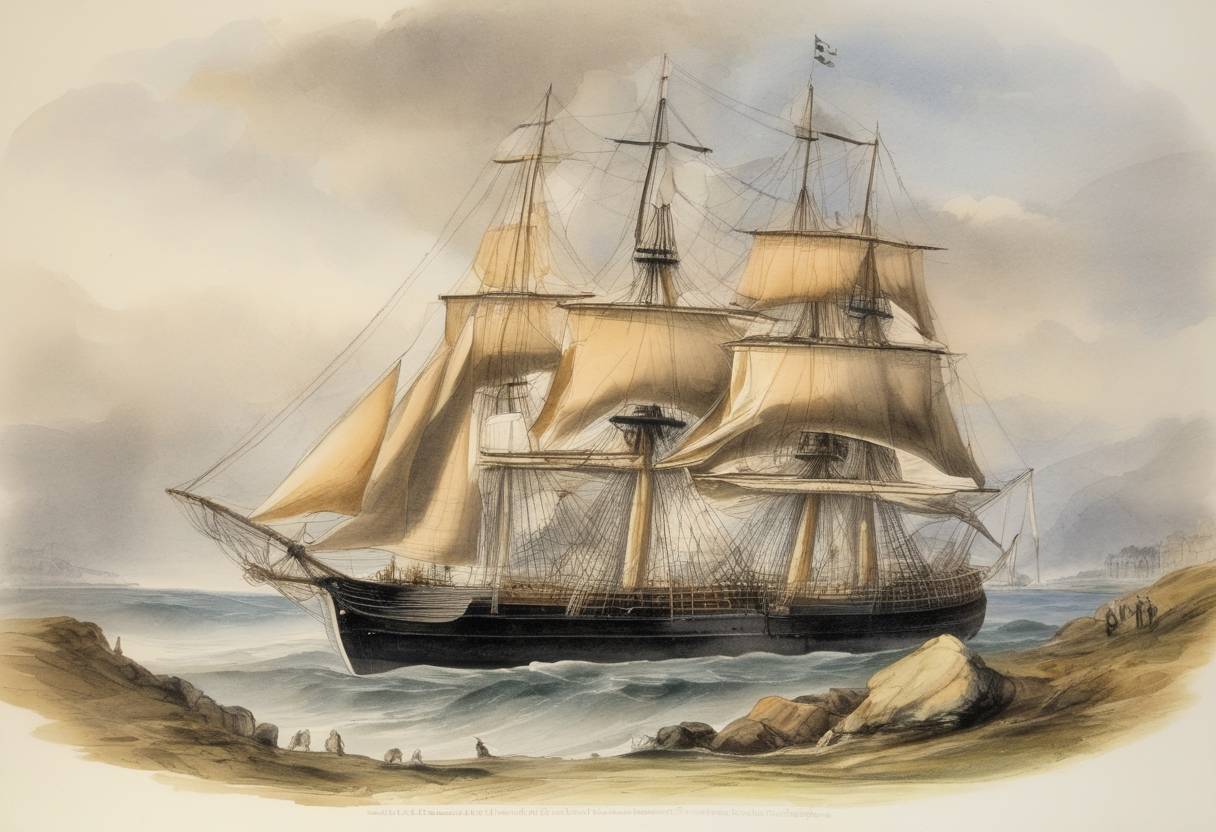
On October 2, 1836, Charles Darwin returned to Falmouth, England, after an extensive and transformative five-year journey aboard the HMS Beagle. This voyage proved pivotal as it laid the groundwork for Darwin’s later formulation of the theory of evolution by natural selection.
The HMS Beagle, a ten-gun brig-sloop, set sail from Plymouth, England, on December 27, 1831, under the command of Captain Robert FitzRoy. Initially, the expedition aimed to conduct a hydrographic survey of the coastlines of the southern parts of South America. As the ship’s naturalist, Darwin was tasked with collecting and examining various geological and biological specimens throughout the journey.
Throughout the voyage, Darwin meticulously gathered fossils, plants, and animals, and made numerous observations. His time on the Galapagos Islands proved especially influential. Here, he noted variations in species such as the finches and tortoises from different islands, shaping his understanding of adaptation and survival.
Additionally, his studies of the Brazilian rainforests, the Andes Mountains, and the Chilean coast contributed to his growing insight into the diversity and adaptation of life. His extensive journals documented these findings, illustrating a keen awareness of nature’s complexity and variability.
The knowledge garnered during the voyage significantly influenced Darwin’s thinking. Upon his return, he began to integrate his observations with ideas from various scientific fields, gradually leading to the development of his groundbreaking work, “On the Origin of Species,” published in 1859. His theory of natural selection offered a scientific explanation for the diversity of life, suggesting that species evolved over time through a process of gradual modification.
Upon his return to England, Darwin was propelled into the scientific community, gaining partnership in esteemed societies, such as the Geological Society of London. His findings challenged existing notions and planted the seeds for future debates on evolutionary biology.
The HMS Beagle’s expedition remains a defining chapter in scientific history, highlighting the profound impact of field research in shaping evolutionary theory. Darwin’s meticulous documentation and astute observational skills served as a testament to the power of empirical evidence in revolutionizing our understanding of life on Earth.
Source: www.britannica.com