Christopher Columbus Begins His Return to Spain - January 4, 1493
1493 · Isabela, Dominican Republic
Christopher Columbus began his return to Spain from his first voyage to the Americas.
December 25, 1492
The Santa María, one of the ships of Christopher Columbus’s expedition, ran aground and sank off the coast of Hispaniola (modern-day Haiti). This accident led Columbus to establish the settlement of La Navidad from its remains.
Hispaniola, Spain's claimed territory (now Haiti) | Navigation expedition sponsored by the Catholic Monarchs of Spain
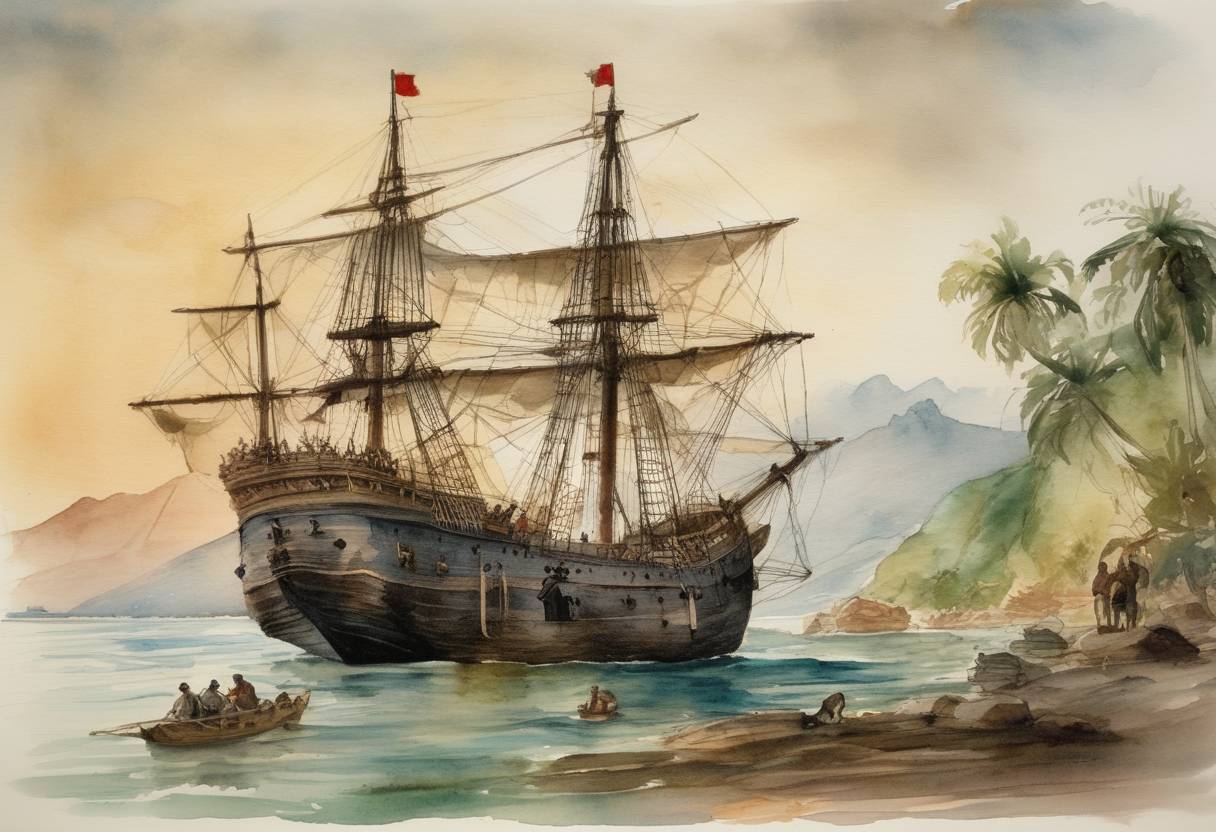
On December 25, 1492, Christopher Columbus’s flagship, the Santa María, met a tragic end when it ran aground off the coast of Hispaniola, in present-day Haiti. This incident occurred during Columbus’s first voyage to the New World, which had embarked from Spain in August of the same year. The grounding took place after Columbus had explored parts of the Caribbean, including the Bahamas and Cuba.
The expedition, sponsored by the Catholic Monarchs of Spain, Isabella I of Castile and Ferdinand II of Aragon, was aimed at finding a new westward route to Asia. Columbus, an Italian navigator, commanded a fleet of three ships: the Niña, the Pinta, and his flagship, the Santa María.
Late on Christmas Eve of 1492, the Santa María struck a sandbank near present-day Môle-Saint-Nicolas, Saviña. Despite efforts by the crew to save the vessel, it became clear by the morning of December 25th that the ship could not be salvaged. To prevent loss of resources and manpower, Columbus and his men began dismantling the ship.
The timbers and other salvageable materials from the Santa María were repurposed to construct a small fort, which Columbus named La Navidad in honor of its construction on Christmas Day. This settlement was the first European establishment in the Americas. Columbus left behind 39 men, led by Diego de Arana, to maintain the fort and establish a presence on the island.
Columbus continued his exploration with the remaining ships, the Niña and the Pinta. When he returned to Hispaniola on his second voyage in November 1493, he discovered that La Navidad had been destroyed and its inhabitants were killed, likely due to conflicts with the indigenous Taíno people. This unfortunate outcome underscored the challenges and tensions that would characterize European interactions with the native populations.
The sinking of the Santa María and the founding of La Navidad marked the beginning of sustained European involvement in the Americas, which led to significant and often devastating changes for the indigenous populations due to colonization, cultural exchange, and conflict. Columbus’s voyages opened the door to widespread European exploration and conquest, fundamentally altering the course of world history.
Source: www.history.com