Afonso IV of Portugal: Death and Legacy
1367 · Lisbon, Portugal
Afonso IV of Portugal, also known as 'Afonso the Brave,' passed away. He was notable for involving Portugal in the Spanish conflicts and improving its legal and administrative systems.
December 7, 1185
The death of Alfonso I, the first king of Portugal, occurred. His reign was marked by military successes against the Moors and the establishment of an independent Portuguese state recognized by the Pope.
Coimbra, Portugal | Kingdom of Portugal
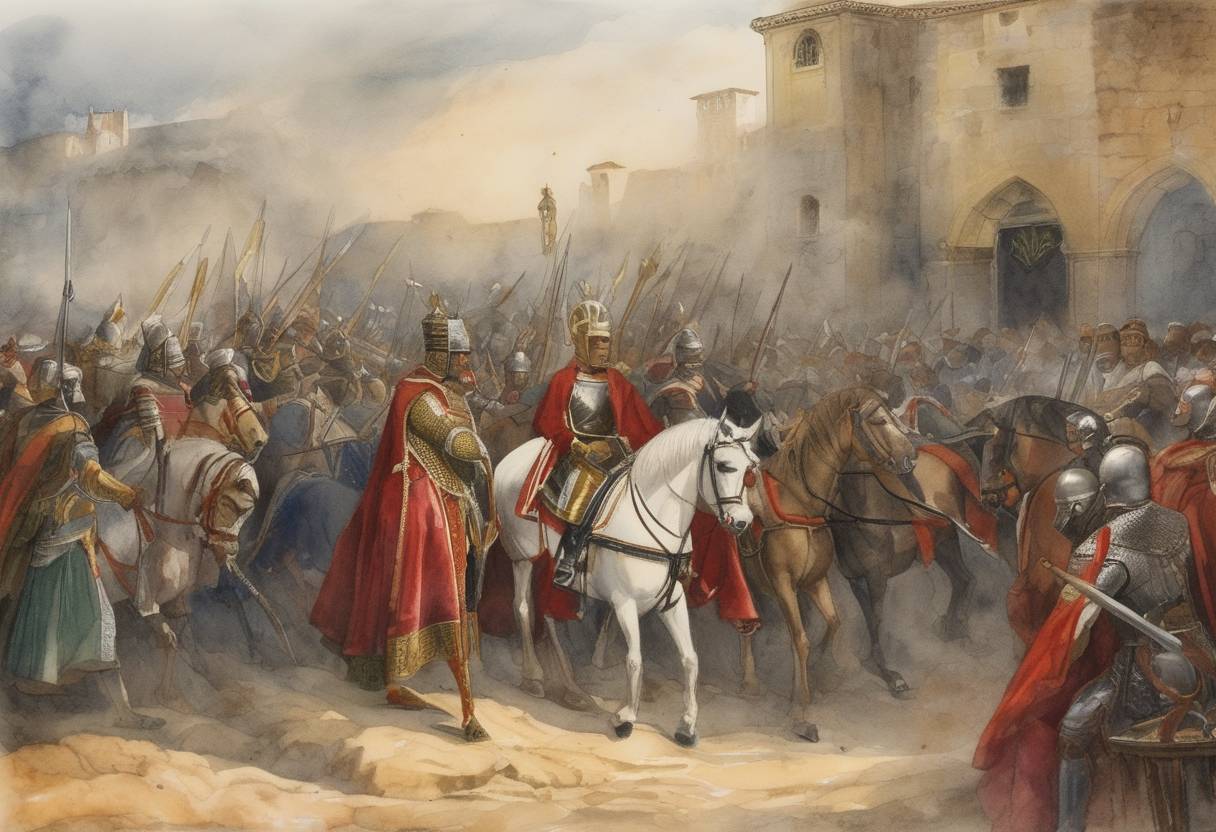
Alfonso I, also known as Afonso Henriques, died on December 6, 1185. He was the first King of Portugal, a title he held from 1139 until his death. His reign was characterized by a series of military successes and significant political developments that helped establish Portugal as a sovereign nation.
Afonso Henriques was born around 1109 in Guimarães, within the County of Portugal, then a part of the Kingdom of León. He was the son of Count Henry of Burgundy and Teresa of León. From early on, Afonso was involved in military campaigns and displayed a strong penchant for leadership and strategy.
A key aspect of Afonso’s reign was his continuous efforts to expand and consolidate Portuguese territories. His most notable military achievement was the victory at the Battle of Ourique in 1139, where he reportedly defeated a large Moorish army. This victory bolstered his support and is often mythologized as a divine validation of his kingship.
Following this victory, Afonso declared himself King of Portugal. Over the next few decades, he secured further victories against both Moorish forces to the south and political adversaries to the north and east, which included several confrontations with the Kingdom of León.
In pursuing recognition of his kingdom’s independence, Afonso I worked relentlessly. His efforts culminated in 1179 when Pope Alexander III acknowledged Portugal as a kingdom through the papal bull “Manifestis Probatum.” This recognition was critical, as it not only legitimized his rule in the eyes of other Christian monarchs but also ensured the support of the Church.
Alfonso I’s reign laid the foundations for a unified and independent Portuguese state. He was instrumental in establishing the country’s borders and encouraging economic and social stability through infrastructural development and religious patronage.
His legacy continued through his successors, and the independent Kingdom of Portugal would go on to become a significant power during the Age of Discoveries in the 15th and 16th centuries.
Afonso I died on December 6, 1185, in Coimbra, where he spent his final years. His death marked the end of an era but paved the way for further consolidation and expansion of Portugal under his successors. He is often referred to as “Afonso the Conqueror” for his critical role in the establishment of the Portuguese kingdom. His burial took place at the Monastery of Santa Cruz in Coimbra, which he had helped to found.
Source: www.britannica.com