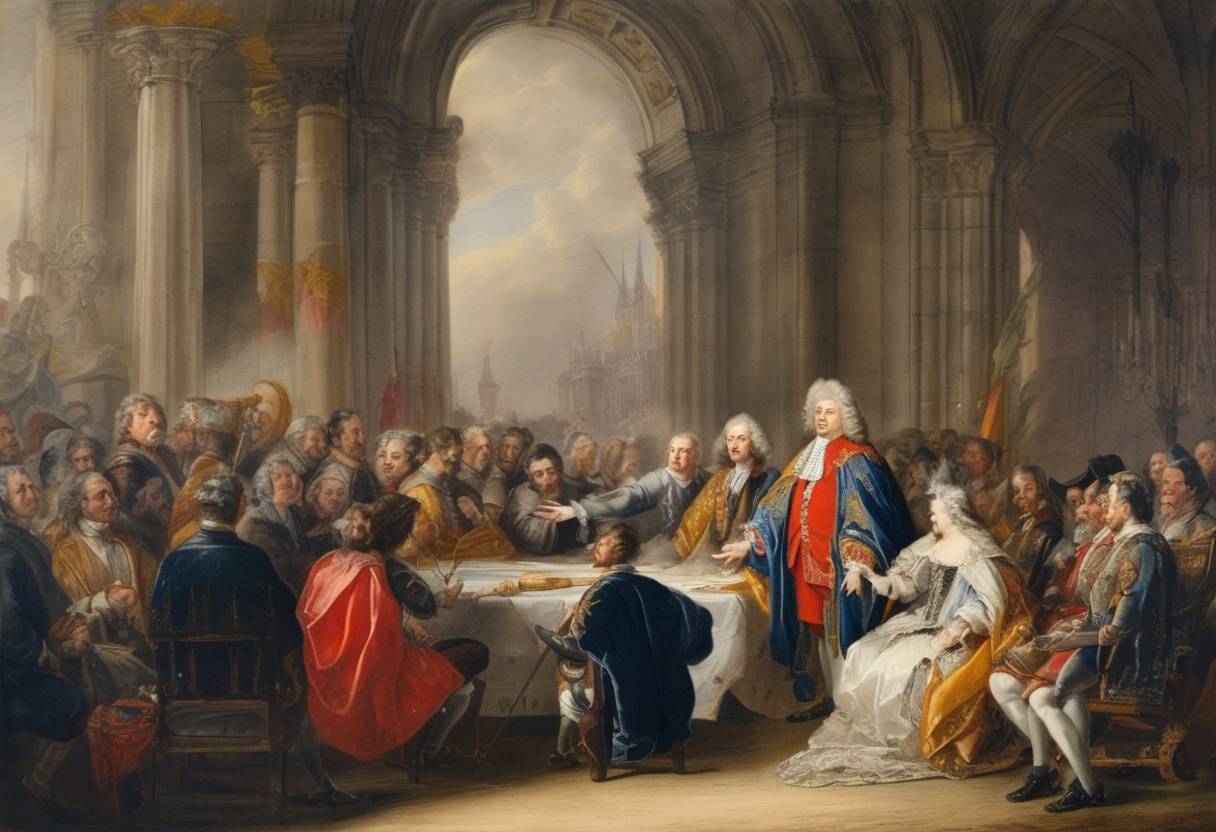
Treaty of Aix-la-Chapelle (1668)
On July 25, 1668, the Treaty of Aix-la-Chapelle was signed, marking the end of the War of Devolution between France and Spain. This treaty concluded a short yet intense conflict primarily over the Spanish Netherlands, resulting from competing dynastic claims.
Context
War of Devolution (1667-1668): This conflict arose when King Louis XIV of France claimed that the Spanish Netherlands should pass to him through his wife, Maria Theresa of Spain, upon the death of her father, King Philip IV of Spain. Louis’s claim was based on the local custom of devolution, which favored inheritance through female lines.
Military Campaigns: France rapidly advanced into the Spanish Netherlands in 1667 with minimal resistance, capturing several towns due to superior military capabilities and strategic planning. This expansionist move alarmed neighboring European powers.
Key Provisions of the Treaty
Territorial Adjustments: France retained control over towns it had captured, including Lille, Tournai, and Charleroi. In exchange, France agreed to return other territories it had occupied during the war.
Balance of Power: The treaty reflected the diplomatic efforts and intervention by the Triple Alliance, comprising England, the Dutch Republic, and Sweden, which sought to maintain a balance of power in Europe. Their involvement pressured both France and Spain to negotiate to prevent further conflicts.
Aftermath
Short-term Peace: The treaty temporarily halted French expansion but did not resolve underlying tensions between France and Spain or Louis XIV’s ambitions for territorial gains.
Ongoing Rivalries: This agreement marked a brief pause in hostilities before the larger and more complex conflicts that followed, notably the Franco-Dutch War (1672-1678) and the War of the League of Augsburg (1688-1697).
The Treaty of Aix-la-Chapelle showcased the complex diplomatic entanglements of 17th-century European politics and demonstrated the increasing role of diplomacy alongside military might in resolving conflicts.