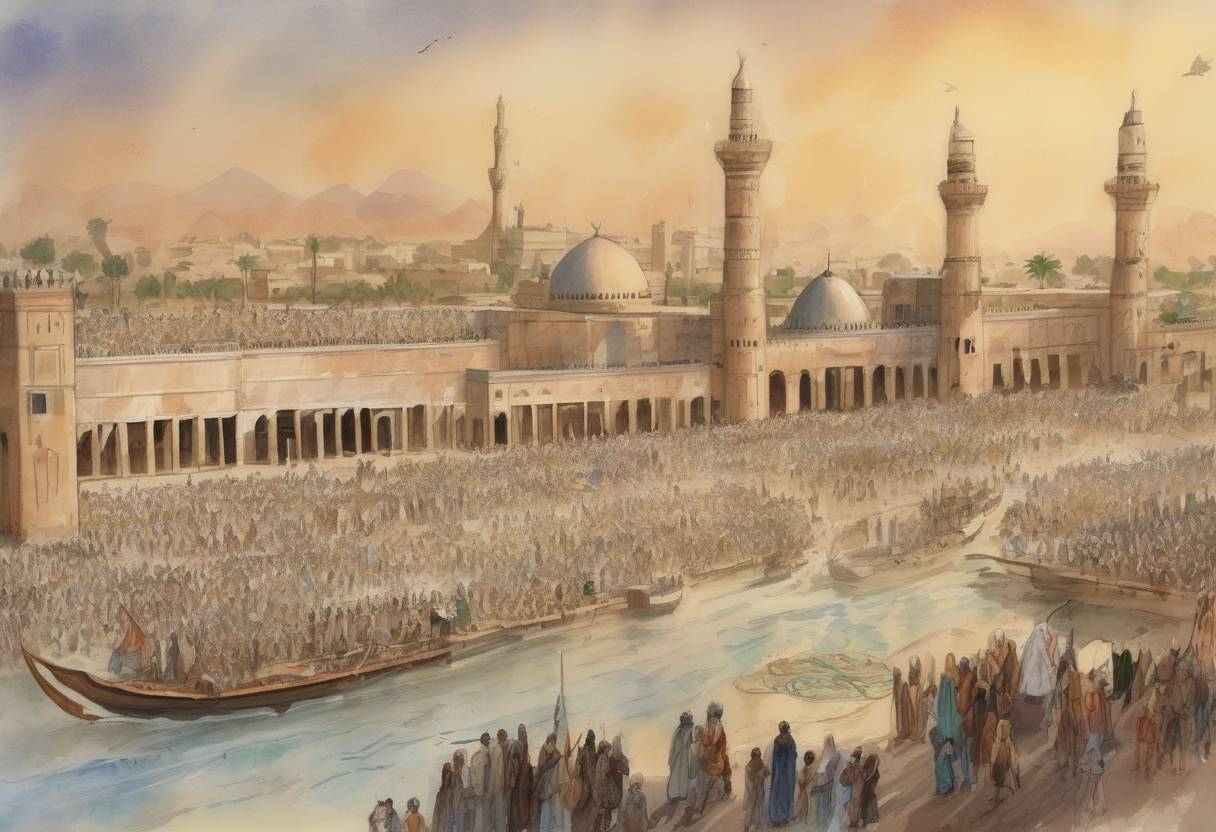
Founding of Baghdad: July 30, 762
On July 30, 762, the city of Baghdad was officially founded by the Abbasid caliph Al-Mansur. This event marked a significant moment in Islamic history, as Baghdad was designed to be the capital of the Abbasid Caliphate, which had recently come to power after overthrowing the Umayyad Caliphate.
Context and Background
- The Abbasid Revolution: The Abbasid Caliphate came to power in 750 CE after a successful revolution against the Umayyad Caliphate. The Abbasids sought to establish a new capital that would symbolize their authority and serve as a center for their administration.
- Strategic Location: Al-Mansur chose the site for Baghdad due to its strategic location along the Tigris River, which facilitated trade and communication. The area was also fertile, supporting agriculture and sustaining a large population.
Design and Construction
- Circular City: Al-Mansur commissioned the construction of a circular city, which was a unique design for its time. The city was approximately two kilometers in diameter and featured concentric walls and a central mosque and palace.
- Architectural Innovation: The design of Baghdad reflected advanced urban planning and architectural innovation. The city was divided into quadrants, with roads radiating from the center, facilitating efficient movement and administration.
Cultural and Intellectual Hub
- Cultural Flourishing: Baghdad quickly became a major cultural, commercial, and intellectual center of the Islamic world. It attracted scholars, poets, scientists, and artists from across the Islamic empire and beyond.
- The House of Wisdom: Under the Abbasids, Baghdad became home to the renowned House of Wisdom, a major intellectual center where scholars translated and preserved Greek, Persian, and Indian texts. This institution played a crucial role in the Islamic Golden Age, fostering advancements in various fields such as mathematics, astronomy, medicine, and philosophy.
Aftermath and Historical Significance
- Economic Prosperity: Baghdad’s strategic location and status as the capital of the Abbasid Caliphate made it a hub for trade and commerce, contributing to its economic prosperity.
- Enduring Legacy: The city’s founding marked the beginning of a period of cultural and scientific achievements that had a lasting impact on the Islamic world and beyond. Baghdad remained a significant center of learning and culture until its decline following the Mongol invasion in 1258.
The founding of Baghdad by Al-Mansur on July 30, 762, was a pivotal event that established the city as a beacon of Islamic civilization, influencing the cultural and intellectual landscape of the medieval world.