The June Days Uprising: June 22, 1848
1848 · Paris, France
The June Days Uprising began in France, as working-class Parisians protested the closure of National Workshops, leading to a violent confrontation with the French government.
February 24, 1848
King Louis-Philippe of France abdicated the throne following the February Revolution, leading to the establishment of the French Second Republic.
Paris, France | French monarchy
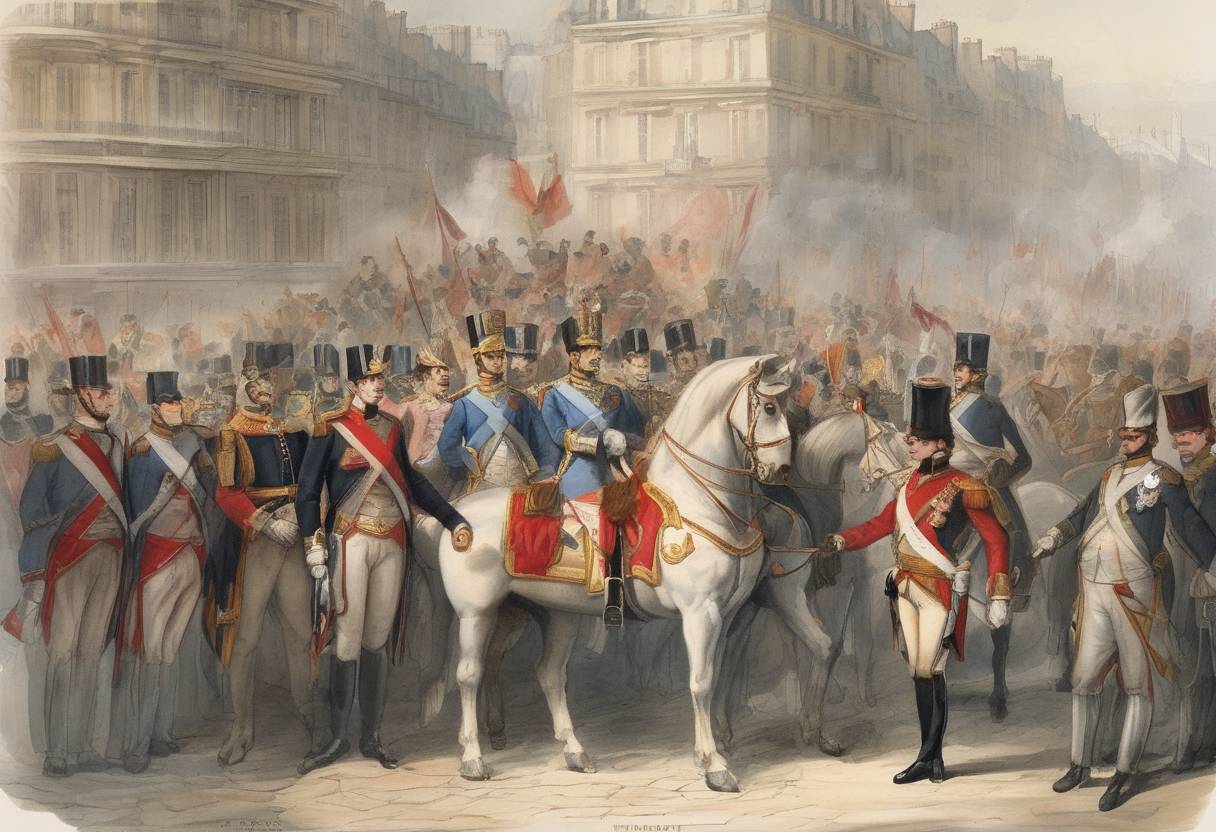
On February 24, 1848, King Louis-Philippe of France abdicated the throne, marking the end of the July Monarchy and paving the way for the establishment of the French Second Republic. This event was a pivotal moment in French history, occurring during a period of widespread revolutionary fervor across Europe.
The July Monarchy (1830-1848): Louis-Philippe came to power after the July Revolution of 1830, which deposed the Bourbon King Charles X. His reign, known as the July Monarchy, was characterized by a constitutional monarchy that favored the bourgeoisie and maintained conservative policies.
Economic and Social Discontent: By the late 1840s, France was experiencing significant economic difficulties, including poor harvests, high unemployment, and a financial crisis. These issues exacerbated social tensions and dissatisfaction with the monarchy’s inability to address the needs of the working class and the broader population.
Political Opposition: The regime faced growing opposition from various political groups, including republicans, socialists, and even some liberal monarchists, who were disillusioned with Louis-Philippe’s increasingly authoritarian rule and his reluctance to expand suffrage.
Outbreak of Protests: In February 1848, a series of political banquets, which were used to circumvent laws against public assembly, were planned to demand electoral reform. The government’s decision to ban these gatherings sparked widespread protests in Paris.
Escalation to Revolution: The protests quickly escalated into a full-scale revolution as demonstrators clashed with government forces. Barricades were erected in the streets, and the situation rapidly deteriorated.
Abdication of Louis-Philippe: Facing mounting pressure and the collapse of his support, Louis-Philippe abdicated on February 24, 1848. He fled to England, leaving behind a power vacuum in France.
Provisional Government: Following the abdication, a provisional government was formed, composed of moderate and radical republicans. This government declared the establishment of the French Second Republic.
Key Figures: Prominent figures in the provisional government included Alphonse de Lamartine, a poet and politician, and Louis Blanc, a socialist thinker who advocated for social reforms.
Reforms and Challenges: The new republic faced immediate challenges, including addressing the demands of the working class, managing economic instability, and navigating political divisions. The government implemented several reforms, such as universal male suffrage and the establishment of national workshops to provide employment.
Impact on France: The February Revolution and the establishment of the Second Republic marked a significant shift in French politics, moving away from monarchy towards republicanism. It also set the stage for future political developments, including the rise of Louis-Napoléon Bonaparte and the eventual establishment of the Second Empire.
European Context: The events in France were part of a broader wave of revolutionary movements across Europe in 1848, known as the “Springtime of Nations,” which sought to challenge autocratic regimes and promote national self-determination and democratic reforms.
The abdication of Louis-Philippe and the subsequent establishment of the French Second Republic were crucial in shaping the trajectory of modern French history, reflecting the ongoing struggle between monarchy and republicanism, and the quest for social and political justice.
Source: en.wikipedia.org