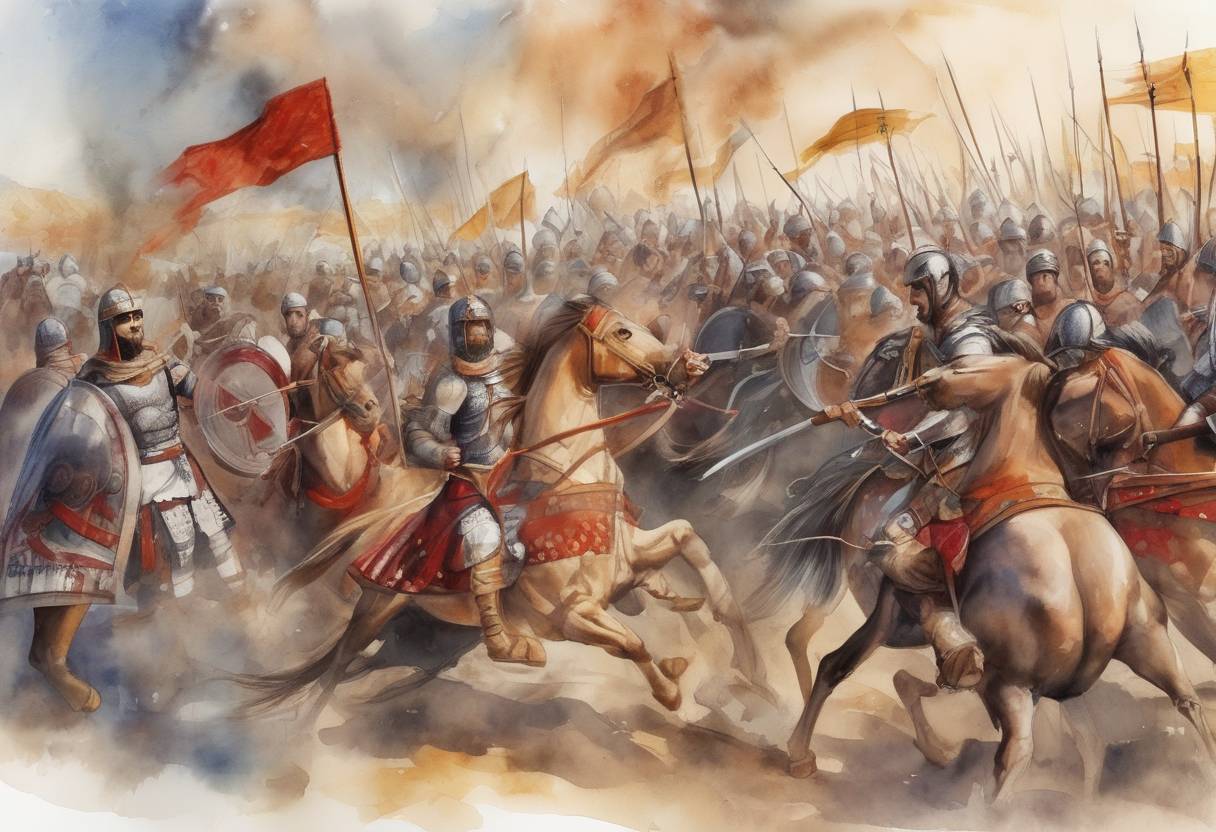
The Battle of Dara: A Key Victory in the Iberian War
The Battle of Dara, fought on September 23, 530, was a pivotal engagement between the Byzantine Empire and the Sassanid Empire during the Iberian War. This conflict was part of a broader series of hostilities between these two great powers, primarily over control of the Caucasus region and influence in the Near East.
Context Leading to the Battle
The Iberian War (526–532) was sparked by the Sassanid Empire’s attempts to assert dominance over the Kingdom of Iberia (modern-day Georgia), a region strategically significant for both empires. The Byzantine Emperor Justinian I sought to counter Sassanid expansion and protect Byzantine interests in the region.
- Belisarius: The Byzantine general who commanded the forces at Dara. Known for his strategic acumen, Belisarius would later become one of the most celebrated military leaders of the Byzantine Empire.
- Perozes: The Sassanid general leading the opposing forces. He was tasked with breaking the Byzantine defenses and securing a decisive victory for the Sassanids.
The Battle
The Battle of Dara took place near the fortified city of Dara, located in what is now southeastern Turkey. Belisarius, anticipating a Sassanid attack, prepared extensively by fortifying the city and organizing his troops strategically.
Byzantine Strategy
Belisarius employed a combination of defensive fortifications and tactical ingenuity. He arranged his forces in a crescent formation, with infantry in the center and cavalry on the flanks. This setup was designed to absorb the Sassanid assault and then counterattack effectively.
The Engagement
The battle commenced with the Sassanids launching a series of frontal assaults against the Byzantine lines. Despite their numerical superiority, the Sassanid forces struggled to break through the well-prepared Byzantine defenses. Belisarius’s use of cavalry to flank and harass the Sassanid troops proved decisive.
After several hours of intense fighting, the Byzantine forces managed to envelop the Sassanid army, leading to a significant rout. The Sassanid general Perozes was killed in the battle, further demoralizing his troops and ensuring a Byzantine victory.
Aftermath and Significance
The victory at Dara was a major boost for the Byzantine Empire, showcasing Belisarius’s military prowess and solidifying his reputation as a formidable general. It also marked a turning point in the Iberian War, allowing the Byzantines to negotiate from a position of strength in subsequent peace talks.
The battle demonstrated the effectiveness of Byzantine military tactics and the importance of strategic fortifications. It also underscored the ongoing rivalry between the Byzantine and Sassanid Empires, a conflict that would continue to shape the political landscape of the region for decades.
In summary, the Battle of Dara was not only a tactical triumph for the Byzantines but also a significant moment in the broader context of Byzantine-Sassanid relations, influencing the balance of power in the Near East during the early 6th century.