Establishment of the Moscow–Washington Hotline
1963 · Washington, D.C., United States
The Moscow–Washington hotline, a direct communication link between the United States and the Soviet Union, is established.
October 22, 1962
President John F. Kennedy addresses the United States about the Cuban Missile Crisis, announcing a naval blockade of Cuba.
Washington, D.C., United States | United States government
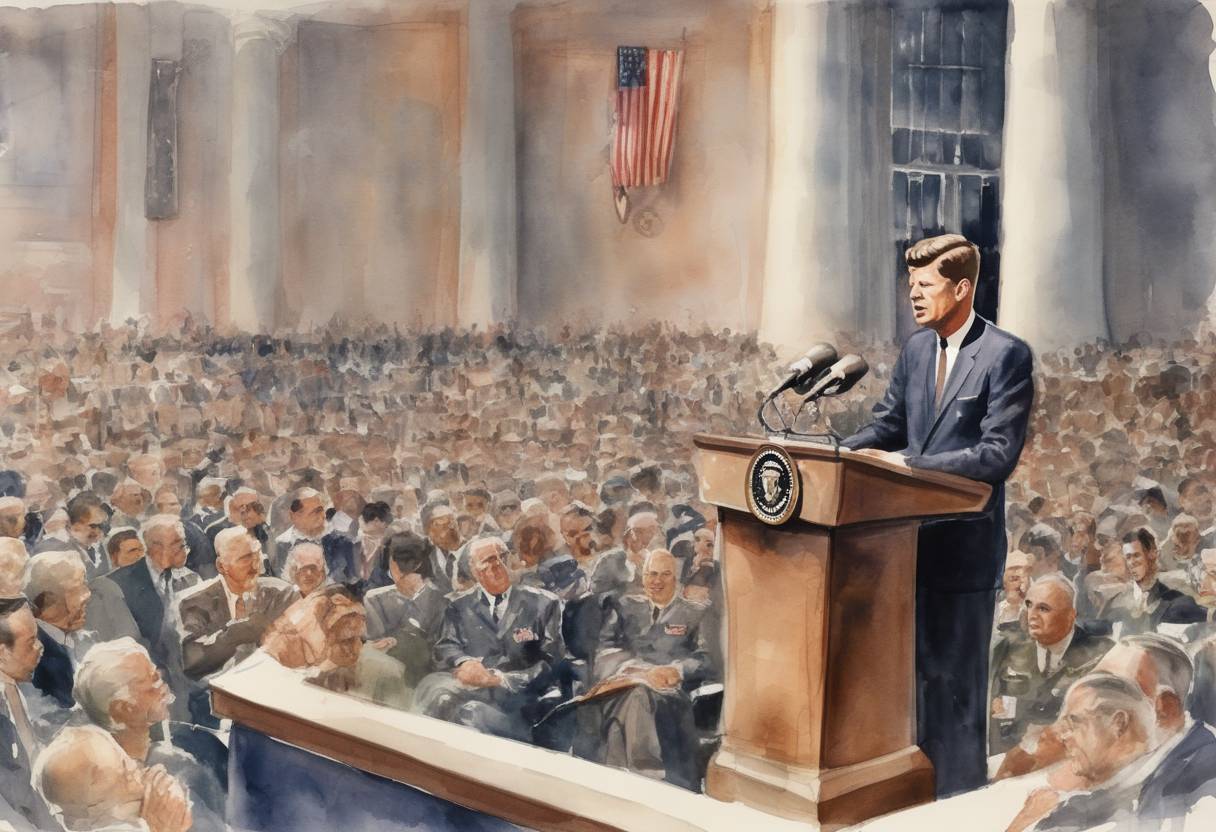
On October 22, 1962, President John F. Kennedy delivered a pivotal televised address to the nation, marking a critical moment in the Cold War known as the Cuban Missile Crisis. This event was a direct response to the discovery of Soviet ballistic missiles in Cuba, just 90 miles off the coast of the United States, which posed a significant threat to American national security.
Cold War Tensions: The Cuban Missile Crisis occurred during a period of intense rivalry between the United States and the Soviet Union. The Cold War was characterized by political, military, and ideological competition, with both superpowers seeking to expand their influence globally.
Cuban Revolution: In 1959, Fidel Castro led a successful revolution in Cuba, overthrowing the U.S.-backed dictator Fulgencio Batista. Castro’s alignment with the Soviet Union and the subsequent nationalization of American businesses in Cuba strained U.S.-Cuban relations.
Bay of Pigs Invasion: In April 1961, the U.S. attempted to overthrow Castro through the Bay of Pigs invasion, which ended in failure and further pushed Cuba towards the Soviet Union for support.
Discovery of Missiles: In October 1962, U.S. reconnaissance flights over Cuba revealed the construction of Soviet missile sites capable of launching nuclear weapons. This discovery prompted urgent deliberations within the U.S. government.
Announcement of the Blockade: Kennedy announced a “quarantine” of Cuba, effectively a naval blockade, to prevent further Soviet shipments of military equipment to the island. He emphasized that this action was defensive and aimed at safeguarding the Western Hemisphere.
Demand for Missile Removal: The President demanded the immediate dismantling and removal of all offensive weapons in Cuba, warning that any missile launched from Cuba would be regarded as an attack by the Soviet Union on the United States, necessitating a full retaliatory response.
Call for Diplomacy: Kennedy expressed a preference for a peaceful resolution and called upon Soviet Premier Nikita Khrushchev to work towards de-escalation. He also sought the support of the Organization of American States (OAS) and the United Nations.
Preparedness for Escalation: While advocating for peace, Kennedy made it clear that the U.S. was prepared to take military action if necessary, underscoring the gravity of the situation.
Resolution: The crisis reached its peak over the following days, with tense negotiations between the U.S. and the Soviet Union. On October 28, Khrushchev agreed to dismantle the missile sites in exchange for a U.S. pledge not to invade Cuba and the secret removal of U.S. missiles from Turkey.
Impact on U.S.-Soviet Relations: The Cuban Missile Crisis was a turning point in the Cold War, leading to improved communication between the superpowers, including the establishment of the Moscow-Washington hotline.
Legacy: The crisis highlighted the dangers of nuclear brinkmanship and underscored the need for arms control agreements, eventually leading to treaties such as the Nuclear Test Ban Treaty of 1963.
Kennedy’s address on October 22, 1962, remains a defining moment in American history, illustrating the delicate balance of power during the Cold War and the importance of diplomatic resolution in averting nuclear conflict.
Source: en.wikipedia.org