Adolf Hitler Becomes Führer of Germany: August 2, 1934
1934 · Berlin, Germany
Adolf Hitler became the Führer of Germany after the death of President Paul von Hindenburg, consolidating his power and marking a pivotal moment in Nazi Germany's history.
February 28, 1933
The Reichstag Fire Decree was issued by President Paul von Hindenburg of Germany, following the Reichstag fire, which suspended civil liberties and allowed for the arrest of political opponents.
Berlin, Germany | German government
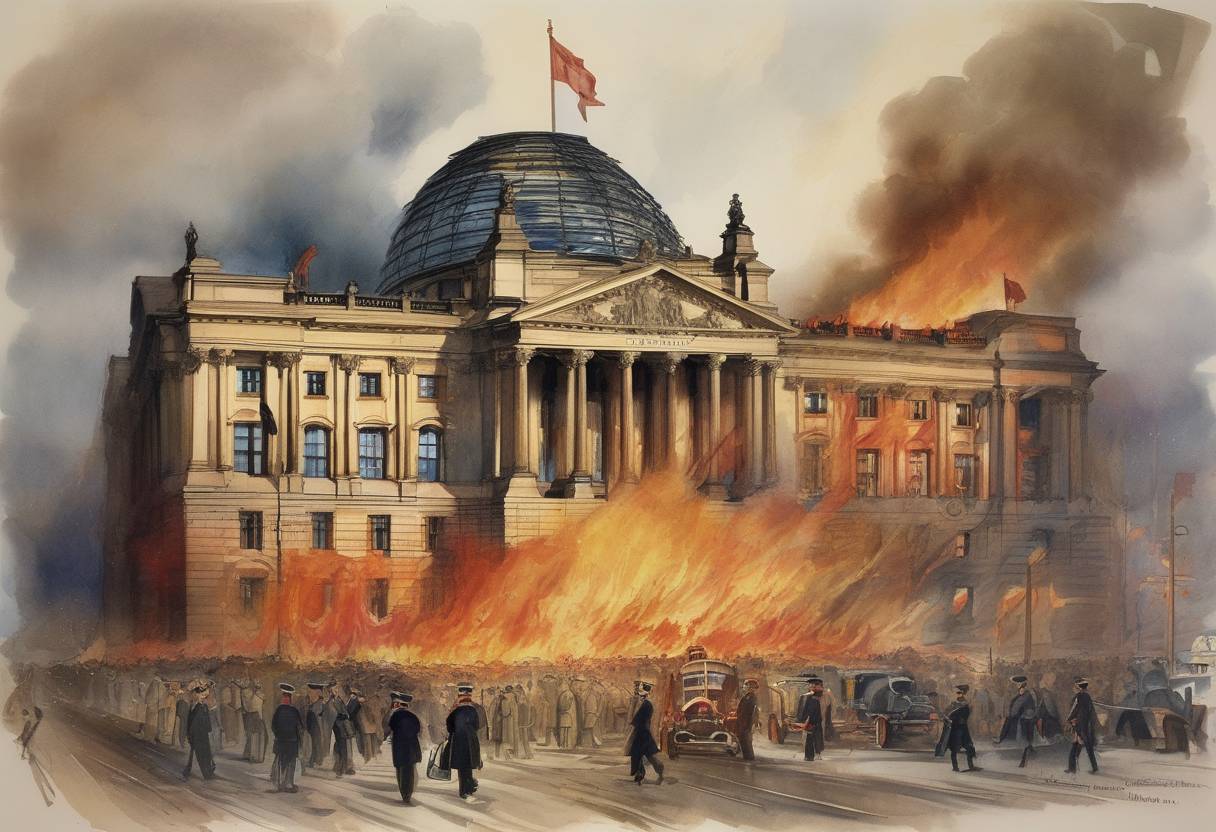
On February 28, 1933, the Reichstag Fire Decree was issued by President Paul von Hindenburg of Germany, marking a pivotal moment in the rise of the Nazi regime. This decree followed the Reichstag fire, which occurred on the night of February 27, 1933, when the German parliament building in Berlin was set ablaze. The fire was a critical event that the Nazis used to consolidate power and suppress opposition.
The Reichstag Fire: The fire broke out in the Reichstag building and was quickly blamed on communist agitators. A Dutch communist, Marinus van der Lubbe, was arrested at the scene and charged with arson. The Nazis used the incident to stoke fears of a communist uprising.
Political Climate: At the time, Germany was in a state of political instability. The Nazi Party, led by Adolf Hitler, had recently come to power, with Hitler appointed as Chancellor on January 30, 1933. However, they did not yet have complete control over the government.
The Reichstag Fire Decree, officially titled the “Decree of the Reich President for the Protection of People and State,” was issued under Article 48 of the Weimar Constitution, which allowed the President to take emergency measures without prior consent from the Reichstag. The key provisions included:
Suspension of Civil Liberties: The decree suspended several fundamental civil liberties, including freedom of speech, freedom of the press, the right to assemble, and the privacy of postal and telephonic communications.
Arrest of Political Opponents: It authorized the arrest and detention of political opponents without specific charges, effectively allowing the Nazis to target communists, socialists, and other political adversaries.
Centralization of Power: The decree enabled the central government to overrule state and local laws, further consolidating power in the hands of the Nazi regime.
Suppression of Opposition: The decree was a critical tool in the Nazi campaign to eliminate political opposition. Thousands of communists, including members of the Reichstag, were arrested in the days following the fire.
Enabling Act: The decree set the stage for the passage of the Enabling Act on March 23, 1933, which gave Hitler’s government the power to enact laws without the Reichstag’s approval, effectively establishing a legal dictatorship.
Impact on German Society: The suspension of civil liberties and the suppression of political dissent marked the beginning of a totalitarian regime in Germany, leading to widespread persecution and the eventual horrors of World War II and the Holocaust.
The Reichstag Fire Decree was a significant step in the dismantling of democratic institutions in Germany and the establishment of Nazi authoritarian rule. It exemplifies how crises can be exploited by those in power to curtail freedoms and consolidate control.
Source: en.wikipedia.org