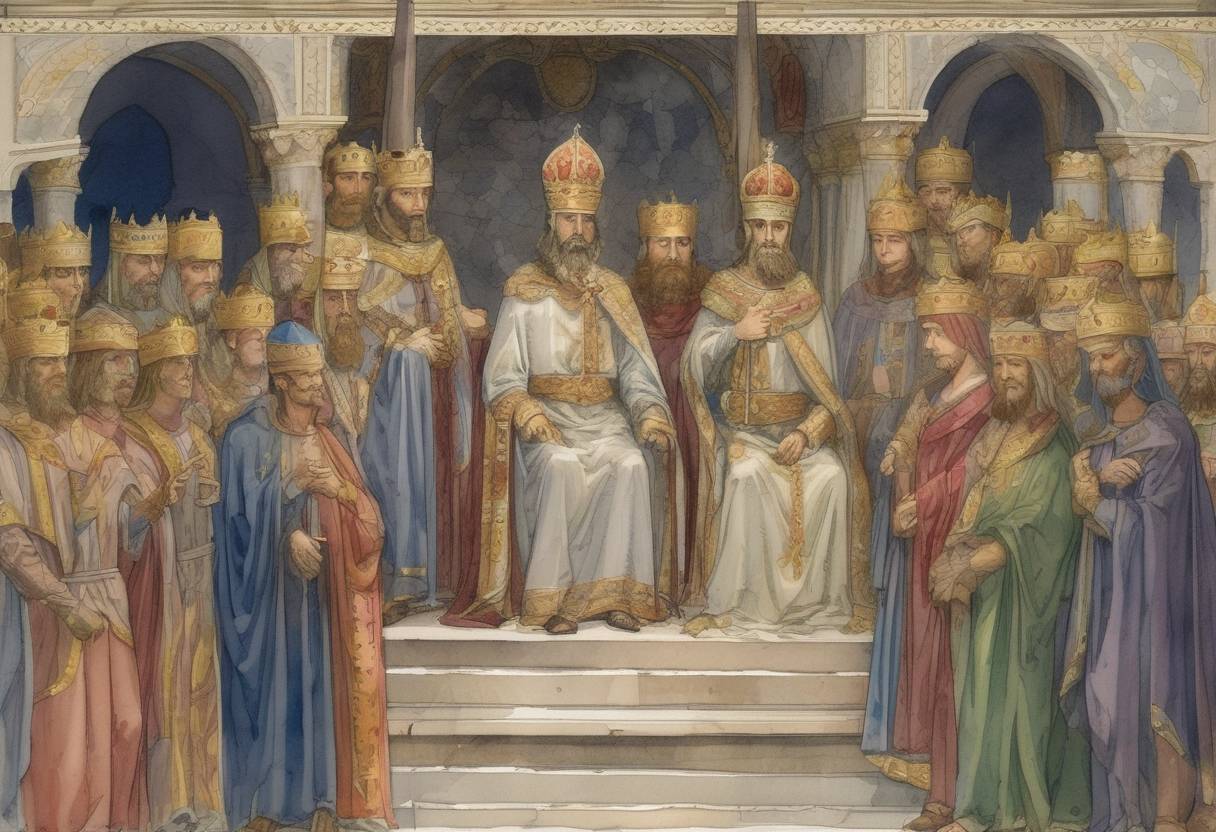
Restoration of Emperor Louis the Pious - March 1, 834
On March 1, 834, Emperor Louis the Pious was restored to power in the Carolingian Empire, marking a pivotal moment in the empire’s history. This event followed a period of intense familial conflict and political instability, as Louis faced opposition from his sons and other nobles.
Background
Louis the Pious, the son of Charlemagne, became the sole ruler of the Carolingian Empire in 814. His reign was initially characterized by efforts to maintain the unity of the empire and implement religious reforms. However, his decision to divide the empire among his sons—Lothair, Pepin, and Louis the German—led to internal strife.
The Division of the Empire
- Ordinatio Imperii (817): Louis attempted to secure the future of the empire by issuing this decree, which outlined the division of territories among his sons. Lothair was designated as co-emperor, while Pepin and Louis the German were given subordinate kingdoms.
- Birth of Charles the Bald (823): The birth of Louis’s fourth son, Charles, from his second marriage to Judith of Bavaria, complicated the succession plans. Louis’s attempts to provide Charles with a share of the empire fueled resentment among his older sons.
The Revolt and Deposition
- Rebellion (830): The tensions culminated in a rebellion led by Lothair, supported by Pepin and Louis the German. They captured Louis and forced him to abdicate in 833, a year often referred to as the “Field of Lies” due to the betrayal involved.
- Lothair’s Rule: Lothair assumed control, but his harsh treatment of his father and his inability to maintain support among the nobility weakened his position.
Restoration of Louis the Pious
- Support for Louis: Discontent with Lothair’s rule grew, and many nobles, along with Louis’s sons Pepin and Louis the German, shifted their allegiance back to their father.
- Restoration (March 1, 834): Louis was restored to power with the support of these nobles and his sons, marking a significant reversal of fortunes. His restoration was celebrated as a triumph of legitimacy and divine favor.
Aftermath and Significance
- Continued Instability: Although restored, Louis’s reign continued to be plagued by familial discord and political challenges. The divisions within the empire persisted, foreshadowing the eventual fragmentation after his death in 840.
- Legacy: The events surrounding Louis’s deposition and restoration highlighted the challenges of maintaining a unified empire and the complexities of succession in medieval Europe. They also underscored the fragile nature of imperial authority in the face of internal dissent.
Louis the Pious’s restoration was a testament to the shifting allegiances and power dynamics of the Carolingian Empire, setting the stage for the eventual Treaty of Verdun in 843, which formally divided the empire among his surviving sons.