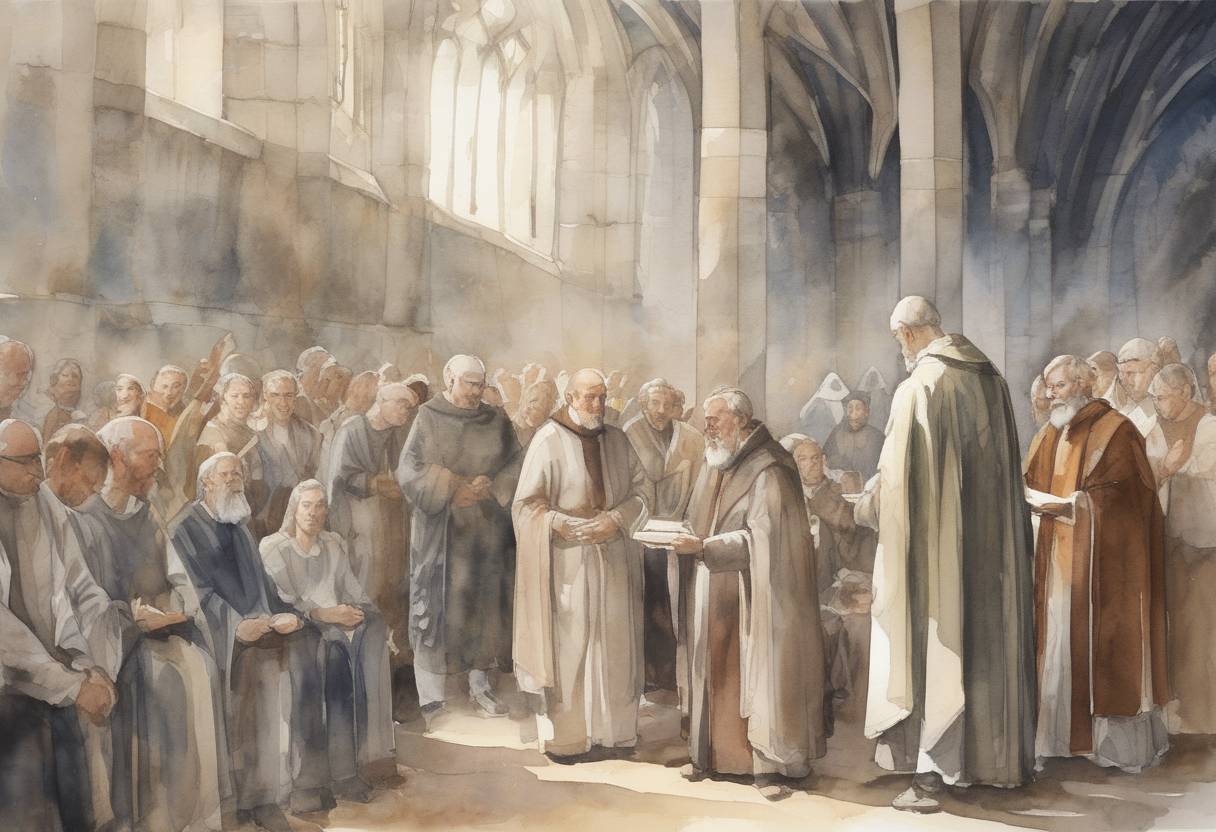
The Venerable Bede: His Life and Legacy
Death of Bede: May 25, 735
On May 25, 735, the Venerable Bede, an English monk and scholar, passed away at the monastery of St. Peter in Monkwearmouth-Jarrow, Northumbria. Bede is best known for his seminal work, Ecclesiastical History of the English People, which remains a crucial source for understanding early English history.
Early Life and Monastic Career
Bede was born around 672⁄673 in the Kingdom of Northumbria. At the age of seven, he was sent to the monastery of Monkwearmouth, where he was educated under the guidance of Abbot Benedict Biscop and later Abbot Ceolfrith. Bede spent his life in monastic devotion, dedicating himself to study, teaching, and writing.
Contributions to Scholarship
Bede’s scholarly work encompassed a wide range of subjects, including theology, history, chronology, and science. His most famous work, Ecclesiastical History of the English People, completed in 731, provides a comprehensive account of the Christianization of England and is considered a foundational text in the study of English history.
Key Aspects of Ecclesiastical History:
- Historical Narrative: Bede’s work chronicles the history of England from Julius Caesar’s invasion to his own time, focusing on the spread of Christianity.
- Sources and Methodology: Bede utilized a variety of sources, including oral traditions, earlier writings, and correspondence with contemporaries, demonstrating a rigorous approach to historical documentation.
- Cultural Impact: The work not only preserved the history of the English church but also influenced the development of a unified English identity.
Legacy and Canonization
Bede’s contributions to education and scholarship earned him the title “The Father of English History.” His works were widely read and respected throughout medieval Europe. In 1899, Bede was canonized as a saint by the Roman Catholic Church, and he is also recognized as a Doctor of the Church, a title given to saints who have made significant contributions to theology or doctrine.
Conclusion
The Venerable Bede’s death marked the end of a life devoted to the pursuit of knowledge and the dissemination of Christian teachings. His works continue to be studied for their historical value and their insight into early medieval England. Bede’s legacy endures as a testament to the intellectual and spiritual life of the early English church.