Dante Alighieri's Death on September 14, 1321
1321 · Ravenna, Italy
Dante Alighieri, the famous Italian poet, dies. Known especially for 'The Divine Comedy,' Dante's work is a cornerstone in the Italian language and world literature.
January 27, 1302
Dante Alighieri is exiled from Florence, Italy, due to his political affiliations and opposition to the Black Guelphs.
Florence, Italy | Florentine Government
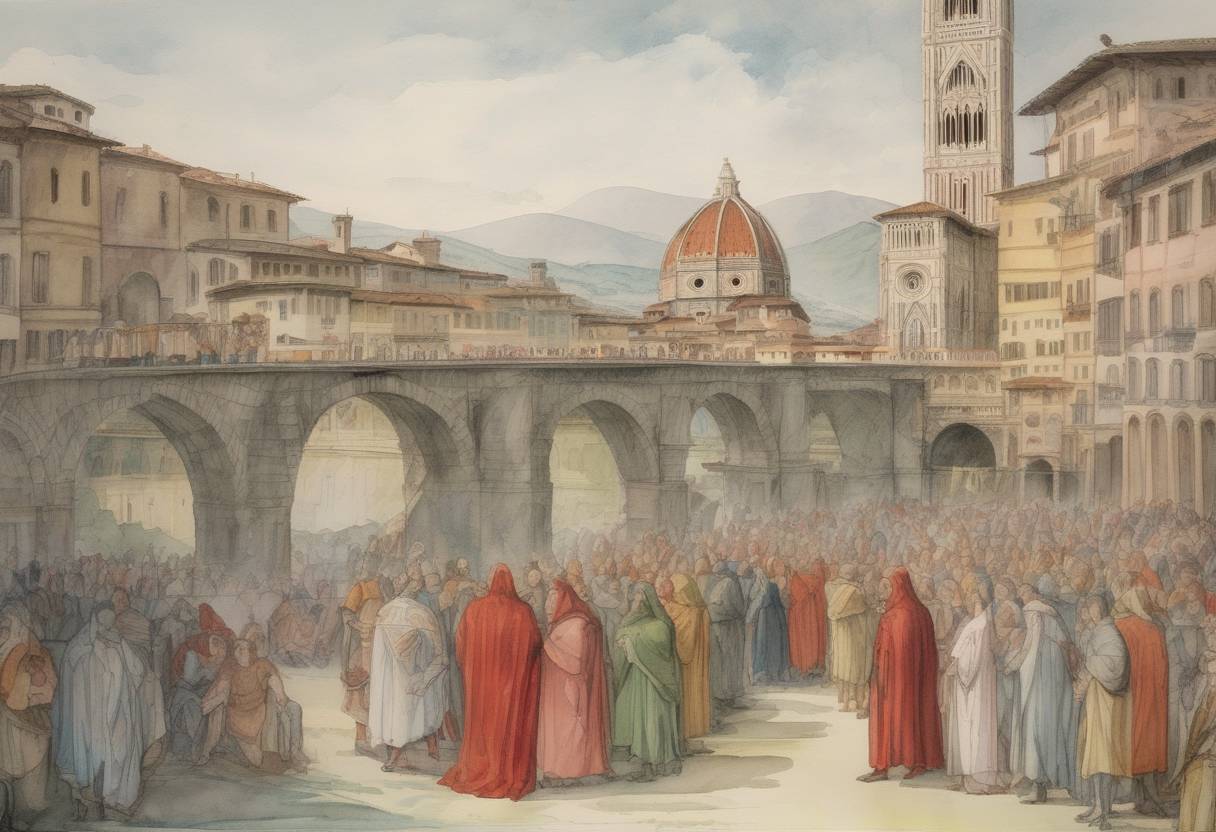
On January 27, 1302, Dante Alighieri, the renowned Italian poet best known for his epic work “The Divine Comedy,” was officially exiled from his hometown of Florence. This pivotal event in Dante’s life was deeply intertwined with the complex political landscape of Florence at the time, marked by intense factionalism and power struggles.
Florence in the late 13th and early 14th centuries was a city divided by political factions. The primary division was between the Guelphs, who supported the Papacy, and the Ghibellines, who were aligned with the Holy Roman Emperor. By the late 13th century, the Guelphs had gained dominance in Florence, but internal divisions soon emerged within their ranks.
The Guelphs split into two factions: the Black Guelphs and the White Guelphs. The Black Guelphs were staunch supporters of Papal authority, while the White Guelphs, with whom Dante was associated, sought greater independence from Papal influence and were more aligned with the interests of the Florentine merchant class.
Dante was actively involved in the political life of Florence. He served as a member of the city’s governing council, the Priori, in 1300. During his tenure, he was part of efforts to maintain peace between the factions, but tensions continued to escalate.
In 1301, Charles of Valois, a French prince, entered Florence with the backing of Pope Boniface VIII, ostensibly to restore order. However, his arrival led to the Black Guelphs seizing control of the city. In the aftermath, many White Guelphs, including Dante, were accused of corruption and financial improprieties.
On January 27, 1302, Dante was sentenced in absentia to exile for two years and fined. When he did not appear to answer the charges, the sentence was later extended to permanent exile, with the threat of execution should he return to Florence.
Dante spent the rest of his life in exile, living in various Italian cities such as Verona, Bologna, and Ravenna. This period of exile profoundly influenced his writing, providing the backdrop for “The Divine Comedy,” in which he explores themes of justice, morality, and redemption.
Dante’s exile is significant not only for its impact on his literary output but also for its reflection of the turbulent political climate of medieval Italy. His experiences underscore the interplay between politics and personal fate, a theme that resonates throughout his work.
Dante’s legacy endures, and his exile is often seen as a catalyst for his greatest achievements, illustrating how personal adversity can lead to profound artistic expression.
Source: en.wikipedia.org