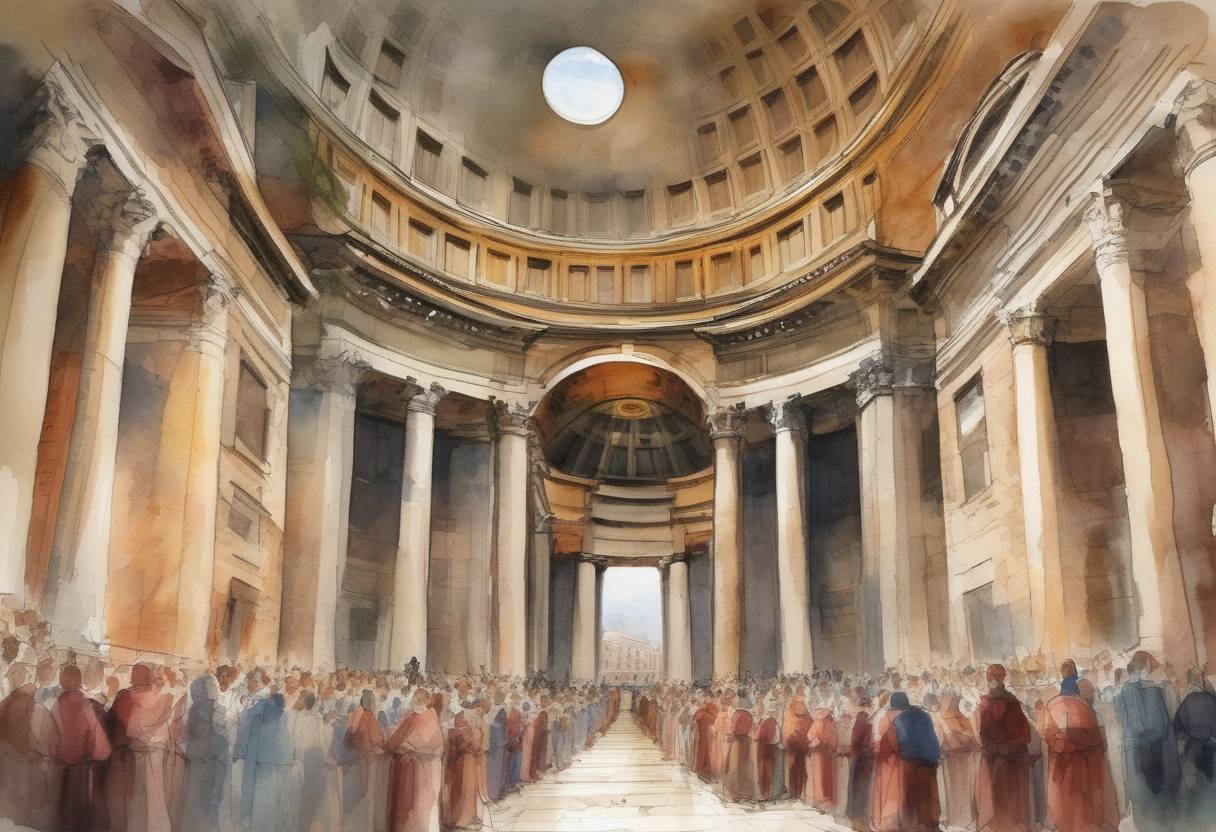
The Consecration of the Pantheon as a Christian Church
On May 13, 609, a significant event in the history of Christianity and the city of Rome took place: the consecration of the Pantheon as a Christian church by Pope Boniface IV. This event marked the first known instance of a pagan temple being transformed into a Christian place of worship, a symbolic gesture reflecting the broader transition from paganism to Christianity within the Roman Empire.
Historical Context
The Pantheon, originally constructed as a temple dedicated to all Roman gods, was completed by Emperor Hadrian around 126 AD. It is renowned for its architectural brilliance, particularly its massive dome and oculus, which remain engineering marvels to this day. By the early 7th century, the Roman Empire had undergone significant religious transformation, with Christianity becoming the dominant faith following Emperor Constantine’s Edict of Milan in 313 AD, which granted religious tolerance to Christians.
The Consecration
Pope Boniface IV, who served as pope from 608 to 615, played a pivotal role in the Christianization of Rome’s pagan heritage. On May 13, 609, he consecrated the Pantheon, dedicating it to the Virgin Mary and all Christian martyrs. This act was not only a religious transformation but also a political and cultural statement, symbolizing the church’s growing influence and its ability to repurpose Rome’s imperial past for Christian purposes.
Significance
The consecration of the Pantheon set a precedent for the conversion of pagan sites into Christian ones, a practice that would become common throughout Europe as Christianity spread. This transformation was emblematic of the church’s strategy to assimilate and recontextualize existing cultural and religious symbols within a Christian framework.
The Pantheon, now known as the Basilica of St. Mary and the Martyrs (Santa Maria ad Martyres), continues to serve as a church and remains one of Rome’s most iconic landmarks. Its conversion is a testament to the enduring legacy of early Christian efforts to integrate and preserve elements of the ancient world within the new religious order.
Aftermath and Legacy
The transformation of the Pantheon had lasting implications for the preservation of ancient architecture. By repurposing the building for Christian worship, the church ensured its survival through the centuries, protecting it from the neglect and destruction that befell many other ancient structures. Today, the Pantheon stands as a symbol of the continuity and adaptation of cultural heritage across different epochs.
In summary, the consecration of the Pantheon by Pope Boniface IV on May 13, 609, was a landmark event in the history of Christianity and Roman architecture, illustrating the dynamic interplay between religious transformation and cultural preservation.