August 7, 1714

The Treaty of Passarowitz was ratified, concluding the Austro-Turkish War (1716-1718) and the Venetian-Turkish War (1714-1718). This treaty resulted in the exchange of territories between the Holy Roman Empire, the Republic of Venice, and the Ottoman Empire.


Passarowitz (now Požarevac), Serbia | Holy Roman Empire, Ottoman Empire, Republic of Venice
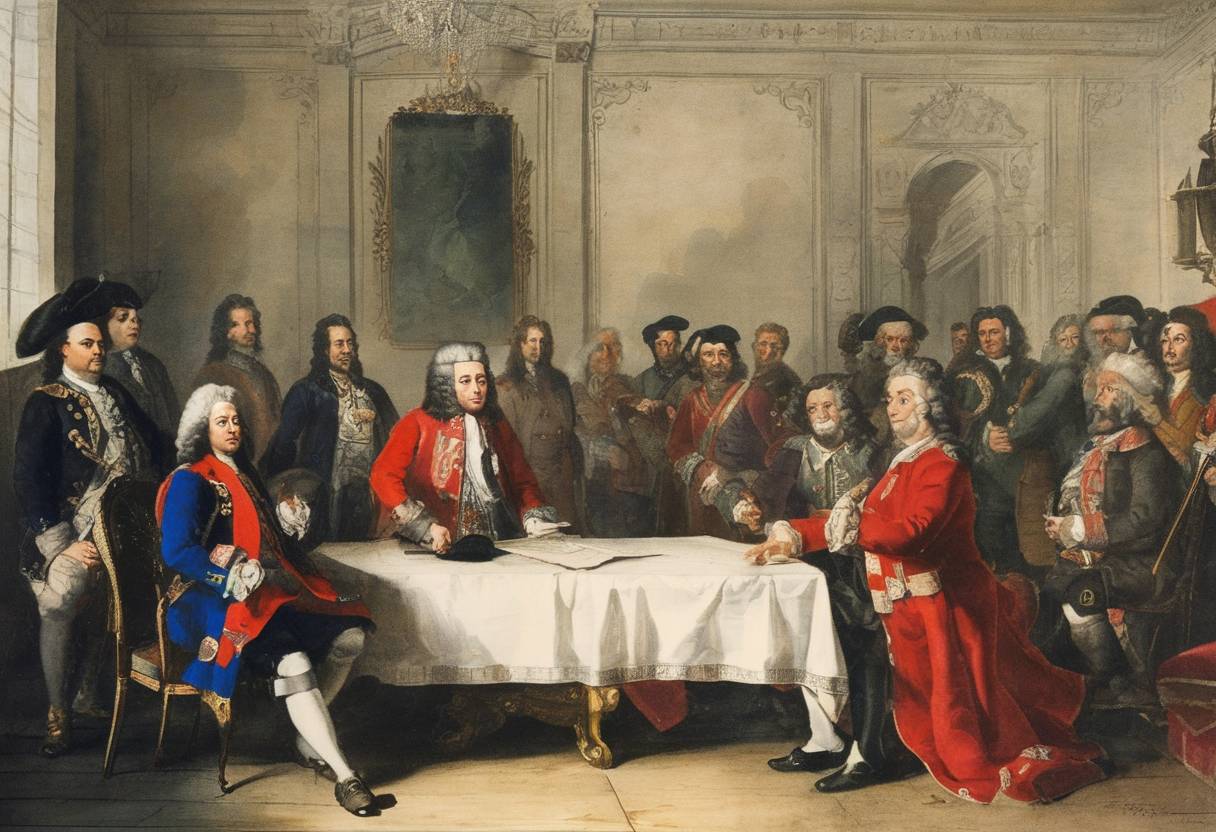
Watercolor painting based depiction of The Treaty of Passarowitz was ratified, concluding the Austro-Turkish War (1716-1718) and the Venetian-Turkish War (1714-1718). This treaty resulted in the exchange of territories between the Holy Roman Empire, the Republic of Venice, and the Ottoman Empire. (1714)

Treaty of Passarowitz and the Austro-Turkish War

The Treaty of Passarowitz was signed on July 21, 1718, officially concluding both the Austro-Turkish War (1716-1718) and the Venetian-Turkish War (1714-1718). It did not occur on August 7, 1714, though its implications had roots tracing back to conflicts and political movements before its signing.

Background

Leading up to the treaty, the Ottoman Empire had engaged in multiple conflicts in Europe, notably against the Habsburg Monarchy and the Republic of Venice. These conflicts were part of larger territorial disputes and power struggles emblematic of the early 18th century.

The Austro-Turkish War (1716-1718)

  • Initiation: Began due to tension in the Balkans, where the Ottoman Empire sought to regain territories lost in earlier wars against European forces.
  • Major Battles: The Battle of Petrovaradin (1716) and the Siege of Belgrade (1717) were significant Austrian victories that weakened Ottoman positions in the Balkans.

The Venetian-Turkish War (1714-1718)

  • Context: Stemming from the Ottoman’s efforts to reclaim southern territories from Venice.
  • Conflict Zones: Primarily centered around the Peloponnese and other Greek territories previously won by Venice at the end of the 17th century.

Terms of the Treaty of Passarowitz

The signing took place at Passarowitz (modern-day Požarevac, Serbia) with significant territorial and political shifts between the involved empires:

  • Austria: Gained territories in the Balkans including the Banat of Temeswar, parts of Serbia, and northern Bosnia. This gain cemented Austria’s influence in southeast Europe.
  • Venice: Was forced to return the Peloponnese to the Ottomans but maintained control over the Ionian Islands and some territories in Dalmatia.
  • Ottoman Empire: Managed to retain control over the Peloponnese and achieve peace, though it signified a continued loss of influence and territorial control in Europe.

Aftermath and Significance

  • Balance of Power: The treaty shifted the balance of power in the Balkans, strengthening Habsburg control and weakening Ottoman influence in the region.
  • Military and Economic Impact: Austria’s acquisitions contributed to its economic and military expansion in the 18th century.
  • Geopolitical Changes: Set the stage for future conflicts and treaties as European powers continued to vie for land and resources at the expense of the waning Ottoman Empire.

Overall, the Treaty of Passarowitz was a key moment in the transition of Ottoman-European relations, marking the gradual decline of Ottoman power and the rise of Austrian influence in Central and Southeastern Europe.